KingSpec VP101 2TB Review — Gen5 Speed With Cooling Included (2026)
Quick answer
The KingSpec VP101 2TB is the capacity to pick in this range: same 10,000 MB/s ratings as the 1 TB, doubled endurance, and a larger DRAM buffer, all with active cooling preinstalled.
Read: 10000 MB/s Write: 10000 MB/s Endurance: 1400 TBW Warranty: 3 years Interface: M.2 5.0 x 4
The KingSpec VP101 2TB is the larger of the range's two models, rated 10,000/10,000 MB/s on PCIe 5.0 with 1,400 TBW of endurance and the fan-cooled heatsink preinstalled.
Controller & Memory
The KingSpec VP101 2TB shares its platform with the 1 TB model that launched the range in August 2023: a Phison controller with an independent cache — identified as the first-generation Phison E26 in XDA's review of the smaller model — behind TLC NAND, running PCIe 5.0 x4 with NVMe 2.0. Ratings are identical across the range at 10,000 MB/s reads and writes, which means capacity buys endurance and cache rather than speed: the 2 TB model doubles the endurance rating to 1,400 TBW and carries a 2 GB DRAM buffer per retailer listings, against roughly 1 GB per terabyte across the line.
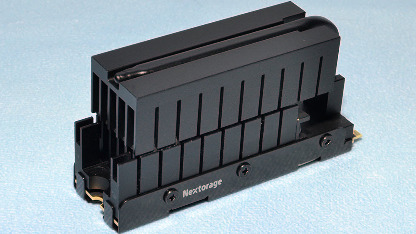
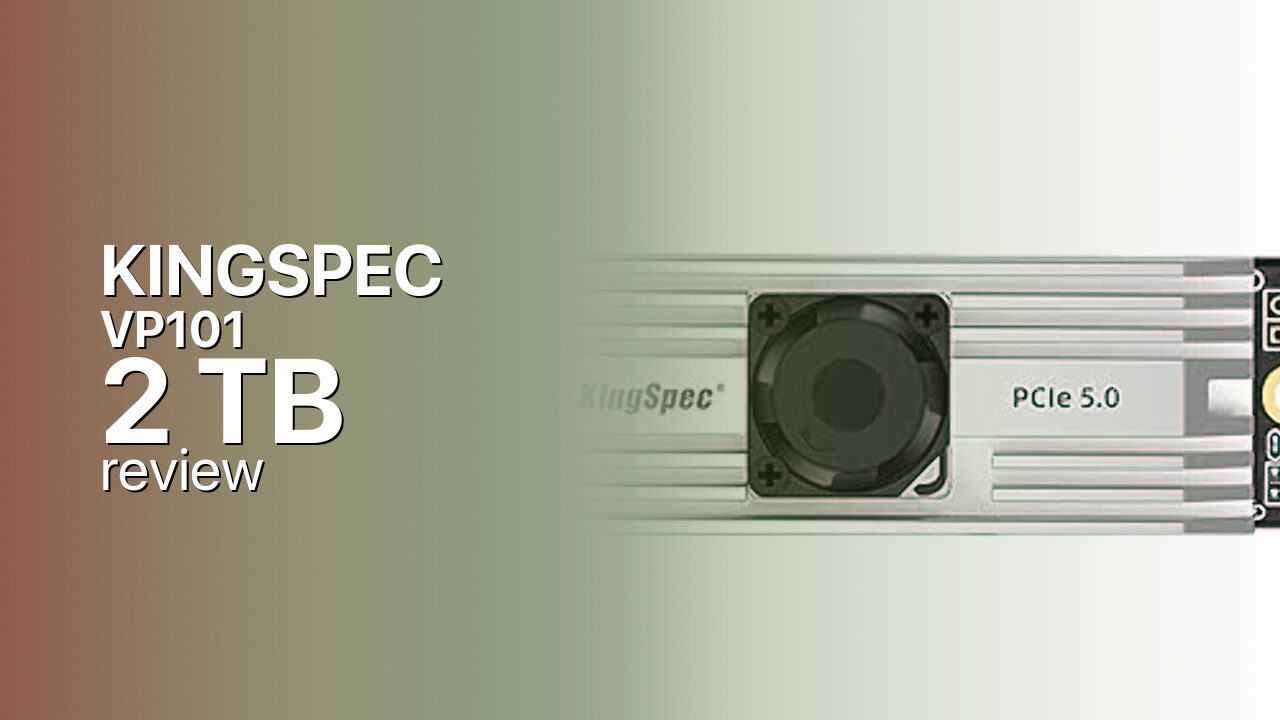
The defining physical feature is the same at both capacities. Every VP101 ships with an aluminum heatsink and built-in cooling fan preinstalled, standing 20.5 mm tall and drawing fan power through a 4-pin motherboard connector with BIOS-adjustable speed. It is a desktop drive through and through: no laptop slot closes over it, most motherboard shrouds will not fit either, and the PS5's 11.25 mm clearance rules it out of console upgrades entirely.
Who should pick the 2 TB over the 1 TB? Anyone building a Gen5 desktop around more than a boot drive — a modern game library alone runs several titles past 100 GB each. The competitive set is unchanged: the Crucial T700 and Corsair MP700 rate higher with five-year warranties and fuller documentation, while the VP101's counterweights are active cooling in the box and an endurance budget that most 2 TB drives at any tier never approach.
Storage Comparisons:
VP101 Performance & Benchmarks
KingSpec rates the VP101 2TB at the same 10,000 MB/s sequential read and write ceiling as the 1 TB model, with the official spec page quoting more realistic ranges of 9,500 to 10,000 MB/s read and 8,500 to 10,000 MB/s write. XDA's review of the 1 TB sibling measured 9,613/8,771 MB/s in CrystalDiskMark SEQ1M Q8T1 — within a few percent of spec — and IOMeter sustained-write runs settled near 1.8 to 2.0 GB/s once the drive was half full. The 2 TB model's doubled NAND and larger DRAM buffer give the controller more parallelism, which should hold steady-state writes slightly higher, though no independent 2 TB measurements have been published.
KINGSPEC VP101 2 TB vs M.2 5.0 x 4 peers
Switch between sequential throughput and random IOPS to see how this drive stacks up against other M.2 5.0 x 4 SSDs in our database. The highlighted bar is the drive on this page — click any other bar to open that drive.
- Kioxia Exceria Pro G2 2 TB: 14,900 MB/s read, 13,400 MB/s write
- Kioxia Exceria Pro G2 4 TB: 14,900 MB/s read, 13,700 MB/s write
- PNY XLR8 CS3250 1 TB: 14,900 MB/s read, 13,500 MB/s write
- PNY XLR8 CS3250 2 TB: 14,900 MB/s read, 14,000 MB/s write
- KINGSPEC VP101 2 TB (this drive): 10,000 MB/s read, 10,000 MB/s write
In practice the rated bandwidth shows up where big files live: multi-hundred-gigabyte game installs, video project archives, and DirectStorage-ready streaming workloads. Boot and level-load times will be indistinguishable from a fast PCIe 4.0 drive, because games rarely stress sequential peaks. The active cooler does its job quietly — KingSpec's own materials emphasize temperature control as the reason the fan exists, since first-generation Gen5 controllers run hot under sustained load. KingSpec publishes no IOPS rating for the range, so random-performance comparisons rest on the platform's E26-class pedigree rather than official figures.
KINGSPEC VP101 vs Competitors
See how the VP101 stacks up against other M.2 5.0 x 4 drives in our database:
Compare with rival drives:
Endurance, TBW & Warranty
The VP101 2TB carries a 1,400 TBW endurance rating under a 3-year warranty, whichever arrives first. That is double the 1 TB model's budget and comfortably above what most 2 TB drives of any generation offer, but the warranty term itself trails the five-year coverage that Crucial, Corsair, and other Gen5 rivals provide. The math on endurance is not close: at 40 GB of writes per day — heavy for a desktop — the budget runs past nine decades, so the three-year clock is the practical limit. The platform's fifth-generation LDPC error correction and its TRIM and S.M.A.R.T. support are standard for the class. Warranty claims go through KingSpec's own support channels, worth remembering with a brand whose documentation is thinner than its hardware deserves.
KINGSPEC VP101 2 TB Specifications
| Category | Value |
|---|---|
| Capacity [?] | 2 TB |
| Interface [?] | M.2 5.0 x 4 |
| Controller [?] | Phison E26 |
| Memory type [?] | 3D TLC |
| DRAM [?] | Yes |
| Read speed (MB/s) [?] | 10000 |
| Write speed (MB/s) [?] | 10000 |
| Read IOPS [?] | n/a |
| Write IOPS [?] | n/a |
| Endurance (TBW) [?] | 1400 |
| MTBF (million hours) [?] | n/a |
| Warranty (years) [?] | 3 |
Verdict: Is the VP101 Worth It in 2026?
The KingSpec VP101 2TB is the capacity to pick in this range: same 10,000 MB/s ratings as the 1 TB, doubled endurance, and a larger DRAM buffer, all with active cooling preinstalled. It suits a Gen5 desktop builder with a free fan header who values the cooler more than brand pedigree. Skip it if the 3-year warranty or the thin documentation matters — XDA's review of the smaller model concluded the platform performs but the brand asks for patience — and the Crucial T700 remains the established alternative with five-year coverage and faster rated speeds. We would sum it up as intriguing early-Gen5 hardware wrapped in generous cooling, held back by support terms rather than silicon.
+ Pros
- Rated up to 10,000 MB/s reads and writes
- 1,400 TBW endurance on the 2TB model
- 2 GB DRAM cache per retailer listings
- Fan-cooled heatsink preinstalled in the box
- XDA's 1TB review measured 9,613 MB/s reads
- PCIe 5.0 x4 with NVMe 2.0 compliance
- Cons
- 3-year warranty trails the 5-year Gen5 norm
- Cooler stands 20.5 mm tall; no PS5 or laptop fit
- Fan needs a free motherboard 4-pin header
- NAND vendor never disclosed
- Ratings identical to the 1 TB model's
Buy this or similar SSD Storage:



Video Review
Best SSDs for PC & Playstation 5