Kioxia BG4 128GB Review — Ultra-Compact OEM NVMe SSD (2026)
Quick answer
The Kioxia BG4 128GB is a competent OEM boot drive — its ultra-compact 2230 form factor fits where no other NVMe drive can, the 2,300 MB/s reads are respectable for PCIe 3.0, and the 3D TLC NAND offers better endurance than QLC alternatives.
Read: 2300 MB/s Write: 1800 MB/s Endurance: 120 TBW Warranty: 5 years Interface: M.2 3.0 x 4 2230 S3
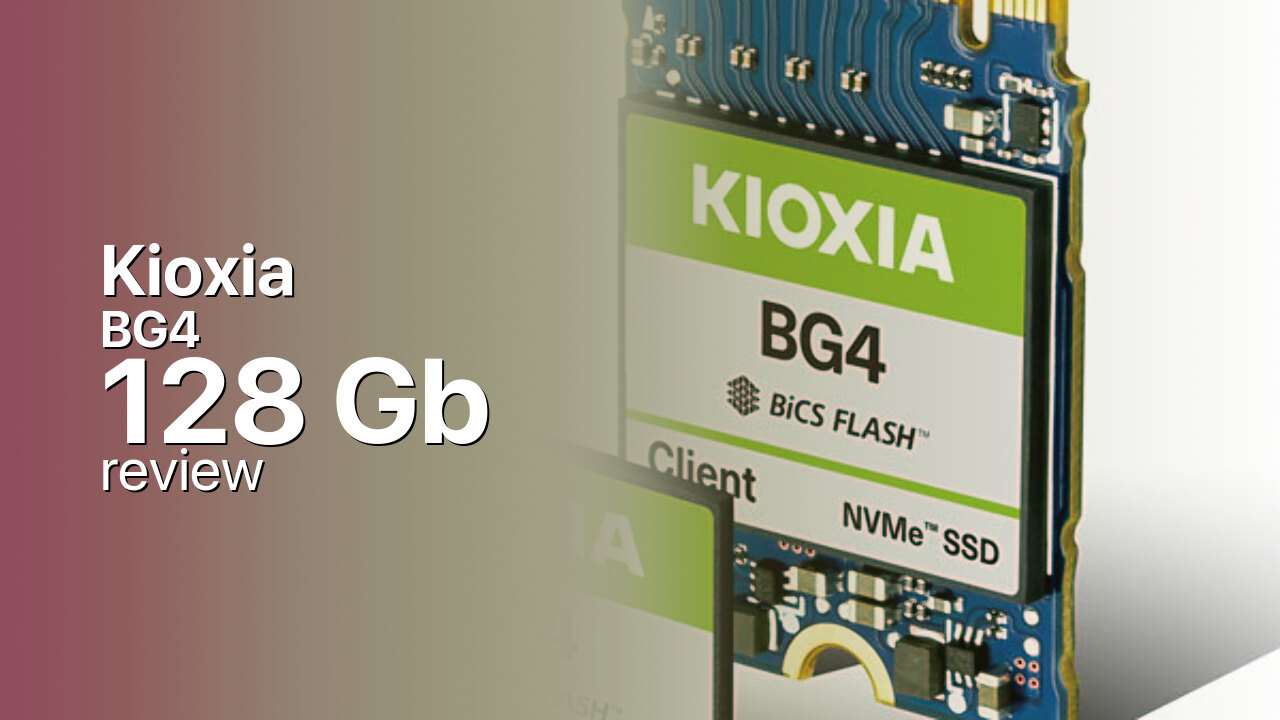
The Kioxia BG4 128GB is an ultra-compact OEM NVMe SSD built for thin laptops and ultrabooks — a single-chip M.2 2230 drive with 3D TLC NAND and HMB support that prioritizes efficiency over peak performance.
Controller & Memory
The BG4 is Kioxia's (formerly Toshiba Memory) entry-level client SSD, designed as an OEM-only drive for laptop manufacturers. It uses an M.2 2230 form factor — just 22mm wide and 30mm long — making it one of the smallest NVMe SSDs available. The entire drive is a single-chip design, with the controller and 3D TLC NAND flash packaged together, which saves space and power in the thermally constrained environments of thin laptops. This BG4 is the drive you'll find inside Microsoft Surface devices, Lenovo ThinkPad ultrabooks, and other compact systems where a standard 2280 M.2 drive won't fit.
The BG4 uses a DRAM-less architecture with HMB (host memory buffer), borrowing a small amount of system RAM to store the flash translation layer map instead of using dedicated on-drive DRAM. This keeps costs and power consumption down — important for battery-powered devices — but means sustained random I/O performance is lower than on DRAM-equipped drives. The in-house Kioxia controller is paired with Toshiba-branded 3D TLC NAND, which offers better endurance and performance than QLC alternatives commonly found in budget drives.
At 128 GB, this drive is a basic boot drive capacity. The 2,300 MB/s reads and 1,800 MB/s writes are respectable for a PCIe 3.0 x4 drive of this size — the compact form factor doesn't compromise sequential throughput. However, the 128 GB capacity limits the controller's ability to parallelize writes across multiple NAND dies, so write speeds are lower than on the 256 GB, 512 GB, and 1 TB variants. The BG4 competes with the WD SN520, Intel 660p, and Samsung PM991 in the OEM ultraboot segment.
The BG4 is not available for retail purchase through normal channels — it's sourced through OEM distributors or the secondary market. This means warranty support varies, and buyers should confirm their specific unit's warranty status before relying on it for critical use.
Storage Comparisons:
BG4 Performance & Benchmarks
The Kioxia BG4 128GB is rated at up to 2,300 MB/s sequential reads and 1,800 MB/s sequential writes over its PCIe 3.0 x4 NVMe interface. The read speed is solid for a PCIe 3.0 drive — about 58% of the interface's theoretical 4,000 MB/s ceiling. The write speed of 1,800 MB/s reflects the 128 GB capacity's limited NAND die count; larger BG4 variants reach higher write speeds because the controller can address more dies in parallel. The BG4 uses a DRAM-less design with HMB (host memory buffer), which means random 4K performance is modest — typically in the 30,000–50,000 IOPS range for reads and 20,000–40,000 IOPS for writes. This is adequate for boot drive duties — OS loading, application launches, and web browsing — but noticeably lower than DRAM-equipped NVMe drives that reach 200,000+ IOPS. The single-chip design is power-efficient, which matters most in the ultrabooks and tablets where this drive is typically found. Tom's Hardware's review of the BG4 praised its power efficiency and noted 'speedy application performance' despite the DRAM-less design. The sustained write performance was rated as 'decent' — the 3D TLC NAND maintains reasonable speeds after the SLC cache fills, unlike QLC drives that drop dramatically. For a 128 GB OEM boot drive, the BG4's performance is well-matched to its intended role in thin laptops and ultrabooks. It's not a gaming or content-creation drive, but for everyday computing in a compact system, it delivers responsive performance with minimal power draw.
Kioxia BG4 128 GB vs M.2 3.0 x 4 2230 S3 peers
Switch between sequential throughput and random IOPS to see how this drive stacks up against other M.2 3.0 x 4 2230 S3 SSDs in our database. The highlighted bar is the drive on this page — click any other bar to open that drive.
- Kioxia BG4 128 GB (this drive): 2,300 MB/s read, 1,800 MB/s write
- Kioxia BG4 256 GB: 2,300 MB/s read, 1,800 MB/s write
- Kioxia BG4 512 GB: 2,300 MB/s read, 1,800 MB/s write
- Kioxia BG4 1 TB: 2,300 MB/s read, 1,800 MB/s write
Endurance, TBW & Warranty
The Kioxia BG4 is an OEM-only drive, which means warranty terms depend on the original equipment manufacturer rather than Kioxia directly. The DB lists a 5-year warranty, which aligns with Kioxia's standard warranty for the BG4 series in OEM contracts. However, end-user warranty coverage varies — if you purchased a laptop with the BG4 pre-installed, your laptop manufacturer's warranty applies. If you sourced the drive separately from the secondary market, warranty coverage may be limited or nonexistent. Kioxia does not publish a TBW (terabytes written) endurance rating for the BG4 in its public documentation. For a 128 GB drive using 3D TLC NAND, endurance is likely in the 70–120 TBW range based on comparable OEM drives. At a typical 15–30 GB per day write workload in a laptop environment, the drive should last 6–22 years before reaching its estimated TBW limit. The 3D TLC NAND provides better endurance than QLC alternatives commonly found in OEM drives at this price point. An MTBF figure is not publicly published for the BG4. For buyers sourcing this drive through OEM channels or the secondary market, the lack of direct-to-consumer warranty support is a consideration — you're relying on the drive's inherent durability and the original system manufacturer's coverage rather than a standalone warranty.
Kioxia BG4 128 GB Specifications
| Category | Value |
|---|---|
| Capacity [?] | 128 GB |
| Interface [?] | M.2 3.0 x 4 2230 S3 |
| Controller [?] | Toshiba |
| Memory type [?] | Toshiba 3D TLC |
| DRAM [?] | HMB |
| Read speed (MB/s) [?] | 2300 |
| Write speed (MB/s) [?] | 1800 |
| Read IOPS [?] | 390000 |
| Write IOPS [?] | 200000 |
| Endurance (TBW) [?] | 120 |
| MTBF (million hours) [?] | 1.5 |
| Warranty (years) [?] | 5 |
Verdict: Is the BG4 Worth It in 2026?
The Kioxia BG4 128GB is a competent OEM boot drive — its ultra-compact 2230 form factor fits where no other NVMe drive can, the 2,300 MB/s reads are respectable for PCIe 3.0, and the 3D TLC NAND offers better endurance than QLC alternatives. But 128 GB is very limiting for modern use, the DRAM-less design caps random I/O performance, and the OEM-only nature means warranty support is inconsistent. If you're upgrading a laptop that uses the BG4, the 512 GB or 1 TB variants are significantly more practical. For DIY builders, retail drives like the WD Blue SN580 offer better performance, documented specs, and direct warranty support at similar prices.
+ Pros
- Ultra-compact M.2 2230 form factor
- 2,300 MB/s reads for PCIe 3.0
- 3D TLC NAND better than QLC alternatives
- Power-efficient single-chip design
- HMB support for DRAM-less efficiency
- Cons
- Only 128 GB capacity
- DRAM-less limits random I/O performance
- OEM-only — no direct retail warranty
- 128 GB variant has lowest write speeds
- Not available through normal retail channels
Buy this or similar SSD Storage:



Video Review
The TINY 1TB SSD