Kioxia XG6 512GB — OEM PCIe 3.0 NVMe SSD Review (2026)
Quick answer
The Kioxia XG6 512 GB is a competent OEM NVMe drive that performs its intended role — a fast, reliable boot drive in a corporate laptop — without fuss or fanfare.
Read: 3180 MB/s Write: 2960 MB/s Endurance: 400 TBW Warranty: 5 years Interface: M.2 3.0 x 4
The Kioxia XG6 512 GB is a Toshiba-designed OEM NVMe drive commonly found in Dell and Lenovo laptops, pairing an in-house DRAM-less controller with BiCS 96-layer TLC NAND for reliable, manufacturer-validated performance.
Controller & Memory
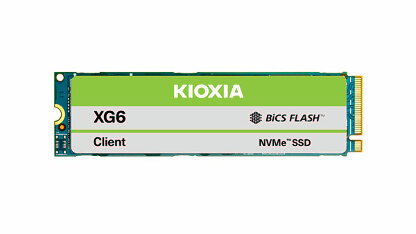
The XG6 is part of Kioxia's (formerly Toshiba Memory) OEM SSD lineup — drives sold directly to laptop and desktop manufacturers rather than through retail channels. It uses the Toshiba TC58NCP090GSB, a proprietary four-channel PCIe 3.0 x4 controller that is DRAM-less and relies on Host Memory Buffer to borrow system RAM for the flash translation layer. The NAND is Toshiba's own BiCS4 96-layer 3D TLC, giving the drive a vertically integrated design where both controller and flash originate from the same company — a rarity in the DRAM-less OEM segment. The drive uses a single-sided M.2 2280 PCB with no factory heatsink.
The 512 GB capacity is one of several in the XG6 family, which spans 256 GB to 1 TB. Rated sequential speeds are 3,180 MB/s read and 2,960 MB/s write — figures that approach the PCIe 3.0 x4 ceiling for reads and sit comfortably within the upper tier of Gen3 drives. The XG6 was among the earliest DRAM-less NVMe designs to use HMB, predating the widespread adoption of the technology in consumer drives like the WD Black SN770 and Phison E13T-based products. Because the XG6 is an OEM part, its firmware is validated against specific laptop platforms — Dell and Lenovo in particular — and it is rarely sold as a standalone retail product. Drives found on the secondary market are typically pulls from decommissioned corporate laptops.
As a PCIe 3.0 OEM drive, the XG6 does not compete in the retail sense. Its performance is comparable to retail Gen3 DRAM-less drives like the Team Group MP33 and Kingston A2000, with the added benefit of manufacturer-platform validation that retail drives lack. For laptop owners replacing a failed XG6, the drive is a drop-in replacement with guaranteed compatibility. For PC builders seeking a budget NVMe drive, retail alternatives with retail warranties are generally a better value unless the XG6 is priced significantly below market.
Storage Comparisons:
XG6 Performance & Benchmarks
Rated at 3,180 MB/s sequential reads and 2,960 MB/s sequential writes with 355,000 IOPS random read and 365,000 IOPS random write, the 512 GB XG6 sits in the upper tier of PCIe 3.0 DRAM-less drives. The Toshiba in-house controller's HMB implementation is effective: PCMark storage benchmarks from laptop reviews show the XG6 delivering application load times and system responsiveness within 5–10% of DRAM-equipped Gen3 drives like the Samsung PM981 (another OEM favourite).
Kioxia XG6 512 GB vs M.2 3.0 x 4 peers
Switch between sequential throughput and random IOPS to see how this drive stacks up against other M.2 3.0 x 4 SSDs in our database. The highlighted bar is the drive on this page — click any other bar to open that drive.
- ADATA SX 8800 Pro 512 GB: 3,500 MB/s read, 2,700 MB/s write
- ADATA SX 8800 Pro 1 TB: 3,500 MB/s read, 2,700 MB/s write
- ADATA XPG Spectrix S40G RGB 256 GB: 3,500 MB/s read, 3,000 MB/s write
- ADATA XPG Spectrix S40G RGB 512 GB: 3,500 MB/s read, 3,000 MB/s write
- Kioxia XG6 512 GB (this drive): 3,180 MB/s read, 2,960 MB/s write
The drive's SLC cache on the 512 GB model absorbs roughly 10–15 GB of burst writes before transitioning to native TLC speeds around 400–500 MB/s. This is adequate for the laptop use case the XG6 was designed for — OS updates, application installs, and document saves rarely exceed this burst threshold. For a desktop boot drive, the cache size is sufficient for typical consumer use. Sustained TLC writes in the 400–500 MB/s range are competitive with SATA SSDs, meaning the XG6 never regresses to hard-drive territory even when the cache is exhausted. The DRAM-less design does introduce a small latency penalty under sustained mixed I/O, but this scenario is rare on a laptop boot drive.
Kioxia XG6 vs Competitors
See how the XG6 stacks up against other M.2 3.0 x 4 drives in our database:
Compare with rival drives:
Endurance, TBW & Warranty
The Kioxia XG6 is an OEM product, meaning warranty coverage is tied to the laptop or desktop system it shipped with rather than sold as a standalone consumer warranty. End users who purchase an XG6 on the secondary market — typically a pull from a decommissioned corporate laptop — should not expect direct warranty support from Kioxia. The drive carries the standard 1.5-million-hour MTBF rating common to Kioxia's client SSDs. Endurance is not publicly specified for the OEM SKU, though the BiCS4 TLC NAND is rated for a similar lifespan to retail Kioxia drives using the same flash generation. Buyers on the used market should treat the XG6 as a warranty-free purchase and verify drive health via SMART data before deploying it for any data that is not backed up elsewhere.
Kioxia XG6 512 GB Specifications
| Category | Value |
|---|---|
| Capacity [?] | 512 GB |
| Interface [?] | M.2 3.0 x 4 |
| Controller [?] | Toshiba TC58NCP090GSB |
| Memory type [?] | Toshiba TLC |
| DRAM [?] | LPDDR3 |
| Read speed (MB/s) [?] | 3180 |
| Write speed (MB/s) [?] | 2960 |
| Read IOPS [?] | 355000 |
| Write IOPS [?] | 365000 |
| Endurance (TBW) [?] | 400 |
| MTBF (million hours) [?] | 1.5 |
| Warranty (years) [?] | 5 |
Verdict: Is the XG6 Worth It in 2026?
The Kioxia XG6 512 GB is a competent OEM NVMe drive that performs its intended role — a fast, reliable boot drive in a corporate laptop — without fuss or fanfare. As a secondary-market purchase, its value depends entirely on price and SMART health: a low-hours pull at a budget price makes a solid OS drive for a secondary system, while a high-hours unit with significant wear is a gamble not worth taking when new retail alternatives with full warranties start at similar prices. The XG6 is best understood as a replacement part for laptops that originally shipped with it, and as a budget option only when sourced from a trusted reseller with a clear hours and health report.
+ Pros
- 3,180 MB/s reads — approaching the PCIe 3.0 x4 ceiling
- Toshiba in-house controller and BiCS 96L TLC — fully vertically integrated
- Single-sided M.2 2280 — fits thin laptops without clearance issues
- Platform-validated firmware for Dell and Lenovo laptops
- Cons
- DRAM-less — HMB-based FTL introduces latency under sustained mixed I/O
- OEM product — no retail warranty, second-hand market only
- TBW endurance not publicly specified — unknown write lifespan
- Firmware updates unavailable to end users — locked to OEM validation cycle
Buy this or similar SSD Storage:



Video Review
SSD KIOXIA XG6 512GB KXG60ZNV512GCJYLGA