Lexar Play 2280 SE 4TB: A Budget PS5 and PC Storage Pick (2026)
Quick answer
The Lexar Play 2280 SE 4TB makes sense for PS5 owners and PC users who want a large, officially PS5-tested capacity upgrade at a budget price and don't need class-leading sustained write performance.
Read: 7000 MB/s Write: 6000 MB/s Endurance: 3200 TBW Warranty: 5 years Interface: M.2 4.0 x 4
The Lexar Play 2280 SE 4TB is a DRAM-less, QLC-based PCIe 4.0 NVMe drive built as a large-capacity budget option, officially tested and approved for the PS5.
Controller & Memory
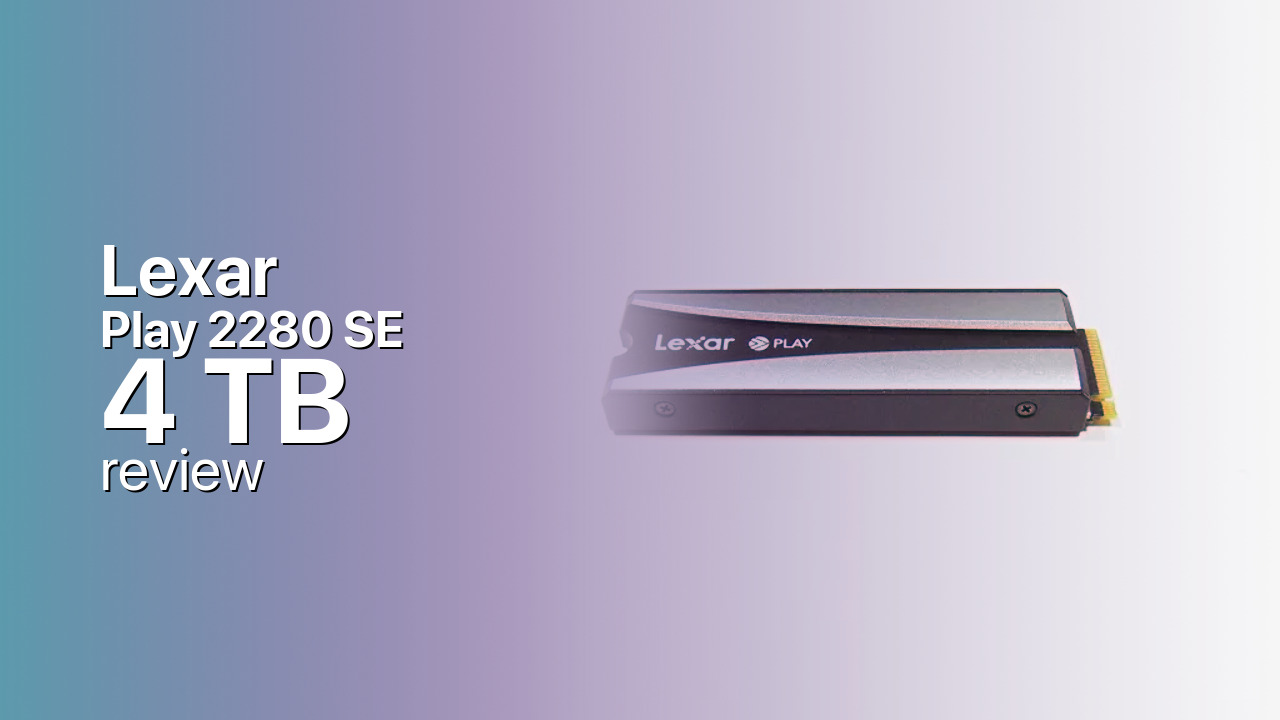
Inside the Lexar Play 2280 SE 4TB is an InnoGrit IG5236 controller paired with Intel 144-layer QLC NAND sold under Lexar's Longsys branding, and no dedicated DRAM chip; the drive relies on Host Memory Buffer (HMB) technology on PC to keep its mapping tables fast. It runs over a PCIe 4.0 x4 link using the NVMe 1.4 protocol, ships in the M.2 2280 form factor with an integrated heatsink, and is only sold in this single 4 TB capacity.
The Play 2280 SE is the budget sibling of Lexar's original Play 2280, which uses a different Maxio controller and genuine TLC NAND rather than QLC; the SE trades some of that consistency for a lower price at the same 7,000 MB/s read and 6,000 MB/s write ratings. Notably, the PS5 console does not support HMB, so when installed in a PS5 the drive runs off its onboard secondary cache instead of borrowing system memory, yet Lexar still lists it as tested and approved for PS5 use.
The integrated heatsink makes the Play 2280 SE 4TB a straightforward PS5 or desktop install without sourcing a separate cooler. Lexar's own NM790 and NQ790 lines are in-house alternatives at other capacities; outside the family, the Samsung 990 EVO Plus and WD Black SN770 compete in a similar budget-to-midrange PCIe 4.0 tier at 4 TB.
Storage Comparisons:
Play 2280 SE Performance & Benchmarks
The Lexar Play 2280 SE 4TB is rated for up to 7,000 MB/s sequential reads and 6,000 MB/s sequential writes, with the InnoGrit IG5236 controller capable of roughly 700,000 IOPS, though Lexar does not publish an official random-IOPS figure. Independent testing has recorded speeds meeting or slightly exceeding those rated numbers in short bursts. On a PS5 specifically, real-world throughput is capped around 6,300 MB/s by the console's own storage subsystem, still well above Sony's minimum requirement.
Lexar Play 2280 SE 4 TB vs M.2 4.0 x 4 peers
Switch between sequential throughput and random IOPS to see how this drive stacks up against other M.2 4.0 x 4 SSDs in our database. The highlighted bar is the drive on this page — click any other bar to open that drive.
- Patriot Viper PV593 1 TB: 14,500 MB/s read, 14,000 MB/s write
- Patriot Viper PV593 2 TB: 14,500 MB/s read, 14,000 MB/s write
- Patriot Viper PV593 4 TB: 14,500 MB/s read, 14,000 MB/s write
- Patriot Viper PV573 2 TB: 14,000 MB/s read, 12,000 MB/s write
- Lexar Play 2280 SE 4 TB (this drive): 7,000 MB/s read, 6,000 MB/s write
As a QLC, DRAM-less drive, the Play 2280 SE leans on its onboard SLC-style cache to sustain peak write speed; once a transfer exceeds that cache on a large continuous write, throughput drops toward the QLC NAND's slower native write speed. Independent testing found the drop-off during a sustained 950 GB write settled into roughly the 300-500 MB/s range, a real but not severe fall-off for a QLC drive of this size. For typical use, gaming, general file work, moderate content work, this rarely matters; it becomes relevant mainly for buyers routinely copying hundreds of gigabytes in one sitting.
Lexar Play 2280 SE vs Competitors
See how the Play 2280 SE stacks up against other M.2 4.0 x 4 drives in our database:
Compare with rival drives:
Endurance, TBW & Warranty
Lexar rates the Play 2280 SE 4TB at 3,200 TBW and backs it with a 5-year limited warranty, generous figures for a budget QLC drive at this capacity. At a realistic 20-30 GB per day write workload, 3,200 TBW works out to several centuries before the drive reaches its rated endurance limit, far beyond both the warranty period and the practical lifespan of the rest of the system around it. Lexar also lists a 2,000,000-hour MTBF figure, though that's a population-level statistical average across many drives rather than a promise about any single unit's lifespan. Warranty service runs through Lexar's regional RMA process, so keep your purchase receipt on hand.
Lexar Play 2280 SE 4 TB Specifications
| Category | Value |
|---|---|
| Capacity [?] | 4 TB |
| Interface [?] | M.2 4.0 x 4 |
| Controller [?] | InnoGrit IG5236CAA 8 Channel |
| Memory type [?] | Intel 144L QLC |
| DRAM [?] | No |
| Read speed (MB/s) [?] | 7000 |
| Write speed (MB/s) [?] | 6000 |
| Read IOPS [?] | 700000 |
| Write IOPS [?] | 600000 |
| Endurance (TBW) [?] | 3200 |
| MTBF (million hours) [?] | 2000000 |
| Warranty (years) [?] | 5 |
Verdict: Is the Play 2280 SE Worth It in 2026?
The Lexar Play 2280 SE 4TB makes sense for PS5 owners and PC users who want a large, officially PS5-tested capacity upgrade at a budget price and don't need class-leading sustained write performance. Buyers doing heavy sustained workloads, like professional video editing or server-style continuous writes, should look at a DRAM-equipped TLC drive instead, since the DRAM-less QLC design here trades some consistency for cost. If sustained write speed matters more than price, the WD Black SN770 is worth comparing at a similar capacity. Overall, this is a capable secondary or games drive with strong endurance and warranty coverage, best treated as extra storage rather than a primary system drive.
+ Pros
- 3,200 TBW endurance, generous for a budget QLC drive
- 5-year manufacturer warranty
- Officially tested and approved for the PS5
- Integrated heatsink included
- 7,000 MB/s reads on PCIe 4.0
- Cons
- QLC NAND, weaker sustained writes than TLC rivals
- No DRAM cache, relies on HMB on PC only
- Only sold in this single 4TB capacity
- PS5 can't use HMB, runs off secondary cache only
Buy this or similar SSD Storage:
Video Review
Massive SSD benchmarked! Lexar PLAY 2280 4TB Review