Micron 2500 512GB Review — an OEM QLC Drive in the Wild (2026)
Quick answer
Buy the Micron 2500 512GB when the price is low and the job is secondary: a cheap bulk drive for a desktop, a like-for-like replacement in a laptop, or the rare 2230-form-factor upgrade for a Surface-class machine, where its 6,600 MB/s reads and AES-256 encryption outclass anything of that age and size.
Read: 6600 MB/s Write: 3650 MB/s Endurance: 200 TBW Warranty: 5 years Interface: M.2 4.0 x 4
The Micron 2500 512GB is an OEM QLC drive with 6,600 MB/s reads and AES-256 encryption — a laptop pull-out that happens to be a capable budget secondary SSD.
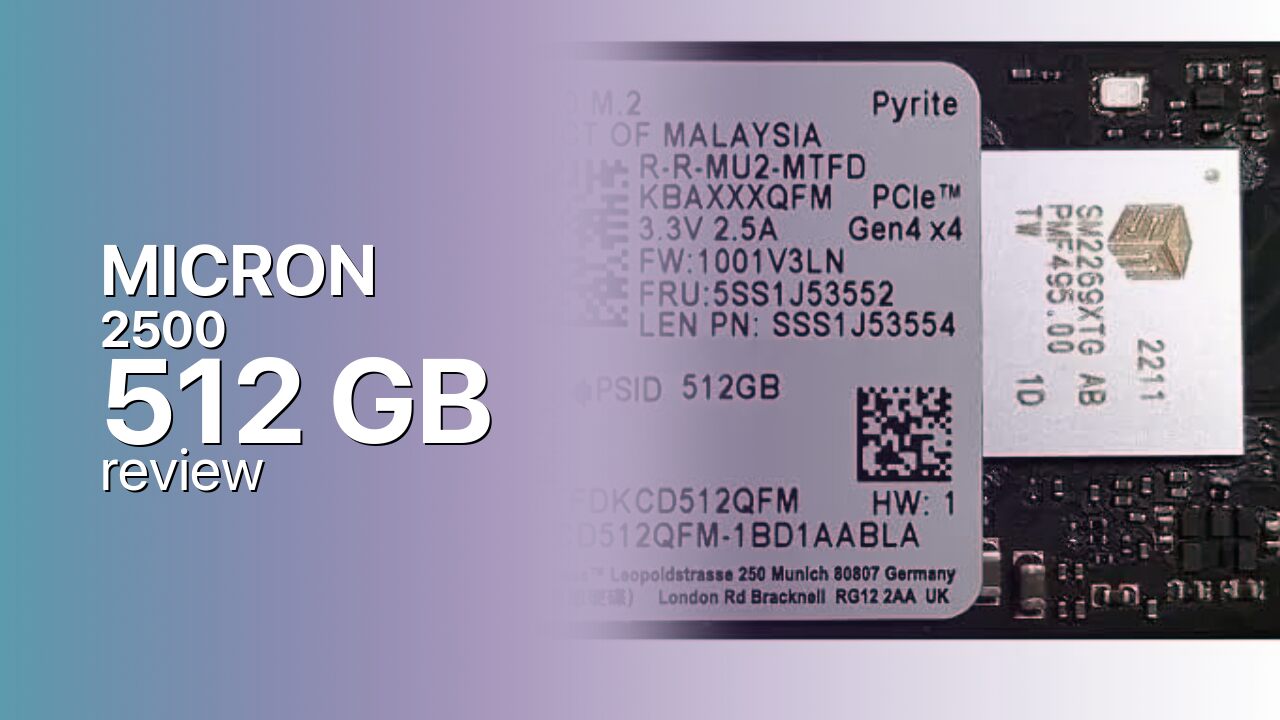
Controller & Memory
The Micron 2500 512GB is Micron's entry into OEM client storage, and it arrived with a claim to fame: it was the first client SSD built on 200-plus-layer QLC NAND, specifically Micron's own 232-layer die. Everything else follows the cost-optimized playbook — a DRAM-less in-house Micron controller using Host Memory Buffer, a pseudo-SLC cache for burst writes, and AES-256 hardware encryption on board. The drive ships to PC makers in multiple M.2 lengths, with 2230 and 2280 versions both spotted at retail through upgrade kits and pulls, which matters for owners of thin laptops and Surface-class machines where the short form factor is the only one that fits.
Within the 2500 line, the 512 GB model is the entry point, and its numbers show it: 6,600 MB/s reads and 3,650 MB/s writes against the 7,100/6,000 MB/s of the larger 1 TB and 2 TB versions, plus 200 TBW of endurance — modest even before remembering this is QLC. The TLC-based Micron 2550 sits above it in the family tree, and on the retail side the same company's Crucial brand sells the QLC-based P3 as the spiritual equivalent for ordinary buyers.
Who ends up with one? Mostly laptop owners replacing a failed OEM stick, Surface-class upgraders needing the 2230 length, and bargain hunters who find pulls cheap enough to forgive the QLC trade-offs. Against the Crucial P3 and other QLC budget drives it is a credible peer; against TLC budget drives like the WD Blue SN580 it trades endurance and sustained writes for a lower price. As a primary drive for a demanding user, or as a PS5 upgrade, it is the wrong tool.
Storage Comparisons:
2500 Performance & Benchmarks
The 512 GB Micron 2500 is rated at 6,600 MB/s sequential reads, 3,650 MB/s writes, and 530K/860K random read/write IOPS — manufacturer figures from the product brief, and unusually strong reads for a QLC entry drive. Micron's marketing leans on system-level benchmarks, claiming up to 46 percent faster access times and 45 percent better PCMark 10 scores than competitor drives; treat those as vendor claims, but the direction is right, because burst-heavy everyday computing is exactly what the pseudo-SLC cache accelerates.
MICRON 2500 512 GB vs M.2 4.0 x 4 peers
Switch between sequential throughput and random IOPS to see how this drive stacks up against other M.2 4.0 x 4 SSDs in our database. The highlighted bar is the drive on this page — click any other bar to open that drive.
- Patriot Viper PV593 1 TB: 14,500 MB/s read, 14,000 MB/s write
- Patriot Viper PV593 2 TB: 14,500 MB/s read, 14,000 MB/s write
- Patriot Viper PV593 4 TB: 14,500 MB/s read, 14,000 MB/s write
- Patriot Viper PV573 2 TB: 14,000 MB/s read, 12,000 MB/s write
- MICRON 2500 512 GB (this drive): 6,600 MB/s read, 3,650 MB/s write
The QLC nature shows in sustained work. Writes run at rated speed only while the pSLC cache is fresh; once it fills, throughput drops to native QLC rates, which are far below the burst figure, and recovery while the cache folds back is leisurely. Random write strength — that 860K IOPS rating — is genuinely good for this class and helps desktop responsiveness feel snappy. HMB handles the mapping tables without DRAM. In practice: excellent for boot drives, office work, and library storage; the wrong choice for constant large writes, where a TLC drive such as the Micron 2550 or WD Blue SN580 holds its pace.
MICRON 2500 vs Competitors
See how the 2500 stacks up against other M.2 4.0 x 4 drives in our database:
Compare with rival drives:
Endurance, TBW & Warranty
Micron rates the 2500 512GB at 200 TBW, a deliberately modest figure that reflects QLC economics at the smallest capacity. At a light 20 GB of writes per day it still works out to more than 27 years, so ordinary laptop duty will never approach it — but heavy users should multiply their habits against that ceiling before choosing QLC. The rated MTTF is 2 million device hours, per Micron's technical product specification. Warranty is the OEM wrinkle: Micron's standard client terms run 5 years limited, but as an OEM part number the practical coverage usually flows through the laptop or system maker's warranty instead, and some channel listings cite shorter terms — check whose warranty actually applies to your purchase.
MICRON 2500 512 GB Specifications
| Category | Value |
|---|---|
| Capacity [?] | 512 GB |
| Interface [?] | M.2 4.0 x 4 |
| Controller [?] | Micron |
| Memory type [?] | Micron 232-L QLC |
| DRAM [?] | No |
| Read speed (MB/s) [?] | 6600 |
| Write speed (MB/s) [?] | 3650 |
| Read IOPS [?] | 530000 |
| Write IOPS [?] | 860000 |
| Endurance (TBW) [?] | 200 |
| MTBF (million hours) [?] | 2000000 |
| Warranty (years) [?] | 5 |
Verdict: Is the 2500 Worth It in 2026?
Buy the Micron 2500 512GB when the price is low and the job is secondary: a cheap bulk drive for a desktop, a like-for-like replacement in a laptop, or the rare 2230-form-factor upgrade for a Surface-class machine, where its 6,600 MB/s reads and AES-256 encryption outclass anything of that age and size. Skip it as a primary drive for a power user — 200 TBW of QLC endurance and 3,650 MB/s post-cache writes are real limits — and skip it entirely for a PS5. The Crucial P3 offers the same QLC character with retail packaging, the TLC-based Micron 2550 costs more per gigabyte and lasts longer, and the WD Blue SN580 remains the safer budget TLC bet. As OEM pulls go, though, this is one of the good ones.
+ Pros
- 6,600 MB/s sequential reads
- First client SSD with 232-layer QLC NAND
- AES-256 hardware encryption
- Compact M.2 2230 option for thin laptops
- Rated up to 860K random-write IOPS
- Cons
- QLC endurance: just 200 TBW at 512 GB
- Writes cap out at 3,650 MB/s
- OEM part — warranty support is indirect
- Sustained writes slow once the pSLC cache fills
Buy this or similar SSD Storage:
Video Review
SSD vs NVMe: What’s The Difference??