MSI M580 4 TB: Max Capacity, Flagship Speed, Bundled Cooler (2026)
Quick answer
The MSI M580 4 TB is the drive to buy if you want the maximum capacity of MSI's Gen5 lineup without giving up flagship speed.
Read: 14600 MB/s Write: 12700 MB/s Endurance: 3000 TBW Warranty: 5 years Interface: M.2 5.0
The MSI M580 4 TB is the largest capacity of MSI's Spatium M580 FROZR PCIe 5.0 line, holding the family's peak 14,600 MB/s reads alongside a 3,000 TBW endurance rating.
Controller & Memory
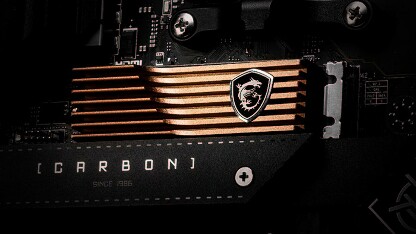
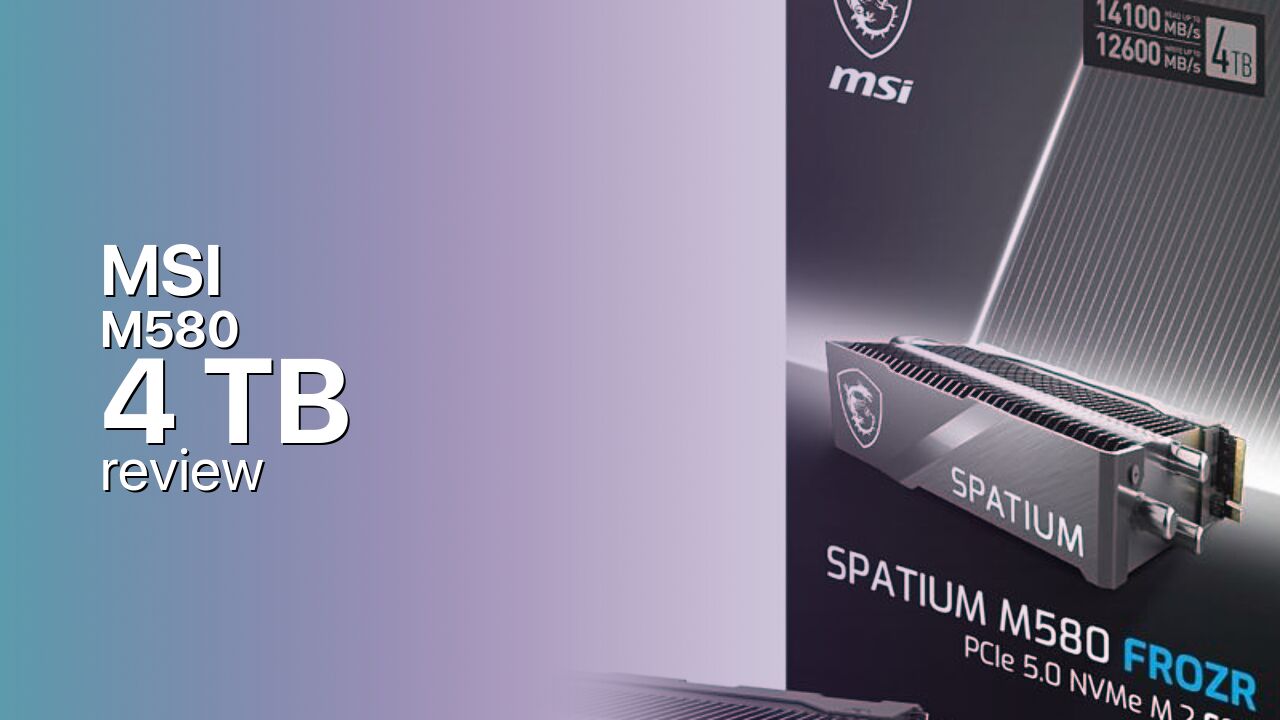
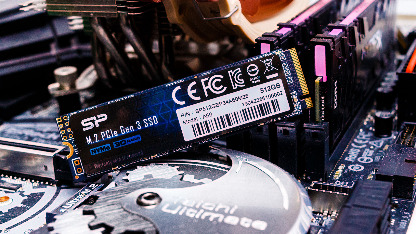
The MSI M580 4 TB is the largest capacity of MSI's Spatium M580 FROZR, a PCIe 5.0 NVMe drive sold in 1 TB, 2 TB and 4 TB sizes, and like every M580 it ships with MSI's FROZR cooler pre-installed in the box. That cooler is a passive tower heatsink built around three CORE heatpipes and a stack of aluminum fins, with no fan, which makes the M580 FROZR unusual among Gen5 drives that normally leave M.2 cooling to the buyer. The cooler exists because the hardware runs hot: the Phison E26 controller and Micron NAND platform can draw more than 11 watts under load, so MSI solves the thermal problem at the factory rather than expecting the user to.
Under the metal is an M.2 2280 drive built on the Phison PS5026-E26 controller, Micron 232-layer 3D TLC NAND and an LPDDR4 DRAM cache, the same platform shared with the Crucial T700 and T705. Unlike some families where the largest capacity runs at lower speeds, the 4 TB M580 keeps the lineup's flagship rating of 14,600 MB/s sequential read and 12,700 MB/s write, the same as the 2 TB and well above the 1 TB's 13,700 and 10,300 MB/s. Where the 4 TB pulls ahead is endurance and headroom: it carries 3,000 TBW against 1,400 TBW on the 2 TB and 700 TBW on the 1 TB, and its larger SLC cache holds sustained writes at full speed the longest of the three. The whole line shares a 5-year warranty, a 1.6 million hour MTBF and a 1.5 million random IOPS rating.
The trade-off is physical and financial. The FROZR tower cooler is tall and blocks adjacent M.2 slots on some motherboards, so the M580 FROZR suits a desktop build with a free, well-spaced PCIe 5.0 M.2 slot rather than a laptop or compact ITX rig, and it is backward compatible with PCIe 4.0 boards where it runs at roughly half its rated bandwidth. The 4 TB also carries a steep PCIe 5.0 capacity premium, so it is justified when the space and the 3,000 TBW endurance actually matter: a large game and media library, a video-editing scratch disk, or a content-creator working drive. Direct rivals are the Crucial T705 and Corsair MP700 Pro on the same Phison E26 platform and Samsung's 9100 Pro; the M580 FROZR's case against them is the included cooler and a 5-year warranty.
Storage Comparisons:
M580 Performance & Benchmarks
The 4 TB MSI Spatium M580 FROZR is rated at 14,600 MB/s sequential read and 12,700 MB/s sequential write over its PCIe 5.0 x4 interface, with up to 1.5 million random read and write IOPS. These are the flagship numbers of the M580 family: the 4 TB matches the 2 TB at the top of the lineup rather than dropping to a lower speed like the 1 TB, so buyers do not sacrifice peak bandwidth to get the maximum capacity. Reviewers who tested the 4 TB report it reaching around 14,100 MB/s reads in measurement, consistent with a 14,600 MB/s rating.
MSI M580 4 TB vs M.2 5.0 peers
Switch between sequential throughput and random IOPS to see how this drive stacks up against other M.2 5.0 SSDs in our database. The highlighted bar is the drive on this page — click any other bar to open that drive.
- Corsair MP700 Pro XT 1 TB: 14,900 MB/s read, 14,200 MB/s write
- Corsair MP700 Pro XT 2 TB: 14,900 MB/s read, 14,500 MB/s write
- Corsair MP700 Pro XT 4 TB: 14,900 MB/s read, 14,400 MB/s write
- Crucial T710 1 TB: 14,900 MB/s read, 13,800 MB/s write
- MSI M580 4 TB (this drive): 14,600 MB/s read, 12,700 MB/s write
For real-world use, that bandwidth shows up most in the workflows that actually saturate a Gen5 link: fast in-game asset streaming and DirectStorage titles, large file transfers, and OS responsiveness where random IOPS matter more than peak sequential. Reviewers frame the M580 FROZR as a fast, hot-running Phison E26 design that reaches flagship-class numbers but needs the bundled FROZR cooler to sustain them, since the E26 platform draws more than 11 watts and will throttle without adequate thermal management.
The 4 TB's particular strength is sustained writes. Like all TLC NVMe drives the M580 writes into a fast SLC cache first, then drops to a lower direct-TLC rate once the cache fills, and the 4 TB carries the largest cache in the lineup. Under a long contiguous write such as a 4K or 8K video render it therefore holds full speed the longest before slowing to the direct-TLC rate, which is exactly the workload that justifies a 4 TB Gen5 drive over the cheaper 2 TB.
MSI M580 vs Competitors
See how the M580 stacks up against other M.2 5.0 drives in our database:
Compare with rival drives:
Endurance, TBW & Warranty
The 4 TB MSI Spatium M580 FROZR carries a rated endurance of 3,000 TBW (terabytes written), the highest in a lineup that scales from 700 TBW on the 1 TB through 1,400 TBW on the 2 TB. MSI covers the drive for 5 years, with coverage ending at whichever threshold comes first, the 5-year term or 3,000 TBW of cumulative writes. The 5-year term is the standard retail coverage for this tier and is longer than the 3-year OEM warranties on some competing Gen5 drives.
For a 4 TB drive the endurance limit is more relevant than on the smaller capacities, because a drive this size is more likely to be used for write-heavy work such as video capture or scratch-disk work. Even so, the time limit binds first for most buyers: at a typical 20 GB of writes per day, exhausting 3,000 TBW would take around 411 years; at a heavy 100 GB per day it is still roughly 82 years. The drive is rated at 1,600,000 hours MTBF, a population-reliability statistic rather than a per-unit life expectancy.
MSI M580 4 TB Specifications
| Category | Value |
|---|---|
| Capacity [?] | 4 TB |
| Interface [?] | M.2 5.0 |
| Controller [?] | Phison PS5026-E26 8 Channels |
| Memory type [?] | Micron 232-L TLC |
| DRAM [?] | Yes |
| Read speed (MB/s) [?] | 14600 |
| Write speed (MB/s) [?] | 12700 |
| Read IOPS [?] | 1500000 |
| Write IOPS [?] | 1500000 |
| Endurance (TBW) [?] | 3000 |
| MTBF (million hours) [?] | 1600000 |
| Warranty (years) [?] | 5 |
Verdict: Is the M580 Worth It in 2026?
The MSI M580 4 TB is the drive to buy if you want the maximum capacity of MSI's Gen5 lineup without giving up flagship speed. It keeps the family's peak 14,600 MB/s reads and 12,700 MB/s writes, adds the lineup's highest endurance at 3,000 TBW, and carries the largest SLC cache so sustained writes hold full speed the longest, all under the bundled FROZR tower cooler.
Step down to the 2 TB if you do not need 4 TB of space, since it delivers the same flagship speed for much less money and is the value sweet spot of the line. Skip the M580 FROZR if your build cannot fit the tall tower cooler, or if you want the single fastest peak benchmarks, where the Crucial T705 edges it. For a desktop content-creator rig or a system with a genuinely large game and media library, the 4 TB M580 FROZR pairs flagship Gen5 speed with the endurance and headroom to match.
+ Pros
- Bundled FROZR passive tower heatsink included
- PCIe 5.0 with 14,600 MB/s flagship sequential reads
- 3,000 TBW endurance, highest in the M580 line
- Phison E26 with Micron 232-layer TLC and DRAM
- Largest SLC cache sustains writes longest
- 5-year warranty with 1.6M-hour MTBF
- Cons
- 4 TB PCIe 5.0 carries a steep capacity premium
- Tall FROZR cooler blocks adjacent M.2 slots
- Hot-running Phison E26 draws over 11 watts
- 2 TB offers the same speed for much less money
- Peak Gen5 speed is wasted on most current games
Buy this or similar SSD Storage:
Video Review
MSI SPATIUM M580 PCIe 5.0 NVMe M.2 FROZR SSD Unboxing and Install