TeamGroup Cardea Z44L 500GB Review — Sensible Budget Gen4 (2026)
Quick answer
The TeamGroup Cardea Z44L 500GB is the honest middle of TeamGroup's budget range: 3,300/2,400 MB/s, 300 TBW and a 5-year warranty in a single-sided drive with the heat spreader included.
Read: 3300 MB/s Write: 2400 MB/s Endurance: 300 TBW Warranty: 5 years Interface: M.2 4.0 x 4
The TeamGroup Cardea Z44L 500GB nearly doubles the write speed of the 250GB entry model while keeping the budget brief, making it the sensible starter of the Z44L range.
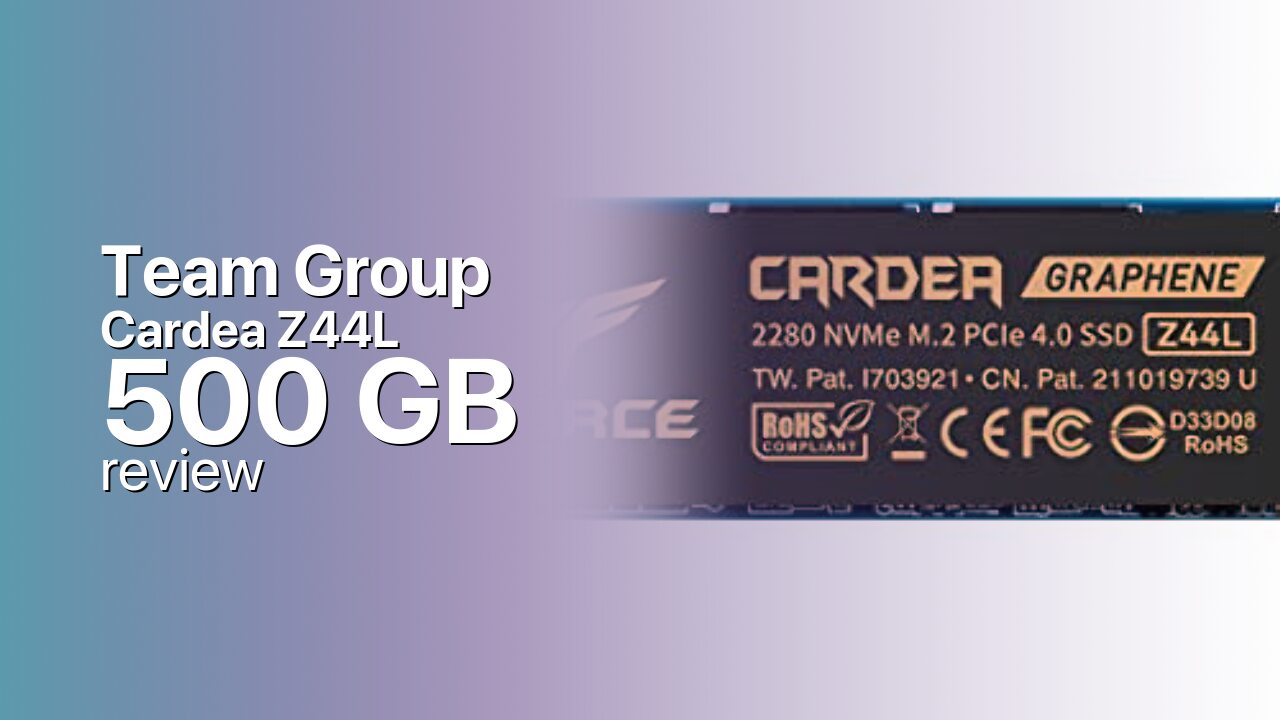
Controller & Memory
The TeamGroup Cardea Z44L 500GB runs TeamGroup's budget Gen4 platform: a Phison E19T controller in a DRAM-less configuration with Host Memory Buffer, 3D TLC NAND, and a single-sided M.2 2280 PCB wearing TeamGroup's patented ultra-thin graphene heat spreader, fitted by the user and low enough to coexist with any motherboard heatsink. The platform leans on NVMe 1.4 features — Predictable Latency Mode, NVM Sets and Read Recovery Levels — which TeamGroup credits for steadier latency and longer flash life across the Z44L family. The bare PCB weighs 7 g, and the fitted spreader keeps total height at 3.7 mm.
Within the lineup, the 500GB is where the trade-offs soften. TeamGroup's spec sheet rates it at 3,300/2,400 MB/s with 300 TBW: writes nearly double the 250GB's 1,300 MB/s, endurance doubles to 300 TBW, and the SLC cache has enough NAND behind it to absorb everyday bursts. Above it, the 1TB reaches 3,500/2,700 MB/s with 600 TBW and the 2TB tops the range at 3,500/3,000 MB with 1,200 TBW.
The buyer is a budget builder or an older PC being upgraded from SATA: 500GB holds Windows, an application set and a handful of games comfortably. Rivals in this bracket are the WD Blue SN580 500GB, which rates far faster writes, and Crucial's QLC-based P3 Plus, which trades endurance for price; the Kingston NV2 rounds out the DRAM-less value tier. The 500GB tier is also where the Z44L's SLC cache stops being a bottleneck for ordinary desktop copying, a point the smaller 250GB capacity cannot claim. Tech-Legends' 1TB review found the family runs cool under load, and the low-power E19T keeps the 500GB equally undemanding.
Storage Comparisons:
Cardea Z44L Performance & Benchmarks
TeamGroup rates the Z44L 500GB at 3,300 MB/s sequential reads and 2,400 MB/s sequential writes over PCIe 4.0 x4, with random performance rated up to 400K read and 550K write IOPS. Compared with the 250GB model, every one of those figures improves, and the difference is felt rather than theoretical: the write rating nearly doubles, and the larger SLC cache holds bursts far longer before throughput settles.
Team Group Cardea Z44L 500 GB vs M.2 4.0 x 4 peers
Switch between sequential throughput and random IOPS to see how this drive stacks up against other M.2 4.0 x 4 SSDs in our database. The highlighted bar is the drive on this page — click any other bar to open that drive.
- Patriot Viper PV593 1 TB: 14,500 MB/s read, 14,000 MB/s write
- Patriot Viper PV593 2 TB: 14,500 MB/s read, 14,000 MB/s write
- Patriot Viper PV593 4 TB: 14,500 MB/s read, 14,000 MB/s write
- Patriot Viper PV573 2 TB: 14,000 MB/s read, 12,000 MB/s write
- Team Group Cardea Z44L 500 GB (this drive): 3,300 MB/s read, 2,400 MB/s write
Real-world character is exactly what a budget boot-and-games drive should be. Windows startup, application launches and game loading are read-dominated and low-queue, where the Z44L feels like any modern NVMe regardless of price. Installs and large copies run at genuine Gen4 speeds until the cache wall, then settle to sustained TLC rates — a non-event at 500GB for normal desktop use. Tech-Legends' review of the Z44L family found it delivers good performance for the money and stays cool under load, and the low-power E19T platform with its graphene spreader makes thermals a non-issue in most slots. The DRAM-less design is invisible in gaming and light multitasking. Against the WD Blue SN580 500GB, the Z44L gives up rated speed; against a SATA drive, it is not a comparison at all.
Team Group Cardea Z44L vs Competitors
See how the Cardea Z44L stacks up against other M.2 4.0 x 4 drives in our database:
Compare with rival drives:
Endurance, TBW & Warranty
TeamGroup backs the Z44L 500GB with a 5-year limited warranty rated to 300 TBW of host writes, whichever comes first. The rating scales at 0.6 TBW per gigabyte across the family — 150 TBW at 250GB, 600 TBW at 1 TB, 1,200 TBW at 2 TB — and 300 TBW covers roughly 41 years of 20 GB-per-day writing, so the calendar term is the practical limit. TBW is measured to JEDEC definitions, and TeamGroup's SMART tool is the reference instrument if third-party software disagrees. The spec sheet lists MTBF at 3,000,000 hours, a population-level reliability figure rather than a per-unit lifespan promise. Warranty service runs through TeamGroup's channels with proof of purchase, including repair or replacement through its global distribution network.
Team Group Cardea Z44L 500 GB Specifications
| Category | Value |
|---|---|
| Capacity [?] | 500 GB |
| Interface [?] | M.2 4.0 x 4 |
| Controller [?] | Phison E19T |
| Memory type [?] | 3D TLC |
| DRAM [?] | No |
| Read speed (MB/s) [?] | 3300 |
| Write speed (MB/s) [?] | 2400 |
| Read IOPS [?] | 400000 |
| Write IOPS [?] | 550000 |
| Endurance (TBW) [?] | 300 |
| MTBF (million hours) [?] | 3000000 |
| Warranty (years) [?] | 5 |
Verdict: Is the Cardea Z44L Worth It in 2026?
The TeamGroup Cardea Z44L 500GB is the honest middle of TeamGroup's budget range: 3,300/2,400 MB/s, 300 TBW and a 5-year warranty in a single-sided drive with the heat spreader included. Choose it as a first NVMe boot drive or a SATA replacement where the budget is genuinely capped. Skip it if write-heavy work or PS5 plans loom — the WD Blue SN580 500GB rates roughly 4,150 MB/s both ways for a modest step up, and Sony's 5,500 MB/s recommendation rules the Z44L out of console duty regardless. Within the Z44L lineup, we would pick this capacity over the constrained 250GB every time; above it, the 1TB's extra endurance justifies itself for main-drive duty.
+ Pros
- 3,300/2,400 MB/s rated speeds
- 300 TBW endurance with 5-year warranty
- 400K/550K rated random IOPS
- Graphene heat spreader included
- Single-sided PCB fits laptops and SFF builds
- NVMe 1.4 PLM and RRL support
- Cons
- Write speed trails WD Blue SN580 by a wide margin
- No DRAM cache — Host Memory Buffer only
- Reads fall short of Sony's 5,500 MB/s PS5 guidance
- 500GB fills quickly with modern game sizes
Buy this or similar SSD Storage:
Video Review
High Speed Cardea Z44Q by Team Group - Review