Team Group T-Force A440 Lite 512GB Review — Gen4 With Heatsink (2026)
Quick answer
The Team Group T-Force A440 Lite 512GB suits one buyer well: the boot-drive upgrader who wants a Gen4 SSD with a heatsink already fitted, TLC NAND and a 5-year warranty, and whose workloads never leave cache-friendly territory.
Read: 7000 MB/s Write: 4500 MB/s Endurance: 300 TBW Warranty: 5 years Interface: M.2 4.0 x 4
The Team Group T-Force A440 Lite 512GB is the entry point into a heatsink-equipped Gen4 line — 7,000 MB/s reads, 300 TBW and five years of coverage.
Controller & Memory
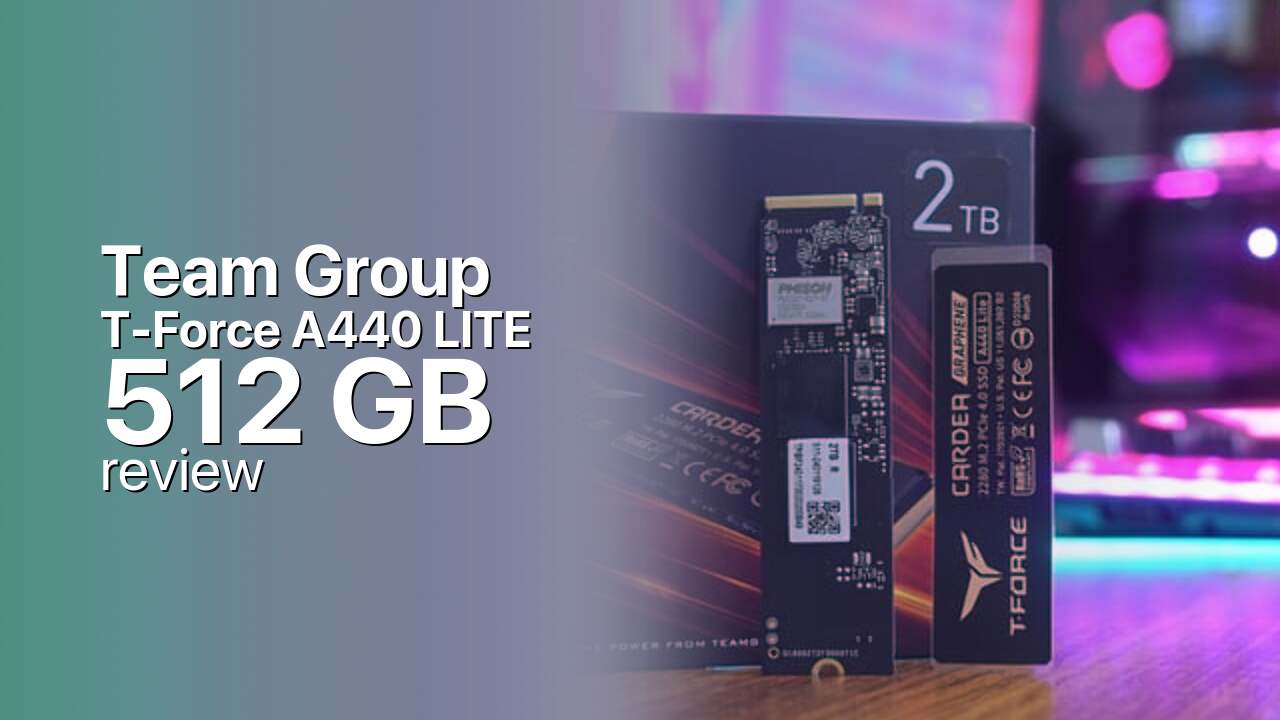
The Team Group T-Force A440 Lite 512GB is the runt of a line built for speed, and the difference shows in its spec sheet: this capacity is rated at 7,000 MB/s sequential reads but only 4,500 MB/s writes, against 6,400 MB/s for the 2 TB flagship. Underneath sits a DRAM-less platform — Phison's PS5027-E27T controller with 64 MB of Host Memory Buffer, paired with Kioxia BiCS6 162-layer 3D TLC — on a single-sided M.2 2280 PCB just 3.7 mm thick. The patented graphene heat sink comes included, which is the Lite's core argument: hardware that usually costs extra arrives in the box under a 5-year warranty.
The A440 Lite family steps up cleanly: 1 TB raises the rating to 7,200/6,200 MB/s and 600 TBW, and the 2 TB tops the line at 7,400/6,400 MB/s and 1,200 TBW. The 512 GB model carries the smallest endurance budget at 300 TBW, and its SLC cache is proportionally the smallest too. Above the Lite sits TeamGroup's Cardea A440 Pro with Phison's older E18 and full DRAM at 7,400/7,000 MB/s; the same E27T platform also powers TeamGroup's own MP44, plus the Apacer AS2280Q4U and Inland TN470. Direct rivals for this capacity include the WD Black SN770 and Kingston NV3 — the WD spends on TLC sustained performance, while TeamGroup's own cheaper T-Force G50 is the value counter PCWorld keeps raising.
The buyer here is a boot-drive builder: someone upgrading a laptop or small desktop who wants a name-brand Gen4 SSD, a heatsink already fitted, and warranty terms that match the big brands. Family reviews frame the trade-offs clearly: TechPowerUp's review of the 2 TB member found solid performance with improved power consumption over the DRAM-equipped E18 generation, while PCWorld's 1 TB review placed the family mid-pack among HMB TLC drives and kept pointing at TeamGroup's own cheaper T-Force G50. At 512 GB, the honest pitch is simpler still: a single-sided TLC drive with the cooling solved, ready for any NVMe slot on the shelf.
Storage Comparisons:
T-Force A440 LITE Performance & Benchmarks
TeamGroup rates the A440 Lite 512GB at 7,000 MB/s sequential reads and 4,500 MB/s writes — capacity-specific figures from the official datasheet, not the 7,400/6,400 MB/s headline that belongs to the 2 TB model. That 4,500 MB/s write rating is the lowest in the line, and it matters for the SLC cache story: smaller capacities get smaller caches, so the point where burst writes settle to sustained TLC pace arrives sooner than on the 1 TB and 2 TB models. TechPowerUp's testing of the family's 2 TB member measured about 50 GB of cache with writes dropping to roughly 730 MB/s afterward — respectable for a DRAM-less design, but proportionally less cache exists here.
Team Group T-Force A440 LITE 512 GB vs M.2 4.0 x 4 peers
Switch between sequential throughput and random IOPS to see how this drive stacks up against other M.2 4.0 x 4 SSDs in our database. The highlighted bar is the drive on this page — click any other bar to open that drive.
- Patriot Viper PV593 1 TB: 14,500 MB/s read, 14,000 MB/s write
- Patriot Viper PV593 2 TB: 14,500 MB/s read, 14,000 MB/s write
- Patriot Viper PV593 4 TB: 14,500 MB/s read, 14,000 MB/s write
- Patriot Viper PV573 2 TB: 14,000 MB/s read, 12,000 MB/s write
- Team Group T-Force A440 LITE 512 GB (this drive): 7,000 MB/s read, 4,500 MB/s write
In everyday use, 7,000 MB/s reads mean boot times and game loads indistinguishable from flagship Gen4 drives, and PCIe 4.0 x4 delivers four times SATA bandwidth for large single-file copies. Where the 512 GB Lite shows its tier is in sustained and mixed work: PCWorld's review of the family found it mid-pack among HMB TLC drives, with synthetic scores ahead of TeamGroup's own cheaper T-Force G50 but real-world sustained writes behind it. Power efficiency is a bright spot — TechPowerUp measured improved consumption over the previous E18 generation — and the included graphene heat sink keeps the 3.7 mm board cool enough that throttling is not a concern in a ventilated slot or a PS5.
Team Group T-Force A440 LITE vs Competitors
See how the T-Force A440 LITE stacks up against other M.2 4.0 x 4 drives in our database:
Compare with rival drives:
Endurance, TBW & Warranty
Team Group covers the A440 Lite 512GB with a 5-year limited warranty rated to 300 TBW of writes, whichever arrives first — figures confirmed on the official datasheet and by TechPowerUp. At a typical 20 GB of daily writes, the endurance budget would take about 41 years to exhaust, so the warranty term is the realistic ceiling for any boot-drive workload. Stepping up matters here: the 1 TB model doubles coverage to 600 TBW and the 2 TB reaches 1,200 TBW on identical terms, and TeamGroup's datasheet defines TBW per the JEDEC standard. The rated MTBF of 1.5 million hours is a population statistic across the fleet rather than a promise for an individual drive. Support runs through TeamGroup's regional service network with proof-of-purchase.
Team Group T-Force A440 LITE 512 GB Specifications
| Category | Value |
|---|---|
| Capacity [?] | 512 GB |
| Interface [?] | M.2 4.0 x 4 |
| Controller [?] | Phison E27T |
| Memory type [?] | 162-layer 3D TLC |
| DRAM [?] | No |
| Read speed (MB/s) [?] | 7000 |
| Write speed (MB/s) [?] | 4500 |
| Read IOPS [?] | n/a |
| Write IOPS [?] | n/a |
| Endurance (TBW) [?] | 300 |
| MTBF (million hours) [?] | 1500000 |
| Warranty (years) [?] | 5 |
Verdict: Is the T-Force A440 LITE Worth It in 2026?
The Team Group T-Force A440 Lite 512GB suits one buyer well: the boot-drive upgrader who wants a Gen4 SSD with a heatsink already fitted, TLC NAND and a 5-year warranty, and whose workloads never leave cache-friendly territory. Skip it if write speed matters — 4,500 MB/s rated and a small cache trail the 1 TB and 2 TB siblings — or if the budget stretches to the 2 TB model, which is the better product on every axis. The WD Black SN770 500GB is the TLC alternative with stronger sustained pace, and TeamGroup's own T-Force G50 undercuts on price. As a heatsink-included starter drive, the 512 GB Lite does its job.
+ Pros
- Rated 7,000 MB/s reads on PCIe 4.0 x4
- Graphene heatsink included at no extra cost
- 5-year warranty with 300 TBW endurance
- Kioxia BiCS6 162-layer TLC, not QLC
- Single-sided 3.7 mm PCB fits laptops and the PS5
- Cons
- Writes rated just 4,500 MB/s — lowest in the line
- No DRAM cache — Host Memory Buffer only
- Smallest SLC cache in the range slows big transfers sooner
- PCWorld found real-world pace behind TeamGroup's cheaper G50
Buy this or similar SSD Storage:
Video Review
Unboxing the A440 Cardea M.2 NvMe SSD