UNIS SSD S5 Ultra 2TB Review — DRAM Cache Meets PCIe 5.0 (2026)
Quick answer
Buy the UNIS S5 Ultra 2TB for a productivity or creator workstation that can use full PCIe 5.0 speed and DRAM-cached consistency, from a buyer comfortable importing a Tsinghua-backed brand whose retail presence outside China is minimal.
Read: 14200 MB/s Write: 13400 MB/s Endurance: 1200 TBW Warranty: 5 years Interface: M.2 5.0 x 4
The UNIS S5 Ultra 2TB adds a 2 GB DRAM cache to full-fat PCIe 5.0 speed — 14,200 MB/s reads, 13,400 MB/s writes and 1,200 TBW of endurance.
Controller & Memory
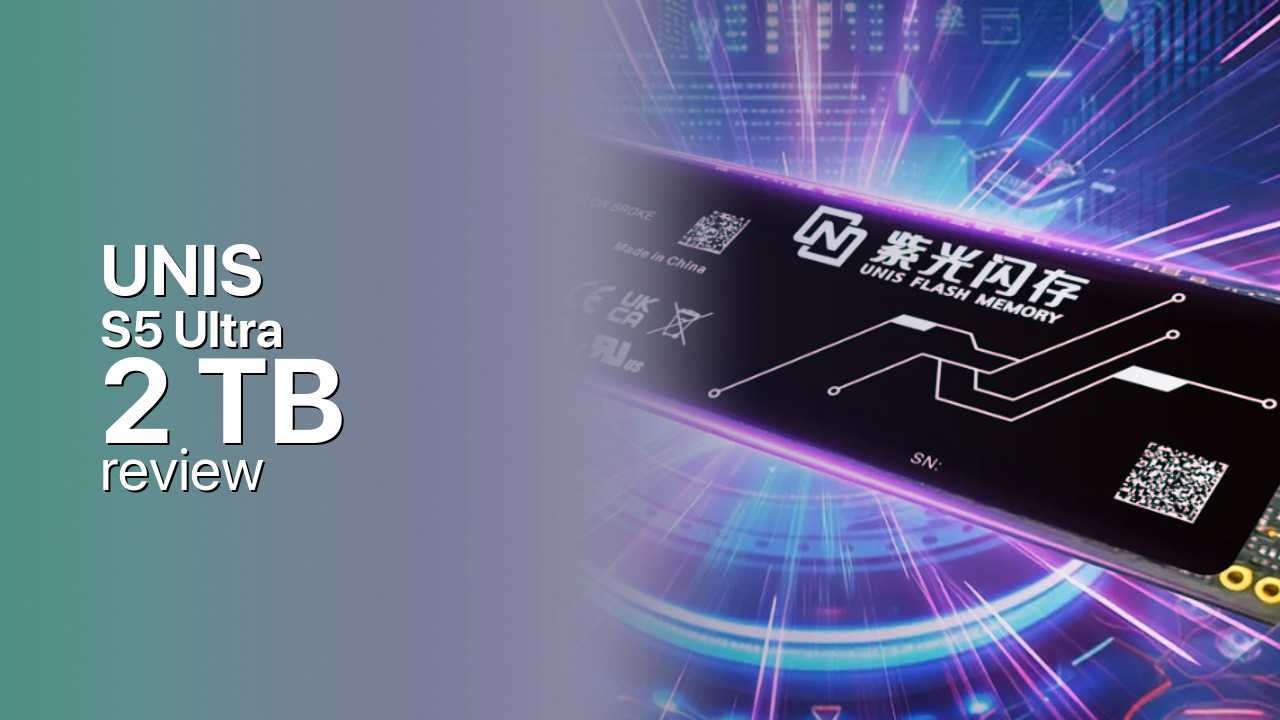
The UNIS S5 Ultra 2TB is the smaller capacity of the UNIS SSD S5 Ultra line, UNIS Flash Memory's PCIe 5.0 flagship launched in March 2025 by the storage arm of China's Tsinghua Unigroup. It combines a 6 nm controller — never officially named, though Tom's Hardware and PCEVA both judge it SM2508-class — with 2 GB of dedicated DRAM cache and 3D TLC NAND on a double-sided M.2 2280 PCB. Rated throughput is 14,200 MB/s sequential reads and 13,400 MB/s writes, with up to 1,700K random-read and 1,600K random-write IOPS, all at full PCIe 5.0 x4 link width.
The DRAM cache is what separates the Ultra from its sibling. The base S5, sold in 1TB and 2TB, is a DRAM-less single-sided design that leans on Host Memory Buffer and actually quotes a higher 14,900 MB/s read rating; the Ultra trades that headline number for the dual-sided PCB and external DRAM that Tom's Hardware expected to make it the better fit for productivity machines. Capacities stop at 2TB and 4TB — this is the smaller of the two — and each ships with a 1 mm graphene heat pad backed by firmware thermal management that UNIS claims holds loaded write temperatures under 78 °C.
Availability is the practical caveat: the S5 Ultra launched through Chinese e-commerce, and Western buyers mostly encounter it through online import channels such as AliExpress. Against the Samsung 9100 Pro (14,800/13,400 MB/s) and Crucial T705 (14,500/12,700 MB/s) it is competitive on paper, but neither rival asks buyers to import from a brand with almost no retail footprint outside Asia. For a workstation builder comfortable with that trade the spec sheet stands up; for everyone else the established brands remain the friction-free option.
Storage Comparisons:
S5 Ultra Performance & Benchmarks
UNIS rates the S5 Ultra 2TB at 14,200 MB/s sequential reads, 13,400 MB/s writes, and up to 1,700K random-read and 1,600K random-write IOPS on the PCIe 5.0 x4 interface. Those are first-party figures — Tom's Hardware noted at launch that only independent testing can confirm them, and full review coverage remains scarce — but the platform story is coherent: a 6 nm controller with 2 GB of dedicated DRAM cache is the same recipe Silicon Motion's SM2508 uses in mainstream Gen5 drives, and it explains the strong random ratings. The DRAM buffer keeps translation tables off the flash during heavy multi-file work, where DRAM-less drives lean on HMB and feel it.
UNIS S5 Ultra 2 TB vs M.2 5.0 x 4 peers
Switch between sequential throughput and random IOPS to see how this drive stacks up against other M.2 5.0 x 4 SSDs in our database. The highlighted bar is the drive on this page — click any other bar to open that drive.
- Kioxia Exceria Pro G2 2 TB: 14,900 MB/s read, 13,400 MB/s write
- Kioxia Exceria Pro G2 4 TB: 14,900 MB/s read, 13,700 MB/s write
- PNY XLR8 CS3250 1 TB: 14,900 MB/s read, 13,500 MB/s write
- PNY XLR8 CS3250 2 TB: 14,900 MB/s read, 14,000 MB/s write
- UNIS S5 Ultra 2 TB (this drive): 14,200 MB/s read, 13,400 MB/s write
For everyday use, a drive at this rating saturates most needs: operating systems boot in the same handful of seconds as any Gen5 drive, 100 GB-plus project folders transfer in under ten seconds at rated speed, and DirectStorage game assets stream without bottleneck. Sustained writes still settle below the burst figure once the pseudo-SLC cache fills — standard NVMe behavior — and the DRAM cache's contribution is keeping the post-cache drop shallower than DRAM-less designs typically manage. UNIS's firmware thermal claim of under 78 °C under loaded writes, aided by the included graphene pad, suggests throttling should be rare in a ventilated case.
UNIS S5 Ultra vs Competitors
See how the S5 Ultra stacks up against other M.2 5.0 x 4 drives in our database:
Compare with rival drives:
Endurance, TBW & Warranty
UNIS's product page lists the 2TB S5 Ultra at 1,200 TBW endurance with a 5-year warranty, whichever limit arrives first. At 20 GB of writes per day the budget lasts about 164 years, so the term is the practical limit. One data point deserves a flag: Chinese launch coverage quoted 2,400 TBW for the 4TB model, implying 600 TBW per terabyte, while UNIS's own page lists 2,000 TBW there — the official figure is used here, and the 2TB rating of 1,200 TBW is consistent across both. Warranty handling is the open question for import buyers: the drive launched through Chinese retail, and UNIS's support network outside Asia is thin, so a claim may mean shipping back to the seller rather than visiting a local service center.
UNIS S5 Ultra 2 TB Specifications
| Category | Value |
|---|---|
| Capacity [?] | 2 TB |
| Interface [?] | M.2 5.0 x 4 |
| Controller [?] | Maxio MAP1602 |
| Memory type [?] | 3D TLC |
| DRAM [?] | Yes |
| Read speed (MB/s) [?] | 14200 |
| Write speed (MB/s) [?] | 13400 |
| Read IOPS [?] | 1700000 |
| Write IOPS [?] | 1600000 |
| Endurance (TBW) [?] | 1200 |
| MTBF (million hours) [?] | n/a |
| Warranty (years) [?] | 5 |
Verdict: Is the S5 Ultra Worth It in 2026?
Buy the UNIS S5 Ultra 2TB for a productivity or creator workstation that can use full PCIe 5.0 speed and DRAM-cached consistency, from a buyer comfortable importing a Tsinghua-backed brand whose retail presence outside China is minimal. Skip it if local warranty support matters — the Crucial T705 2TB delivers similar rated speed (14,500/12,700 MB/s) on the Phison E26 with worldwide service — or if maximum rated reads are the goal, where UNIS's own DRAM-less S5 quotes 14,900 MB/s and the Samsung 9100 Pro quotes 14,800. Within its niche the Ultra is well specified: 2 GB of DRAM, 1,200 TBW endurance and a 5-year warranty at rated Gen5 speed. The spec sheet competes; the support network does not.
+ Pros
- 14,200 MB/s reads and 13,400 MB/s writes
- 2 GB dedicated DRAM cache
- 1,700K random-read IOPS rating
- 1,200 TBW endurance with 5-year warranty
- Graphene heat pad included in the box
- 3D TLC NAND on a full PCIe 5.0 x4 link
- Cons
- Little retail availability outside China
- Controller never officially named
- No independent benchmark data yet
- Double-sided PCB blocks some laptop slots
- Base S5 model rates faster reads at 14,900 MB/s
Buy this or similar SSD Storage:
Video Review
M. 2 , NVME SSD EXTERNAL USB C convertor #shorts #ssd #computerscience #technology #techmeta