UNIS SSD S5 Ultra 4TB Review — DRAM, Speed and 2,000 TBW (2026)
Quick answer
The UNIS S5 Ultra 4TB suits workstation builders and archivists who want 4TB of DRAM-cached TLC at full PCIe 5.0 ratings and are willing to import from a Tsinghua-backed brand with minimal Western retail presence: 4 GB of DRAM, 2,000 TBW endurance and a 5-year warranty are genuinely competitive specifications.
Read: 14200 MB/s Write: 13400 MB/s Endurance: 2000 TBW Warranty: 5 years Interface: M.2 5.0 x 4
The UNIS S5 Ultra 4TB tops the line with a 4 GB DRAM cache, 14,200 MB/s PCIe 5.0 reads and a 2,000 TBW endurance budget for heavy creative work.
Controller & Memory
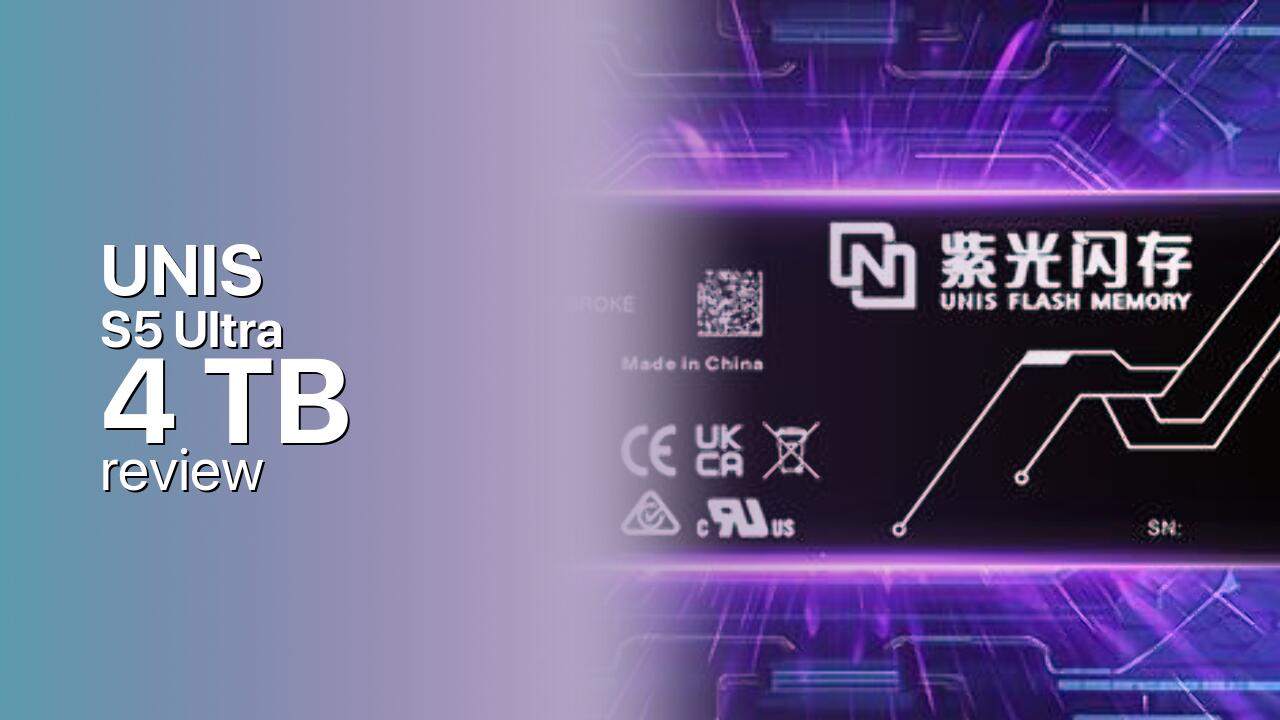
The UNIS S5 Ultra 4TB is the top capacity of the UNIS SSD S5 Ultra line, UNIS Flash Memory's PCIe 5.0 flagship from the storage arm of China's Tsinghua Unigroup, launched in March 2025. This model pairs a 6 nm controller that UNIS has never officially named (Tom's Hardware and PCEVA both judge it SM2508-class) with 4 GB of dedicated DRAM cache, double the 2TB model's 2 GB, plus 3D TLC NAND on a double-sided M.2 2280 PCB. Ratings stand at 14,200 MB/s sequential reads, 13,400 MB/s writes and up to 1,700K random-read and 1,600K random-write IOPS over the full PCIe 5.0 x4 link.
The extra DRAM matters at 4TB, where translation tables are largest and DRAM-less designs lean hardest on Host Memory Buffer. Endurance is rated at 2,000 TBW on UNIS's product page — launch coverage quoted 2,400, but the official figure governs — under a 5-year warranty. UNIS claims firmware thermal management holds loaded write temperatures below 78 °C and idle below 40 °C, with a 1 mm graphene pad included on every unit.
The buyer profile is a workstation or library builder who wants rated Gen5 speed, DRAM-backed consistency and 4TB of TLC in one board, and who is comfortable sourcing a Chinese-market drive. Direct rivals are the Samsung 9100 Pro 4TB and Crucial T705 4TB, both rated faster sequentially and both available through ordinary retail; the S5 Ultra reached Western buyers mainly through import channels such as AliExpress. The spec sheet competes head-on; the purchasing experience does not.
Storage Comparisons:
S5 Ultra Performance & Benchmarks
UNIS rates the S5 Ultra 4TB at 14,200 MB/s sequential reads, 13,400 MB/s writes and up to 1,700K random-read and 1,600K random-write IOPS — the only capacity in the line whose random ratings the launch coverage published explicitly. The 4 GB DRAM cache underpins those random numbers, keeping 4TB of mapping tables in dedicated memory rather than trading HMB bandwidth with the operating system. These remain first-party figures: Tom's Hardware noted at launch that only independent testing can confirm them, and published reviews are still rare.
UNIS S5 Ultra 4 TB vs M.2 5.0 x 4 peers
Switch between sequential throughput and random IOPS to see how this drive stacks up against other M.2 5.0 x 4 SSDs in our database. The highlighted bar is the drive on this page — click any other bar to open that drive.
- Kioxia Exceria Pro G2 2 TB: 14,900 MB/s read, 13,400 MB/s write
- Kioxia Exceria Pro G2 4 TB: 14,900 MB/s read, 13,700 MB/s write
- PNY XLR8 CS3250 1 TB: 14,900 MB/s read, 13,500 MB/s write
- PNY XLR8 CS3250 2 TB: 14,900 MB/s read, 14,000 MB/s write
- UNIS S5 Ultra 4 TB (this drive): 14,200 MB/s read, 13,400 MB/s write
At rated speed the use cases are unambiguous. Four terabytes of 8K footage, a local language model or a full game library sits behind a link that moves 100 GB in about eight seconds, and random performance strong enough for 1,700K reads keeps scratch disks and virtual machine fleets responsive. Sustained writes still settle to native TLC rates once the pseudo-SLC cache fills, standard for the class, though the external DRAM typically keeps post-cache behavior more even than DRAM-less Gen5 designs manage. Thermals are engineered rather than hoped for: UNIS specifies firmware control under 78 °C loaded and 40 °C idle, with the included graphene pad as first-line cooling. A motherboard heatsink remains worthwhile for marathon transfers.
UNIS S5 Ultra vs Competitors
See how the S5 Ultra stacks up against other M.2 5.0 x 4 drives in our database:
Compare with rival drives:
Endurance, TBW & Warranty
UNIS's official product page rates the 4TB S5 Ultra at 2,000 TBW endurance with a 5-year warranty, whichever comes first — equivalent to about 1.1 TB of writes per day across the term, far beyond desktop workloads. One discrepancy is worth recording: Chinese launch coverage from GeekPark and Wccftech quoted 2,400 TBW for this capacity, consistent with a 600 TBW-per-terabyte formula, while UNIS's own page lists 2,000 TBW; the official figure is used here and the spec table matches it. The 2TB model rates 1,200 TBW on the same terms. For import buyers the warranty path is the real constraint — claims would likely route through the original seller rather than a local service center, so terms deserve a check before purchase.
UNIS S5 Ultra 4 TB Specifications
| Category | Value |
|---|---|
| Capacity [?] | 4 TB |
| Interface [?] | M.2 5.0 x 4 |
| Controller [?] | Maxio MAP1602 |
| Memory type [?] | 3D TLC |
| DRAM [?] | Yes |
| Read speed (MB/s) [?] | 14200 |
| Write speed (MB/s) [?] | 13400 |
| Read IOPS [?] | 1700000 |
| Write IOPS [?] | 1600000 |
| Endurance (TBW) [?] | 2000 |
| MTBF (million hours) [?] | n/a |
| Warranty (years) [?] | 5 |
Verdict: Is the S5 Ultra Worth It in 2026?
The UNIS S5 Ultra 4TB suits workstation builders and archivists who want 4TB of DRAM-cached TLC at full PCIe 5.0 ratings and are willing to import from a Tsinghua-backed brand with minimal Western retail presence: 4 GB of DRAM, 2,000 TBW endurance and a 5-year warranty are genuinely competitive specifications. Skip it if after-sales service and easy returns are priorities — the Crucial T705 4TB and Samsung 9100 Pro 4TB rate faster sequentially, buy through ordinary channels, and carry deeper review track records. As a statement of how far Chinese storage brands have closed the specification gap, the Ultra is convincing; as a friction-free purchase, it is not quite there yet.
+ Pros
- 14,200 MB/s reads and 13,400 MB/s writes
- 4 GB dedicated DRAM cache
- 2,000 TBW endurance with 5-year warranty
- 1,700K random-read IOPS rating
- Firmware thermal control rated below 78 °C loaded
- 3D TLC NAND, double-sided 2280
- Cons
- Minimal retail availability outside China
- Controller never officially named
- Launch coverage quoted 2,400 TBW vs the official 2,000
- No independent benchmark data yet
- Double-sided PCB blocks some laptop slots
Buy this or similar SSD Storage:
Video Review
What SSD Should You Buy??? #crucial #sandiskprofessional #contentcreation