TeamGroup T-Create Classic H514 4TB Review — Big, Fast, Creator-Ready (2026)
Quick answer
The TeamGroup T-Create Classic H514 4TB is for creators and AI-workstation builders whose libraries have outgrown 2TB: 2,400 TBW of endurance, full 14,200/13,300 MB/s Gen5 ratings, a DRAM-cached SM2508 platform and included cooling in two flavors.
Read: 14200 MB/s Write: 13300 MB/s Endurance: 2400 TBW Warranty: 5 years Interface: M.2 5.0 x 4
The TeamGroup T-Create Classic H514 4TB is the range flagship — 14,200 MB/s reads, 2,400 TBW of endurance and DRAM-cache muscle for AI and video workloads.
Controller & Memory
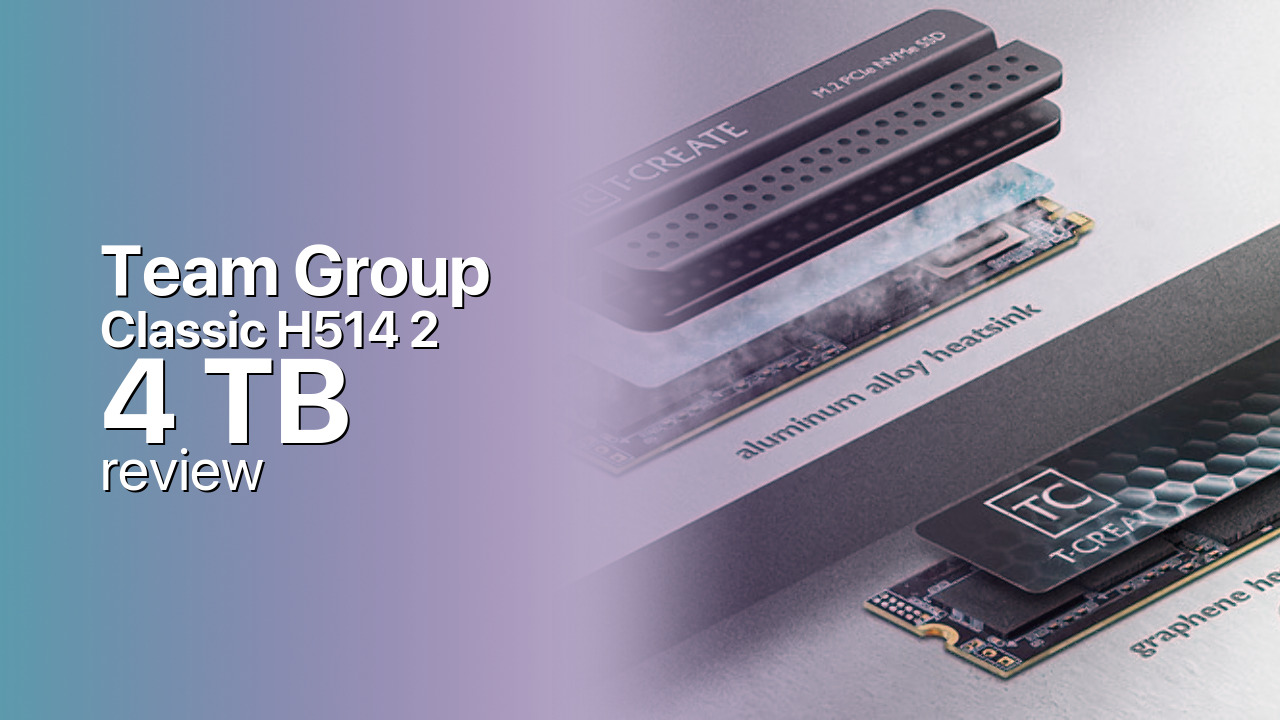
The TeamGroup T-Create Classic H514 4TB closes TEAMGROUP's PCIe 5.0 creator line at the top, pairing the same Silicon Motion SM2508 6 nm controller, DRAM cache and 3D TLC NAND as its siblings with the range's largest endurance budget: 2,400 TBW. The board is a standard M.2 2280 on PCIe 5.0 x4, rated at 14,200 MB/s reads, 13,300 MB/s writes and latencies as low as 0.05 ms and 0.015 ms, and it arrives with either the patented 3.7 mm graphene heat spreader or the 11.7 mm matte-black aluminum heatsink. TEAMGROUP specs a 0–70 °C operating range, and both cooling variants share identical performance ratings.
Endurance is this model's argument. 2,400 TBW is four times the 1TB's budget and, on TEAMGROUP's JEDEC-basis rating, equates to roughly 1.3 TB written every day across the five-year warranty — headroom aimed at 8K video libraries, recurring AI training sets and permanent project archives. TEAMGROUP positions the line at creators running local large language models of 7B to 175B parameters, and 4TB is where those workloads plus a media library coexist. The 2TB model offers identical speed ratings for tighter builds, and the range also starts at 1TB. For perspective on the endurance headroom, even continuous 500 GB daily writes would take roughly 13 years to exhaust this model's budget.
Against the Samsung 9100 Pro 4TB (14,800/13,400 MB/s rated) and the Crucial T705 4TB (14,500/12,700 MB/s), the H514 trails on rated sequential speed but counters with the included-cooling choice and a 2,400 TBW endurance budget. On a PCIe 4.0 board none of that matters — that buyer should shop the Gen4 tier instead, where TEAMGROUP's own Classic I45 lives.
Storage Comparisons:
Classic H514 2 Performance & Benchmarks
TEAMGROUP rates the 4TB Classic H514 at 14,200 MB/s sequential reads and 13,300 MB/s writes on PCIe 5.0 x4 — identical to the 2TB and ahead of the 1TB's 14,000/11,000 MB/s — with latencies as low as 0.05 ms reads and 0.015 ms writes and no published IOPS figure. At rated speed a 250 GB export finishes in under twenty seconds, and the DRAM-cached SM2508 platform is built to hold that behavior across the long, multi-file transfers that distinguish real creative work from benchmark loops.
Team Group Classic H514 2 4 TB vs M.2 5.0 x 4 peers
Switch between sequential throughput and random IOPS to see how this drive stacks up against other M.2 5.0 x 4 SSDs in our database. The highlighted bar is the drive on this page — click any other bar to open that drive.
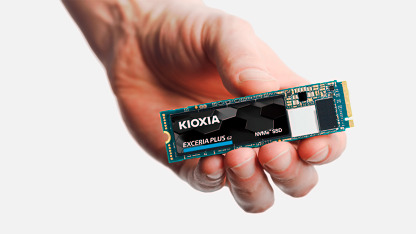
- Kioxia Exceria Pro G2 2 TB: 14,900 MB/s read, 13,400 MB/s write
- Kioxia Exceria Pro G2 4 TB: 14,900 MB/s read, 13,700 MB/s write
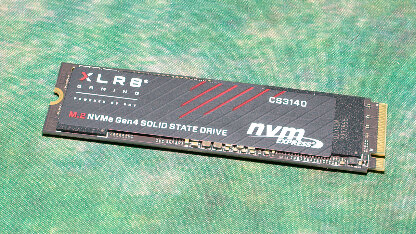
- PNY XLR8 CS3250 1 TB: 14,900 MB/s read, 13,500 MB/s write
- PNY XLR8 CS3250 2 TB: 14,900 MB/s read, 14,000 MB/s write
- Team Group Classic H514 2 4 TB (this drive): 14,200 MB/s read, 13,300 MB/s write
Sustained performance follows the standard NVMe pattern: a pseudo-SLC cache absorbs bursts before speeds settle to native TLC rates, and external DRAM keeps the translation tables flowing so the drop-off stays manageable on scratch-disk duty. For thermals, TEAMGROUP specs a 0–70 °C operating range and ships real cooling on every unit — the 3.7 mm graphene spreader for slim builds, the 11.7 mm aluminum block for sustained loads — with the company advising solid case airflow on Gen5 systems. Independent review coverage of the H514 family is still thin following its March 2026 launch: early hands-on impressions have surfaced, full benchmark suites have not, so these figures stand as manufacturer ratings.
Team Group Classic H514 2 vs Competitors
See how the Classic H514 2 stacks up against other M.2 5.0 x 4 drives in our database:
Compare with rival drives:
Endurance, TBW & Warranty
The 4TB Classic H514 carries TEAMGROUP's largest endurance rating in the line: 2,400 TBW on a JEDEC-standard basis, backed by a 5-year limited warranty that ends at whichever limit arrives first. That budget equates to roughly 1.3 TB of writes per day across the warranty term; even a demanding 100 GB daily workload would need over six decades to exhaust it, so the warranty clock is the practical limit. The official spec sheet lists a 1,000,000-hour MTBF, a population statistic rather than a per-unit promise. Sibling capacities scale down to 1,200 TBW at 2TB and 600 TBW at 1TB on identical terms, and warranty claims run through TEAMGROUP's standard support process with proof of purchase.
Team Group Classic H514 2 4 TB Specifications
| Category | Value |
|---|---|
| Capacity [?] | 4 TB |
| Interface [?] | M.2 5.0 x 4 |
| Controller [?] | Silicon Motion SM2508 |
| Memory type [?] | 3D TLC |
| DRAM [?] | Yes |
| Read speed (MB/s) [?] | 14200 |
| Write speed (MB/s) [?] | 13300 |
| Read IOPS [?] | n/a |
| Write IOPS [?] | n/a |
| Endurance (TBW) [?] | 2400 |
| MTBF (million hours) [?] | n/a |
| Warranty (years) [?] | 5 |
Verdict: Is the Classic H514 2 Worth It in 2026?
The TeamGroup T-Create Classic H514 4TB is for creators and AI-workstation builders whose libraries have outgrown 2TB: 2,400 TBW of endurance, full 14,200/13,300 MB/s Gen5 ratings, a DRAM-cached SM2508 platform and included cooling in two flavors. Skip it for gaming-only systems and PCIe 4.0 boards, where cheaper-per-gigabyte Gen4 drives deliver the same real-world responsiveness, and skip it if rated peak speed is the deciding metric — the Samsung 9100 Pro 4TB quotes 14,800/13,400 MB/s and the Crucial T705 4TB quotes 14,500/12,700 MB/s, both with deeper review track records and established retail channels. As the flagship of TEAMGROUP's creator line, it makes its strongest case on endurance and capacity rather than raw speed.
+ Pros
- 14,200 MB/s reads and 13,300 MB/s writes
- 2,400 TBW endurance with 5-year warranty
- Silicon Motion SM2508 controller with DRAM cache
- Roughly 1.3 TB per day write budget over the warranty
- Graphene or aluminum heatsink included
- 3D TLC NAND across the range
- Cons
- Rated speed trails Samsung 9100 Pro and Crucial T705
- Independent benchmark coverage still scarce
- No published IOPS rating
- Aluminum heatsink version stands 11.7 mm tall
- Overkill for gaming-only builds on Gen4 boards
Buy this or similar SSD Storage:



Video Review
Team Group T-Force Gen 6 SSD, Gen 5 NVMe SSD, Portable SSDs And Flash Storage Products at Computex