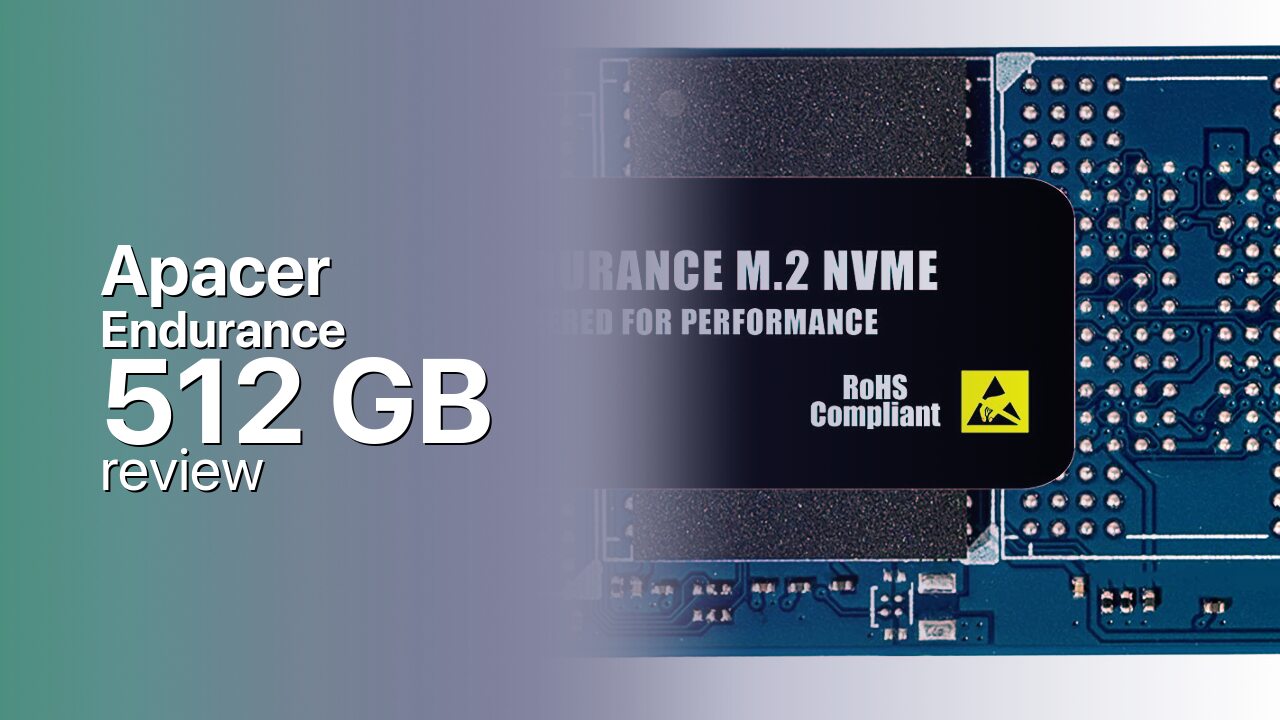
Apacer Endurance 512 GB: The Entry Capacity of Apacer's NAS Line (2026)
Quick answer
The Apacer Endurance 512 GB is best understood as what Apacer built it to be, a PCIe 4.0 M.2 SSD tuned for 24/7 NAS use rather than a peak-throughput enthusiast drive.
Read: 5000 MB/s Write: 4400 MB/s Endurance: 340 TBW Warranty: 5 years Interface: M.2 4.0 x 4
The Apacer Endurance 512 GB is the entry capacity of Apacer's PB4480-R line, a PCIe 4.0 NAS SSD tuned for 24/7 use with 5,000 MB/s reads and a five-year warranty.
Controller & Memory
The Apacer Endurance 512 GB belongs to Apacer's PB4480-R family, which the company positions as a high-endurance M.2 PCIe Gen4 SSD built specifically for NAS storage rather than as a generic consumer boot drive. It runs a Maxio MAP1602-class DRAM-less controller with 3D TLC NAND over a PCIe 4.0 x4 link, rated at 5,000 MB/s sequential reads and 4,400 MB/s sequential writes with up to 340,000 random read and write IOPS. The differentiator is not peak speed, which sits in the budget-Gen4 band, but the NAS-tuned design: Apacer targets 24/7 sustained-write reliability, quotes a 2 million hour MTBF, and backs the drive with a five-year warranty, the longer coverage that NAS and workstation buyers expect.
The PB4480-R ships in 512 GB, 1 TB, 2 TB, and 4 TB, all on the same controller and 3D TLC platform. The 512 GB reviewed here is the entry point, suited to a NAS cache or a small RAID array rather than primary bulk storage, where the larger capacities make more sense. eTeknix reviewed the 1 TB model and characterised the Endurance line as designed specifically for NAS systems, confirming the positioning rather than treating it as a peak-performance enthusiast drive. The value proposition is reliability tuning and warranty length at a budget-Gen4 price, not record-breaking throughput.
For a NAS use case the relevant competitors are other M.2 drives pitched at sustained workloads, and for a general budget-Gen4 role the drive sits alongside MAP1602 designs like the Addlink S93 and the Team Group MP44. The Apacer Endurance's edge is the NAS-focused firmware and the five-year warranty; its limitation is the modest 5,000 MB/s ceiling and DRAM-less architecture, which trail the 7,000 MB/s-plus flagship Gen4 drives. For buyers building an all-NVMe NAS or adding fast cache to a storage array, the 512 GB is a sensible entry point, and stepping up to 1 TB or 2 TB makes sense for larger cache or pooled storage.
Storage Comparisons:
Endurance Performance & Benchmarks
Apacer rates the Endurance 512 GB at 5,000 MB/s sequential reads and 4,400 MB/s sequential writes over PCIe 4.0 x4, with up to 340,000 random read and 340,000 random write IOPS per the johnnylucky database. Those figures place the drive in the budget-Gen4 performance band rather than the flagship tier, which is consistent with its role as a reliability-tuned NAS drive rather than a peak-throughput enthusiast drive. The Maxio MAP1602-class controller is a proven DRAM-less PCIe 4.0 design that uses Host Memory Buffer for the flash translation layer, the standard architecture for drives in this speed and price range.
Apacer Endurance 512 GB vs M.2 4.0 x 4 peers
Switch between sequential throughput and random IOPS to see how this drive stacks up against other M.2 4.0 x 4 SSDs in our database. The highlighted bar is the drive on this page — click any other bar to open that drive.
- Patriot Viper PV593 1 TB: 14,500 MB/s read, 14,000 MB/s write
- Patriot Viper PV593 2 TB: 14,500 MB/s read, 14,000 MB/s write
- Patriot Viper PV593 4 TB: 14,500 MB/s read, 14,000 MB/s write
- Patriot Viper PV573 2 TB: 14,000 MB/s read, 12,000 MB/s write
- Apacer Endurance 512 GB (this drive): 5,000 MB/s read, 4,400 MB/s write
For NAS workloads the more relevant metrics are sustained-write consistency and power-loss resilience, and Apacer's positioning of the PB4480-R as a 24/7 NAS SSD suggests firmware tuned for steady mixed writes rather than burst sequential speed. eTeknix's review of the 1 TB model treated the line as a NAS-purpose drive, which is the right frame for evaluating the 512 GB. Random I/O at 340,000 IOPS is modest by flagship standards but adequate for NAS cache duties, where the drive absorbs small random writes from the array and serves them back without the latency spikes a QLC drive would show. As a DRAM-less HMB design, the drive will trail drives with discrete DRAM under heavy sustained random writes, but for the NAS role it is built for the trade-off is acceptable given the price.
Apacer Endurance vs Competitors
See how the Endurance stacks up against other M.2 4.0 x 4 drives in our database:
Compare with rival drives:
Endurance, TBW & Warranty
Apacer backs the Endurance 512 GB with a five-year limited warranty, terminated at whichever arrives first between the term and the drive's TBW endurance rating, the longer coverage that NAS and workstation buyers expect and a step up from the three-year warranty on Apacer's consumer AS2280Q4X line. The PB4480-R is marketed as a high-endurance NAS drive, and Apacer quotes a 2 million hour MTBF for the family, a fleet-reliability statistic describing expected failure rates across a population of drives rather than a lifespan promise for any individual unit. Apacer does not publish a per-capacity TBW table for the PB4480-R in accessible English-language sources, so the 512 GB's exact endurance rating is not independently verified here; what is verifiable is the five-year term and the NAS-tuned positioning, which together indicate the drive is built for sustained 24/7 operation rather than light consumer use. For a NAS cache drive that absorbs continuous small random writes, the five-year coverage is the more meaningful reliability figure, since it reflects Apacer's confidence in the firmware's sustained-write handling. Buyers running the 512 GB in a pooled-storage or RAID cache role should size the drive so it is not continuously full, since SLC cache and over-provisioning headroom both affect sustained-write endurance in NAS duty.
Apacer Endurance 512 GB Specifications
| Category | Value |
|---|---|
| Capacity [?] | 512 GB |
| Interface [?] | M.2 4.0 x 4 |
| Controller [?] | Maxio MAP1602 |
| Memory type [?] | 3D TLC |
| DRAM [?] | No |
| Read speed (MB/s) [?] | 5000 |
| Write speed (MB/s) [?] | 4400 |
| Read IOPS [?] | 340000 |
| Write IOPS [?] | 340000 |
| Endurance (TBW) [?] | 340 |
| MTBF (million hours) [?] | 2000000 |
| Warranty (years) [?] | 5 |
Verdict: Is the Endurance Worth It in 2026?
The Apacer Endurance 512 GB is best understood as what Apacer built it to be, a PCIe 4.0 M.2 SSD tuned for 24/7 NAS use rather than a peak-throughput enthusiast drive. Its 5,000 MB/s reads, 3D TLC, DRAM-less HMB architecture, and 340,000 IOPS place it in the budget-Gen4 band, while its real value sits in the NAS-focused firmware, the 2 million hour MTBF, and the five-year warranty that distinguishes it from Apacer's three-year consumer AS2280Q4X line. For an all-NVMe NAS build, a fast cache volume, or a small RAID array, the 512 GB is a sensible entry point, and buyers who need more cache or pooled storage should step up to the 1 TB or 2 TB. The drive is not the right choice for buyers chasing 7,000 MB/s-plus flagship Gen4 speeds or the heaviest sustained random-write workloads, where a drive with discrete DRAM like the Anacomda i4-X or Samsung 980 Pro pulls ahead. Within its intended NAS role, the Endurance 512 GB delivers reliability tuning and warranty length at a budget-Gen4 price, which is a fair trade for the throughput it gives up.
+ Pros
- NAS-tuned firmware for 24/7 sustained-write reliability
- Five-year warranty, longer than consumer AS2280Q4X line
- 2 million hour MTBF rating
- 3D TLC NAND, avoids QLC's endurance and SLC-cache pitfalls
- Budget-Gen4 price point for a reliability-focused drive
- Cons
- 5,000 MB/s reads trail flagship Gen4 drives by a wide margin
- DRAM-less HMB design limits sustained random I/O
- 512 GB is small for anything beyond NAS cache duty
- Per-capacity TBW not published in accessible sources
- 340K IOPS is modest by current Gen4 standards
Buy this or similar SSD Storage:



Video Review
ASUSTOR NAS with 6x NVMe SSDs 🔊 #asmr