ADATA XPG Gammix S11 Pro 512GB Review — Mid-Range PCIe 3.0 NVMe (2026)
Quick answer
The ADATA XPG Gammix S11 Pro 512GB is a competent PCIe 3.0 NVMe SSD that benefits from a dedicated DRAM cache and a built-in heatsink.
Read: 3500 MB/s Write: 3000 MB/s Endurance: 320 TBW Warranty: 5 years Interface: M.2 3.0 x 4
The ADATA XPG Gammix S11 Pro 512GB is a PCIe 3.0 NVMe SSD with DRAM cache and a low-profile heatsink that still holds its own in 2026.
Controller & Memory
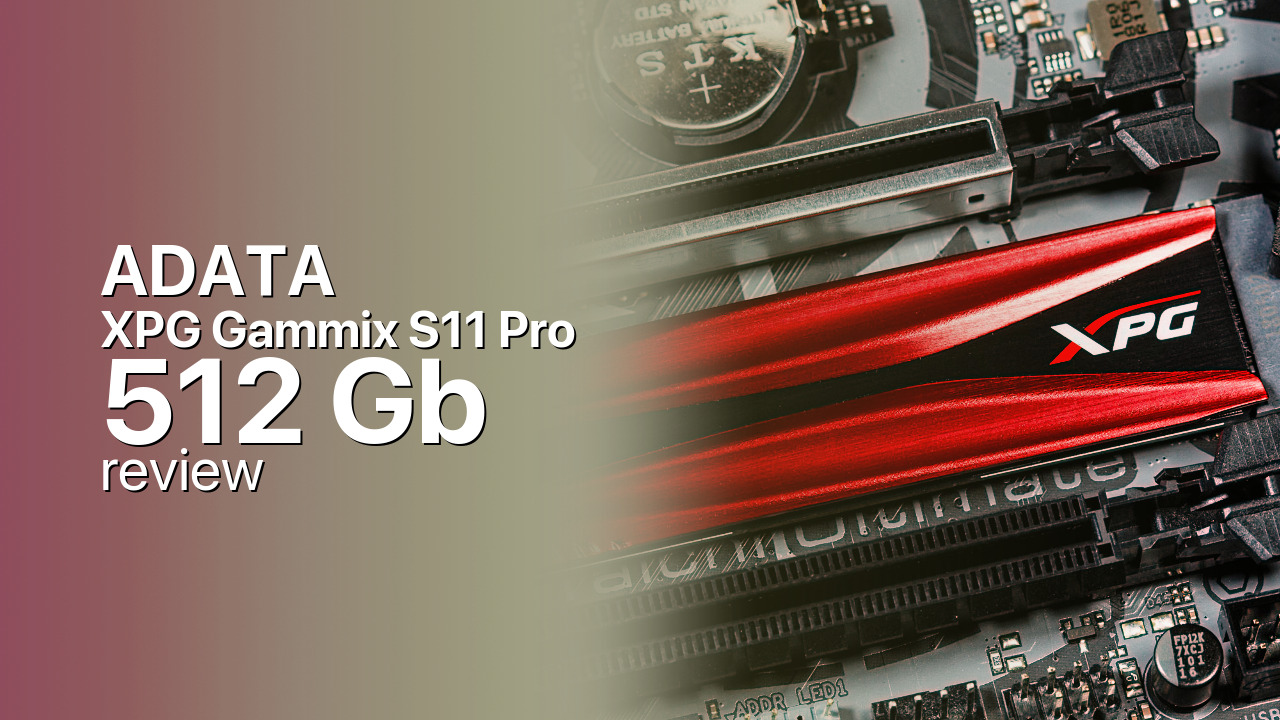
The 512 GB Gammix S11 Pro pairs Silicon Motion's SM2262EN controller with 256 MB of Nanya DDR3L DRAM and Micron 3D TLC NAND on an M.2 2280 PCB topped with a red aluminum heatsink. The heatsink is thin enough for most desktop slots but will add a few millimeters of height — something to keep in mind on small-form-factor motherboards where the M.2 slot sits beneath a graphics card.
ADATA rates the 512 GB model at 3,500 MB/s sequential reads and 3,000 MB/s sequential writes, with up to 390,000 random read and 380,000 random write IOPS. Those figures put it near the theoretical ceiling of PCIe 3.0 x4, which tops out around 3,900 MB/s in practice. The drive earns a 320 TBW endurance rating and a five-year warranty, whichever comes first.
The Gammix S11 Pro is essentially a heatsink-equipped variant of ADATA's earlier S11 line, with the SM2262EN offering slightly better power efficiency than the original SM2262. It sits one tier below the SX8200 Pro in ADATA's lineup — the SX8200 Pro uses the newer SM2262EN with optimized firmware to reach PCIe 3.0's upper limits more consistently.
At this capacity, the 512 GB model is well-suited as a boot drive with room for a moderate game library or application stack. The dedicated DRAM cache gives it an advantage over DRAM-less HMB drives in sustained random workloads, where controller-to-NAND address translation doesn't need to borrow system memory.
Direct competitors include the Samsung 970 EVO 500GB (a similar PCIe 3.0 drive with Samsung's own controller and DRAM) and the Crucial P5 500GB (Micron-backed, also DRAM-equipped). The SX8200 Pro 512GB is ADATA's own step-up option, trading the heatsink for marginally higher sustained throughput.
Storage Comparisons:
XPG Gammix S11 Pro Performance & Benchmarks
The ADATA XPG Gammix S11 Pro 512GB is rated at 3,500 MB/s sequential reads and 3,000 MB/s sequential writes, with up to 390,000 random read and 380,000 random write IOPS. In independent testing, the drive comes close to these manufacturer figures in CrystalDiskMark, with measured sequential reads around 3,410 MB/s and writes near 2,440 MB/s — a result that reflects real-world overhead from the test environment.
ADATA XPG Gammix S11 Pro 512 GB vs M.2 3.0 x 4 peers
Switch between sequential throughput and random IOPS to see how this drive stacks up against other M.2 3.0 x 4 SSDs in our database. The highlighted bar is the drive on this page — click any other bar to open that drive.
- ADATA XPG Gammix S11 Pro 512 GB (this drive): 3,500 MB/s read, 3,000 MB/s write
- ADATA SX 8800 Pro 512 GB: 3,500 MB/s read, 2,700 MB/s write
- ADATA SX 8800 Pro 1 TB: 3,500 MB/s read, 2,700 MB/s write
- ADATA XPG Spectrix S40G RGB 256 GB: 3,500 MB/s read, 3,000 MB/s write
- ADATA XPG Spectrix S40G RGB 512 GB: 3,500 MB/s read, 3,000 MB/s write
The SM2262EN controller is an eight-channel design that handles the Micron TLC NAND through a dedicated 256 MB DRAM cache. The DRAM is important here: it stores the flash translation table on-die rather than borrowing system RAM through Host Memory Buffer, which gives the Gammix S11 Pro more consistent random I/O under mixed workloads — the kind of load you see during OS boot, application launches, and background indexing.
Like most TLC drives with SLC caching, the Gammix S11 Pro writes at near-sequential speeds until the SLC buffer fills, after which throughput drops to the native TLC rate. Reviewers have observed this drop during large sustained transfers — the drive handles short bursts well but slows on multi-gigabyte writes once the cache exhausts. For everyday use — game load times, OS responsiveness, and typical file copies — the cache is rarely a bottleneck. It matters most when moving tens of gigabytes in a single session, such as video editors copying raw footage.
The included aluminum heatsink helps keep controller temperatures in check during sustained loads, reducing the likelihood of thermal throttling. In real-world file copy tests, the drive sustained over 1.6 GB/s for both reads and writes across a 4.5 GB transfer, and a fresh Windows installation booted in roughly 30 seconds. For a PCIe 3.0 drive in this tier, those are solid numbers — not class-leading, but competitive with the Samsung 970 EVO and Crucial P5 at similar capacities.
ADATA XPG Gammix S11 Pro vs Competitors
See how the XPG Gammix S11 Pro stacks up against other M.2 3.0 x 4 drives in our database:
Compare with rival drives:
Endurance, TBW & Warranty
ADATA covers the Gammix S11 Pro 512GB with a five-year limited warranty, rated at 320 TBW (terabytes written). At a typical consumer workload of 20 GB per day, that endurance translates to roughly 44 years of use before hitting the TBW limit — well beyond the warranty period and any realistic drive lifespan. Even at a heavier 50 GB per day, the 320 TBW rating survives for over 17 years. For the vast majority of users, the five-year warranty expires long before endurance becomes a concern. ADATA's SSD Toolbox utility provides firmware updates, S.M.A.R.T. monitoring, and drive health diagnostics. The warranty is limited to the TBW cap or five years from purchase, whichever comes first, and ADATA handles RMA through authorized distributors and retailers rather than direct-to-consumer in most regions. The 320 TBW rating is mid-pack for a 512 GB PCIe 3.0 drive — the Samsung 970 EVO 500GB carries a 300 TBW rating, while the Crucial P5 500GB is rated at 300 TBW as well.
ADATA XPG Gammix S11 Pro 512 GB Specifications
| Category | Value |
|---|---|
| Capacity [?] | 512 GB |
| Interface [?] | M.2 3.0 x 4 |
| Controller [?] | Silicon Motion SM2262EN |
| Memory type [?] | Micron TLC |
| DRAM [?] | NANYA 256MB DDR3L |
| Read speed (MB/s) [?] | 3500 |
| Write speed (MB/s) [?] | 3000 |
| Read IOPS [?] | 390000 |
| Write IOPS [?] | 380000 |
| Endurance (TBW) [?] | 320 |
| MTBF (million hours) [?] | 2 |
| Warranty (years) [?] | 5 |
Verdict: Is the XPG Gammix S11 Pro Worth It in 2026?
The ADATA XPG Gammix S11 Pro 512GB is a competent PCIe 3.0 NVMe SSD that benefits from a dedicated DRAM cache and a built-in heatsink. It's a sensible pick for anyone upgrading from SATA or building a mid-range system where PCIe 4.0 bandwidth isn't essential. Buyers who need sustained multi-gigabyte write performance should look at the SX8200 Pro instead, which handles SLC cache exhaustion more gracefully. The Samsung 970 EVO 500GB offers comparable performance without a heatsink, making it a better fit for thin laptops. The Gammix S11 Pro earns its place when it's priced below both — a DRAM-equipped drive with thermal management at a budget-friendly position is hard to dismiss.
+ Pros
- 3,500/3,000 MB/s sequential read/write speeds
- 256 MB Nanya DDR3L DRAM cache
- Built-in aluminum heatsink reduces thermal throttling
- 320 TBW endurance rating for 512 GB capacity
- Five-year limited warranty
- Near-saturates PCIe 3.0 x4 interface
- Cons
- SLC cache exhausts under large sustained writes
- SX8200 Pro offers better performance at similar price
- Heatsink adds height, may not fit all M.2 slots
- Not suitable for PS5 (PCIe 3.0, below 5,500 MB/s)
Buy this or similar SSD Storage:



Video Review
ADATA XPG Gammix S11 Pro Review - PCIE NVMe SSD 512GB | Best SSD for Gaming 2020 / Video Editing