ADATA XPG Gammix S70 Blade 1TB — PCIe 4.0 Performance NVMe Tested (2026)
Quick answer
The ADATA XPG Gammix S70 Blade 1 TB remains a smart buy in 2026 for someone upgrading a PS5, building a midrange PCIe 4.0 desktop, or specifically needing a single-sided 1 TB drive for a thin laptop.
Read: 7400 MB/s Write: 6400 MB/s Endurance: 740 TBW Warranty: 5 years Interface: M.2 4.0 x 4
The ADATA XPG Gammix S70 Blade 1 TB is the kind of PCIe 4.0 NVMe that aged well — still one of the cleanest PS5 upgrade picks in 2026 thanks to its 7,400 MB/s reads, 1 GB DRAM cache and 740 TBW endurance.
Controller & Memory
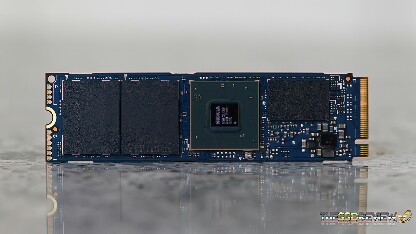
Released in mid-2021, the ADATA XPG Gammix S70 Blade 1 TB targets gamers, PS5 owners, and content creators who want sub-millisecond load times without paying current-generation PCIe 5.0 prices. At its heart sits Innogrit’s IG5236 “Rainier” controller — an 8-channel PCIe 4.0 design that pushes the bus close to its theoretical 8 GB/s ceiling — paired with Micron’s 176-layer B47R 3D TLC NAND (four 256 GB packages on the 1 TB SKU) and two 512 MB Samsung DDR4 chips for a full 1 GB of dedicated DRAM cache. The PCB is single-sided M.2 2280, which is the practical reason this drive landed on every PS5 compatibility list in 2021, and the same reason it slots cleanly into thin laptops where double-sided drives fail to clear the chassis.
The “Blade” branding distinguishes this SKU from the original S70, which shipped with a thicker integrated heatsink — same controller and NAND family, different cooling story. ADATA sells the Blade both bare and with a thin adhesive heatsink (the AGAMMIXS70B-1T-CS variant), the latter sized specifically to fit under the PS5’s expansion slot cover. The series is offered in 512 GB, 1 TB, 2 TB and 4 TB capacities; smaller capacities give up some sequential write headroom and TBW, while the larger ones add cache depth without a meaningful change in rated peak speed.
In its tier, the S70 Blade lands squarely against the Samsung 980 Pro and WD Black SN850 — both 7,000 MB/s rated drives with smaller (600 TBW) endurance budgets at this capacity. Against the Sabrent Rocket 4 Plus and Kingston KC3000 (some of whose SKUs share the same IG5236 controller), the Blade trades places: typically a slight edge on sustained sequentials, near parity on random I/O. Today, with PCIe 5.0 drives like the Crucial T705 and Samsung 9100 Pro available, the S70 Blade reads as a mature mid-tier choice rather than a flagship — which is reflected in current street pricing.
Storage Comparisons:
XPG Gammix S70 Blade Performance & Benchmarks
Rated sequential performance is 7,400 MB/s read and 6,400 MB/s write — figures that independent reviewers consistently reproduce in CrystalDiskMark and ATTO when the drive is adequately cooled. Random I/O is rated at 650,000 read and 740,000 write IOPS, which translates to snappy small-file access for OS duties, application launches, and the project-file workloads typical of game development or large code repositories.
ADATA XPG Gammix S70 Blade 1 TB vs M.2 4.0 x 4 peers
Switch between sequential throughput and random IOPS to see how this drive stacks up against other M.2 4.0 x 4 SSDs in our database. The highlighted bar is the drive on this page — click any other bar to open that drive.
- Patriot Viper PV593 1 TB: 14,500 MB/s read, 14,000 MB/s write
- Patriot Viper PV593 2 TB: 14,500 MB/s read, 14,000 MB/s write
- Patriot Viper PV593 4 TB: 14,500 MB/s read, 14,000 MB/s write
- Patriot Viper PV573 2 TB: 14,000 MB/s read, 12,000 MB/s write
- ADATA XPG Gammix S70 Blade 1 TB (this drive): 7,400 MB/s read, 6,400 MB/s write
What the rated numbers don’t show is what happens past the SLC cache. The S70 Blade uses a dynamic SLC cache that compresses several gigabytes of TLC into pseudo-SLC for burst writes; once it fills (typically after 100–200 GB of continuous writes on the 1 TB variant), sustained write speed drops to direct-to-TLC levels in the 1,500–2,000 MB/s range. For a boot drive, a game library, or general content work this almost never matters. For uncompressed 4K capture, large dataset ingest, or daily 200 GB+ transfers, it is worth knowing.
Thermals are the other practical caveat. With the supplied adhesive heatsink the drive runs comfortably under 65°C in a typical desktop, and the PS5’s slot cover provides enough additional dissipation that thermal throttling is rare in console use — Sony’s own storage benchmark records the drive at around 6,400 MB/s, well above the console’s 5,500 MB/s recommendation. Bare in a hot laptop, or in a poorly ventilated motherboard M.2 slot, expect the controller to throttle on sustained workloads; adding even a budget passive heatsink resolves it. For gaming specifically, the gap between this drive and faster PCIe 5.0 alternatives is undetectable: most modern titles bottleneck on engine asset processing rather than NVMe throughput.
ADATA XPG Gammix S70 Blade vs Competitors
See how the XPG Gammix S70 Blade stacks up against other M.2 4.0 x 4 drives in our database:
Compare with rival drives:
Endurance, TBW & Warranty
ADATA covers the 1 TB S70 Blade with a 5-year limited warranty, bounded by 740 TBW of writes — whichever comes first. That TBW figure is roughly 25% higher than what the Samsung 980 Pro and WD Black SN850 offer at the same capacity, and translates to about 405 GB of writes per day across the full five years — well beyond anything a consumer workload approaches. At a more typical 30 GB/day write pattern, the drive would take roughly 67 years to exhaust its TBW budget, long after the controller or NAND would have aged out for other reasons.
The drive is also rated at 2 million hours MTBF, which is a population-reliability statistic for batch testing, not a per-unit lifespan promise. Warranty service is handled through ADATA’s RMA portal directly rather than through the retailer after the standard return window has elapsed — keep proof of purchase for the full coverage period.
ADATA XPG Gammix S70 Blade 1 TB Specifications
| Category | Value |
|---|---|
| Capacity [?] | 1 TB |
| Interface [?] | M.2 4.0 x 4 |
| Controller [?] | Innogrit Rainer IG5236 |
| Memory type [?] | Micron 3D TLC |
| DRAM [?] | SLC Caching and DRAM cache buffer |
| Read speed (MB/s) [?] | 7400 |
| Write speed (MB/s) [?] | 6400 |
| Read IOPS [?] | 650000 |
| Write IOPS [?] | 740000 |
| Endurance (TBW) [?] | 740 |
| MTBF (million hours) [?] | 2 |
| Warranty (years) [?] | 5 |
Verdict: Is the XPG Gammix S70 Blade Worth It in 2026?
The ADATA XPG Gammix S70 Blade 1 TB remains a smart buy in 2026 for someone upgrading a PS5, building a midrange PCIe 4.0 desktop, or specifically needing a single-sided 1 TB drive for a thin laptop. Its mix of PCIe 4.0 throughput, generous 740 TBW endurance, a proper 1 GB DRAM cache, and a PS5-friendly form factor still earns its place at the mid-tier price band. Skip it if you are building a current-generation enthusiast desktop where PCIe 5.0 drives like the Crucial T705 or Samsung 9100 Pro are within budget — their raw read advantage is real in synthetic benchmarks even if invisible during gaming. The closest direct alternative remains the WD Black SN850X, which trades slightly lower TBW for a marginally better random-write profile. Within the PCIe 4.0 tier, however, the S70 Blade is one of the cleanest no-compromise picks of its generation.
+ Pros
- Innogrit IG5236 controller hits 7,400 MB/s sequential reads
- 740 TBW endurance, ~25% above tier average
- Full 1 GB Samsung DDR4 DRAM cache on the 1 TB SKU
- Single-sided M.2 2280 PCB fits PS5 and thin laptops
- 176-layer Micron TLC NAND, not QLC
- 5-year warranty serviced direct via ADATA RMA
- Cons
- Bare SKU ships without a heatsink for desktop installs
- SLC burst cache exhausts after ~150 GB of sustained writes
- PCIe 4.0 platform — PCIe 5.0 drives now lead synthetic benchmarks
- ADATA SSD Toolbox software less polished than Samsung Magician
- 2021 controller design — newer competitors edge it on random IOPS
Buy this or similar SSD Storage:



Video Review
XPG GAMMIX S70 PCIe Gen4x4 M.2 2280 SSD Review