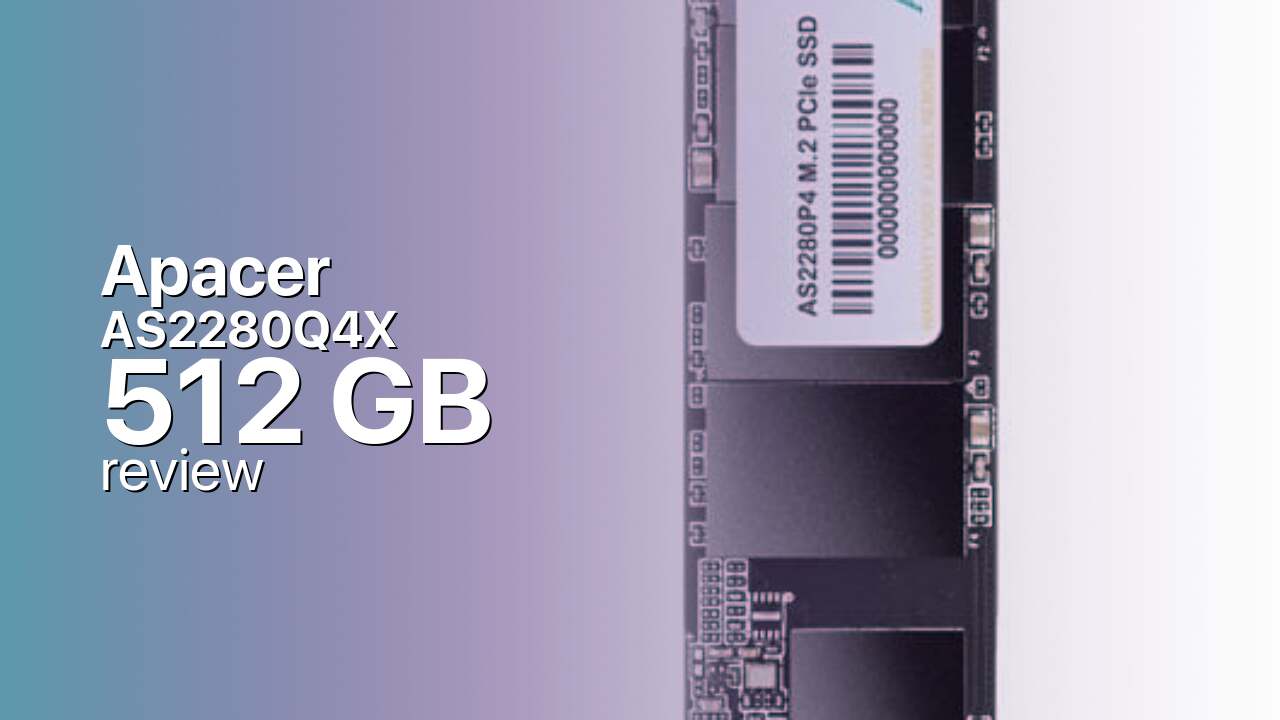
Apacer AS2280Q4X 512 GB: A Budget Gen4 Drive With a Heat Spreader (2026)
Quick answer
The Apacer AS2280Q4X 512 GB is a competent budget Gen4 drive that delivers the essentials, 5,000 MB/s reads, 750,000 IOPS, YMTC 232-layer TLC, and a bundled graphene heat spreader, at a price that fits a boot-and-apps or budget-gaming build.
Read: 5000 MB/s Write: 4400 MB/s Endurance: 300 TBW Warranty: 3 years Interface: M.2 4.0 x 4
The Apacer AS2280Q4X 512 GB is a mainstream DRAM-less PCIe 4.0 drive on Maxio's MAP1602A and YMTC 232L TLC, rated at 5,000 MB/s reads with 750,000 IOPS and a bundled heat spreader.
Controller & Memory
The Apacer AS2280Q4X 512 GB runs the MaxioTech MAP1602A Falcon Lite controller, a 12 nm DRAM-less PCIe 4.0 design built on a 32-bit ARM core, paired with YMTC 232-layer 3D TLC NAND. It borrows system memory through Host Memory Buffer for the flash translation layer rather than carrying a discrete DRAM chip, the standard architecture for drives in this speed and price band. Apacer rates the drive at 5,000 MB/s sequential reads and 4,400 MB/s sequential writes over PCIe 4.0 x4, with up to 750,000 random read and write IOPS, and it ships with a graphene heat spreader applied as a free accessory to keep the controller cool under load.
The AS2280Q4X line spans 512 GB, 1 TB, 2 TB, and 4 TB on the same MAP1602A controller and YMTC 232L TLC, all carrying the same 5,000 MB/s read and 4,400 MB/s write ceiling and the same three-year warranty. Endurance scales with capacity, 300 TBW on the 512 GB reviewed here, 600 TBW on the 1 TB, and 1,200 TBW on both the 2 TB and 4 TB, per Apacer's official ratings. The 512 GB is the entry point, suited to a boot-and-apps role where budget matters more than capacity, and it reaches the same peak read speed and IOPS as the larger models. eNOS Tech's review of the 2 TB model confirmed the MAP1602A platform, the YMTC 232-layer TLC, and the graphene heat-spreader accessory, characterising the drive as a solid budget Gen4 option.
Positioned against other DRAM-less Gen4 drives, the AS2280Q4X sits alongside MAP1602 designs like the Addlink S93 and the Team Group MP44, all sharing the same architectural envelope of roughly 5,000 to 7,400 MB/s reads, HMB architecture, and YMTC or comparable TLC. The AS2280Q4X's distinguishing features are the included graphene heat spreader, which most bare drives in this tier omit, and Apacer's brand backing. Its trade-offs are the modest 5,000 MB/s ceiling, which trails the 7,000 MB/s-plus flagship Gen4 drives, the DRAM-less HMB architecture that raises sustained random-write latency, and the three-year warranty that is shorter than the five-year coverage common on higher-end drives. For a budget gaming build or a laptop boot drive, the 512 GB covers the role at a competitive price.
Storage Comparisons:
AS2280Q4X Performance & Benchmarks
Apacer rates the AS2280Q4X 512 GB at 5,000 MB/s sequential reads and 4,400 MB/s sequential writes over PCIe 4.0 x4, with up to 750,000 random read and 750,000 random write IOPS. The MaxioTech MAP1602A Falcon Lite is a 12 nm DRAM-less controller on a 32-bit ARM core, the same class of proven budget-Gen4 silicon that powers a wide range of YMTC-based drives, and eNOS Tech's review of the 2 TB model confirmed the platform.
Apacer AS2280Q4X 512 GB vs M.2 4.0 x 4 peers
Switch between sequential throughput and random IOPS to see how this drive stacks up against other M.2 4.0 x 4 SSDs in our database. The highlighted bar is the drive on this page — click any other bar to open that drive.
- Patriot Viper PV593 1 TB: 14,500 MB/s read, 14,000 MB/s write
- Patriot Viper PV593 2 TB: 14,500 MB/s read, 14,000 MB/s write
- Patriot Viper PV593 4 TB: 14,500 MB/s read, 14,000 MB/s write
- Patriot Viper PV573 2 TB: 14,000 MB/s read, 12,000 MB/s write
- Apacer AS2280Q4X 512 GB (this drive): 5,000 MB/s read, 4,400 MB/s write
For everyday workloads, operating system boots, application launches, and game loads, the 5,000 MB/s read speed is comfortably above the threshold where storage stops being the bottleneck on game loading, which happens once reads exceed roughly 5,500 MB/s on the most demanding titles and the CPU takes over. The 750,000 random IOPS rating is healthy for a budget drive and keeps small-file operations responsive. As a DRAM-less HMB design, the AS2280Q4X shows higher 4K random write latency under heavy sustained mixed workloads than drives with discrete DRAM, such as the Samsung 980 Pro or the Phison E18-based Anacomda i4-X, but those are pricier drives in a higher tier. The graphene heat spreader helps the controller sustain performance under load by drawing heat away from the MAP1602A, a meaningful inclusion for a budget drive where thermal throttling can otherwise cap sustained throughput. For the boot-and-apps role the 512 GB is built for, the performance envelope is well-matched.
Apacer AS2280Q4X vs Competitors
See how the AS2280Q4X stacks up against other M.2 4.0 x 4 drives in our database:
Compare with rival drives:
Endurance, TBW & Warranty
Apacer covers the AS2280Q4X 512 GB with a three-year limited warranty, terminated at whichever arrives first between the term and the drive's 300 TBW endurance rating. That 300 TBW figure, from Apacer's official ratings, is typical for a 512 GB budget TLC drive and matches what the segment's direct competitors carry at this capacity. Endurance scales with capacity across the line, 600 TBW on the 1 TB and 1,200 TBW on both the 2 TB and 4 TB, all under the same three-year term. At a typical consumer write load of 20 GB per day, the 512 GB's 300 TBW rating translates to roughly 41 years before the write budget is exhausted, so the three-year warranty term expires long before the NAND approaches its rated limit. The trade-off versus higher-end drives is the warranty length itself, five-year coverage is common on flagship Gen4 drives and on reliability-focused lines like Apacer's own PB4480-R NAS SSD. The 300 TBW headroom is genuine but modest, so buyers running heavy sustained write workloads such as video capture or large media transfers should consider stepping up to the 1 TB or 2 TB for their higher endurance rather than relying on the 512 GB's smaller write budget.
Apacer AS2280Q4X 512 GB Specifications
| Category | Value |
|---|---|
| Capacity [?] | 512 GB |
| Interface [?] | M.2 4.0 x 4 |
| Controller [?] | MaxioTech MAP1602A Falcon Lite |
| Memory type [?] | YMTC 2326-L TLC |
| DRAM [?] | No |
| Read speed (MB/s) [?] | 5000 |
| Write speed (MB/s) [?] | 4400 |
| Read IOPS [?] | 750000 |
| Write IOPS [?] | 750000 |
| Endurance (TBW) [?] | 300 |
| MTBF (million hours) [?] | 2000000 |
| Warranty (years) [?] | 3 |
Verdict: Is the AS2280Q4X Worth It in 2026?
The Apacer AS2280Q4X 512 GB is a competent budget Gen4 drive that delivers the essentials, 5,000 MB/s reads, 750,000 IOPS, YMTC 232-layer TLC, and a bundled graphene heat spreader, at a price that fits a boot-and-apps or budget-gaming build. Its MAP1602A DRAM-less platform is proven and well-matched to everyday workloads, and the included heat spreader is a real differentiator against bare drives in this tier. The trade-offs are clear and consistent with the price: a 5,000 MB/s ceiling that trails flagship Gen4 drives, a DRAM-less HMB architecture that raises sustained random-write latency, a 300 TBW endurance rating that is modest, and a three-year warranty that is shorter than the five-year coverage on higher-end drives. For a laptop boot drive, a budget gaming rig, or a secondary application volume, the 512 GB covers the role well. Buyers who need more capacity or write headroom should step up to the 1 TB or 2 TB AS2280Q4X, and buyers who need flagship Gen4 throughput or discrete-DRAM consistency should look at the Anacomda i4-X or Samsung 980 Pro instead.
+ Pros
- MAP1602A Falcon Lite, a proven budget-Gen4 DRAM-less platform
- YMTC 232-layer 3D TLC NAND
- Graphene heat spreader included to aid sustained performance
- 750,000 random read IOPS, healthy for the price tier
- Backed by Apacer, an established memory brand
- Cons
- 5,000 MB/s reads trail flagship Gen4 drives significantly
- DRAM-less HMB design raises sustained random write latency
- Three-year warranty, shorter than five-year flagship coverage
- 300 TBW endurance is modest for heavy write workloads
- 512 GB fills quickly for modern game libraries
Buy this or similar SSD Storage:



Video Review
Fast Inexpensive NVMe Drive - Apacer AS2280P4 M.2 PCIeTM Gen3 x4 SSD