Crucial P3 Plus 4 TB Review — PCIe 4.0 QLC NVMe SSD (2026)
Quick answer
The Crucial P3 Plus 4 TB earns its place if you want a cheap, single-M.2 path to four terabytes of PCIe 4.0 NVMe storage and the drive\xe2\x80\x99s job is bulk reads \xe2\x80\x94 game libraries, media caches, secondary archives, project footage you pull from more than you push to.
Read: 4800 MB/s Write: 4100 MB/s Endurance: 800 TBW Warranty: 5 years Interface: M.2 4.0 x 4
The Crucial P3 Plus 4 TB is one of the cheapest single-M.2 paths to four terabytes of PCIe 4.0 NVMe storage, built on Micron QLC and aimed squarely at bulk game and media libraries.
Controller & Memory
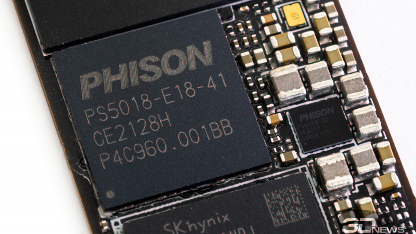
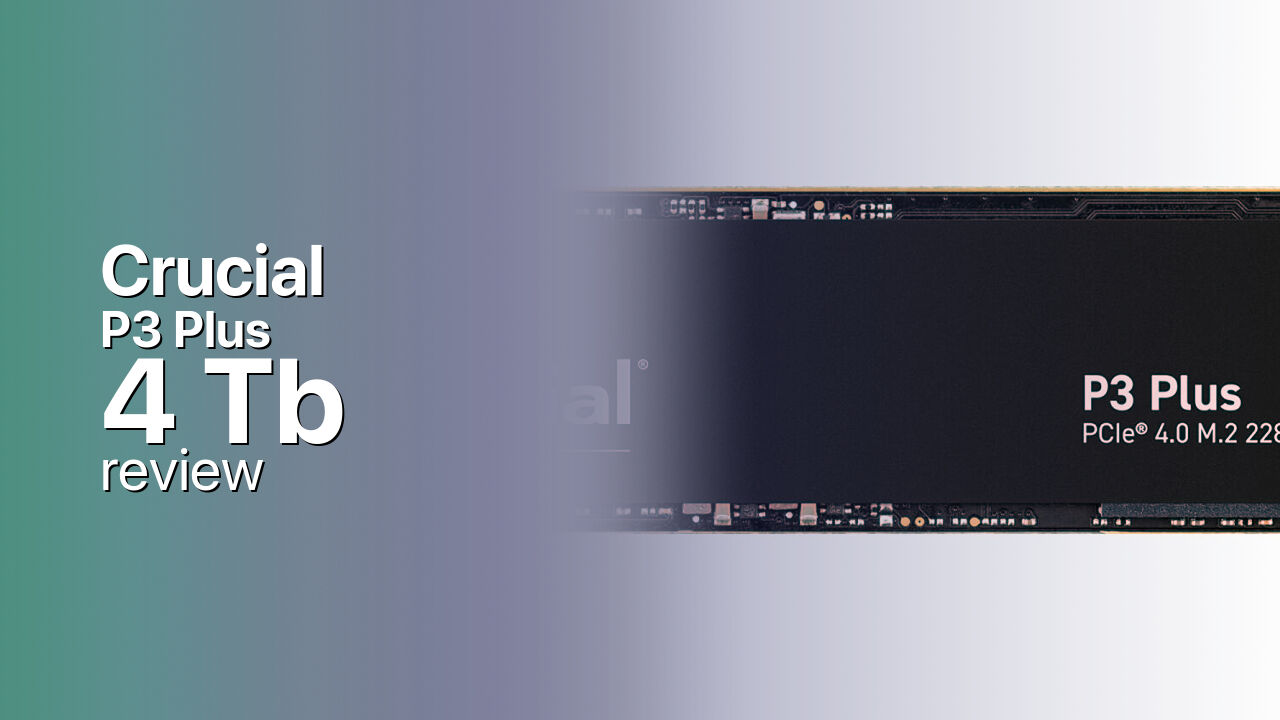
The Crucial P3 Plus 4 TB is Micron’s value-tier PCIe 4.0 NVMe drive, built around the Phison E21T — a four-channel DRAM-less controller — with Micron’s 176-layer 3D QLC NAND across both faces of a double-sided M.2 2280 PCB. There is no on-board DDR DRAM; the controller leans on Host Memory Buffer (HMB) to borrow a small slice of system RAM for the flash-translation-layer map. That combination is what keeps the P3 Plus 4 TB at its price point, and it is also the part that sets the ceiling on what the drive can do under load.
The family runs 500 GB, 1 TB, 2 TB and 4 TB; at 4 TB this is the headline volume-storage SKU, and the one where Crucial’s positioning makes the most sense. Direct rivals at the capacity and tier are the WD Blue SN580 4 TB (TLC, slightly higher sustained writes), the Sabrent Rocket Q 4 TB (QLC, PCIe 3.0 but with DRAM and 940 TBW), the Samsung 990 EVO 4 TB (TLC, hybrid Gen 4 / Gen 5 interface), and Crucial’s own P3 4 TB (PCIe 3.0 sibling at lower speeds). The P3 Plus’s case is Gen 4 sequential numbers at the price most rivals charge for Gen 3 QLC; its weakness is the same as every DRAM-less QLC drive — sustained writes drop sharply once the SLC cache fills.
The target audience for the 4 TB capacity is well-defined: a Steam library, a Plex / Jellyfin media cache, a creator’s footage archive, or a bulk secondary drive in a Gen 4 desktop. It is not the right pick for a single-drive build where the same disk has to host OS, projects, and frequent multi-hundred-gigabyte transfers — a TLC drive like the Lexar NM790 or WD Blue SN580 is better for that. The double-sided PCB also rules it out for a PS5 expansion slot.
Storage Comparisons:
P3 Plus Performance & Benchmarks
Crucial rates the P3 Plus 4 TB at up to 4,800 MB/s sequential reads and 4,100 MB/s sequential writes on a PCIe 4.0 x4 link, with random IOPS of up to 680,000 reads and 800,000 writes. Those numbers are roughly 70 to 80 percent of a full Gen 4 ceiling and well above any PCIe 3.0 drive, so on a Gen 4 platform you will feel a real-world difference compared to a Rocket Q 4 TB or a SATA QLC archive, especially on game launches and large sequential reads.
Crucial P3 Plus 4 TB vs M.2 4.0 x 4 peers
Switch between sequential throughput and random IOPS to see how this drive stacks up against other M.2 4.0 x 4 SSDs in our database. The highlighted bar is the drive on this page — click any other bar to open that drive.
- Patriot Viper PV593 1 TB: 14,500 MB/s read, 14,000 MB/s write
- Patriot Viper PV593 2 TB: 14,500 MB/s read, 14,000 MB/s write
- Patriot Viper PV593 4 TB: 14,500 MB/s read, 14,000 MB/s write
- Patriot Viper PV573 2 TB: 14,000 MB/s read, 12,000 MB/s write
- Crucial P3 Plus 4 TB (this drive): 4,800 MB/s read, 4,100 MB/s write
The practical experience is dominated by SLC cache behaviour. The P3 Plus carves a large dynamic SLC cache out of the QLC NAND, so the first tens to low hundreds of gigabytes of a copy run near the rated 4,100 MB/s ceiling; once that cache fills, independent reviewers consistently find sustained writes drop into the low hundreds of MB/s on the 4 TB variant — the floor of Micron 176-layer QLC in direct mode. For boot, OS, gaming, and Steam-library use that drop is invisible, because contiguous writes that large simply do not happen. For video editors dumping multi-hundred-gigabyte project files onto the P3 Plus 4 TB in one continuous pour, the post-cache slowdown is the most important number on the page and a TLC drive is the better choice.
Crucial P3 Plus vs Competitors
See how the P3 Plus stacks up against other M.2 4.0 x 4 drives in our database:
Compare with rival drives:
Endurance, TBW & Warranty
Crucial rates the P3 Plus 4 TB at 800 TBW (terabytes written) over a 5-year limited warranty, whichever limit is reached first. That is the highest endurance figure in the P3 Plus lineup and corresponds to roughly 440 GB of host writes every day for the full five-year period \xe2\x80\x94 well beyond what an ordinary desktop or laptop user generates, even with the drive in active use as a Steam library scratch disk. At a more realistic 30 GB/day workload the rated endurance corresponds to over 70 years of nominal life before the counter is exhausted. The published MTTF figure is 1.5 million hours, which is a statistical population metric rather than a guaranteed lifespan for any individual drive. Warranty service is handled directly via Crucial RMA with proof of purchase, and Crucial\xe2\x80\x99s Storage Executive utility provides SMART monitoring and firmware updates on Windows.
Crucial P3 Plus 4 TB Specifications
| Category | Value |
|---|---|
| Capacity [?] | 4 TB |
| Interface [?] | M.2 4.0 x 4 |
| Controller [?] | Phison E21T |
| Memory type [?] | Micron QLC |
| DRAM [?] | (HMB) |
| Read speed (MB/s) [?] | 4800 |
| Write speed (MB/s) [?] | 4100 |
| Read IOPS [?] | 680000 |
| Write IOPS [?] | 800000 |
| Endurance (TBW) [?] | 800 |
| MTBF (million hours) [?] | 1.5 |
| Warranty (years) [?] | 5 |
Verdict: Is the P3 Plus Worth It in 2026?
The Crucial P3 Plus 4 TB earns its place if you want a cheap, single-M.2 path to four terabytes of PCIe 4.0 NVMe storage and the drive\xe2\x80\x99s job is bulk reads \xe2\x80\x94 game libraries, media caches, secondary archives, project footage you pull from more than you push to. Skip it if you write hundreds of gigabytes contiguously every day, because the DRAM-less QLC combination drops sharply after the SLC cache fills and a TLC drive like the WD Blue SN580 4 TB or Lexar NM790 4 TB is the more consistent tool. The closer alternative on a budget is the WD Blue SN580 4 TB, which has TLC NAND, similar sequential numbers, and steadier sustained writes for similar money; the Samsung 990 EVO 4 TB is the cleaner step-up. As a Gen 4 bulk-storage workhorse, the P3 Plus 4 TB is one of the cheapest credible options on the market.
+ Pros
- 4,800 MB/s sequential reads on PCIe 4.0
- 800 TBW endurance with 5-year warranty
- 4 TB single-M.2 capacity at a budget price
- Phison E21T runs cool without a heatsink
- Micron 176-layer QLC with large SLC cache
- Crucial Storage Executive utility included
- Cons
- DRAM-less HMB design limits mixed workloads
- Sustained writes drop sharply after SLC cache
- Double-sided PCB blocks PS5 expansion slot
- 4,100 MB/s writes trail TLC Gen 4 rivals
- No bundled heatsink in retail box
Buy this or similar SSD Storage:



Video Review
Fuel your system with GEN4 performance! Introducing the brand new Crucial P3 & P3 Plus SSD range!