Galax HOF 50 1TB PCIe 5.0 NVMe SSD Review (2026)
Quick answer
The Galax HOF 50 1 TB is a genuine PCIe 5.0 drive on the proven Phison E26 plus Micron 232-layer TLC platform, backed by a five-year warranty and the enthusiast pedigree of the Hall of Fame line.
Read: 9500 MB/s Write: 8500 MB/s Endurance: 700 TBW Warranty: 5 years Interface: M.2 5.0
The Galax HOF 50 1 TB is the smaller capacity of Galax's Hall of Fame PCIe 5.0 lineup, pairing a Phison E26 controller with Micron 232-layer TLC for around 9,500 MB/s sequential reads.
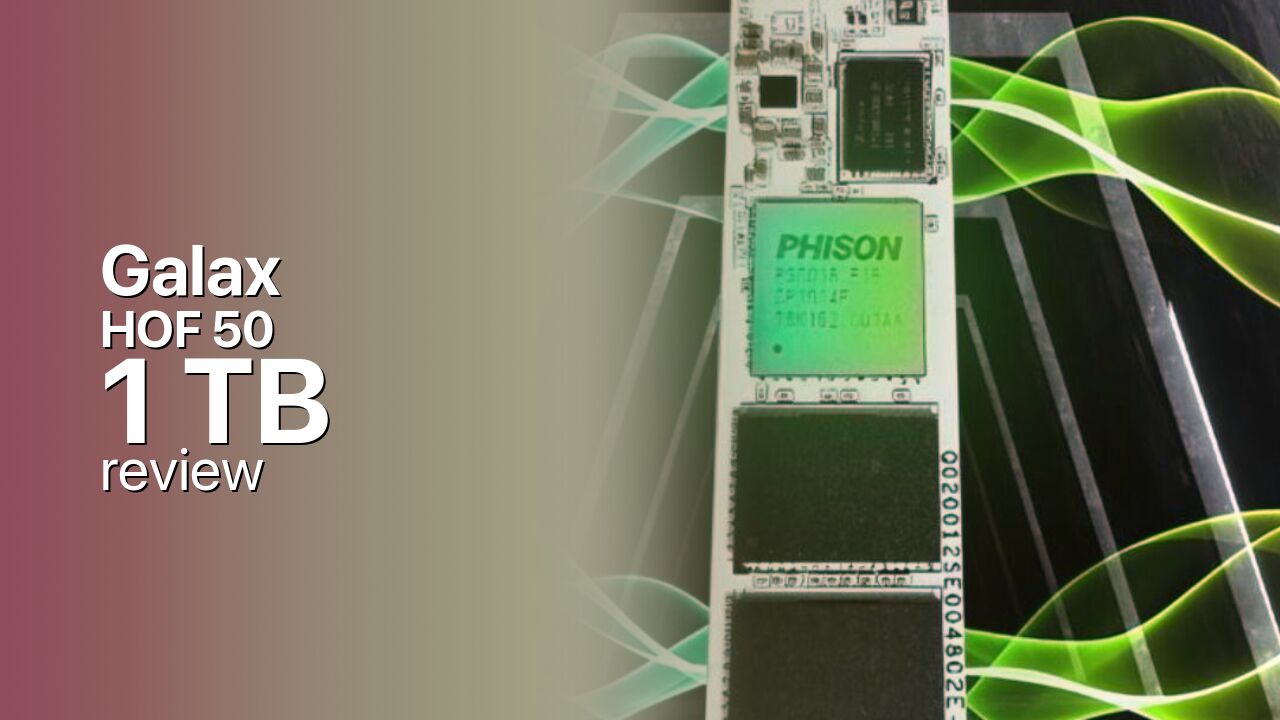
Controller & Memory
The Galax HOF 50 is the Hall of Fame line's PCIe 5.0 entry, built on the Phison PS5026-E26 8-channel controller that defined the first generation of consumer Gen5 drives. The 1 TB model reviewed here is the smaller of the two HOF 50 capacities, which also include a 2 TB flagship, and it pairs the E26 controller with Micron 232-layer TLC NAND and a DRAM cache. The Hall of Fame badge is Galax's premium tier, with a heritage in overclocking and enthusiast hardware, and the HOF 50 carries that positioning into the Gen5 era.
The important nuance on the 1 TB is that it is the slower of the two capacities. The 2 TB flagship reaches the lineup's headline sequential figures, while the 1 TB, with fewer NAND die in parallel, is rated lower. Treat the 1 TB's roughly 9,500 MB/s sequential read and 8,500 MB/s sequential write as the smaller-capacity figures rather than the full Gen5 headline. The platform underneath is shared: Phison E26, Micron 232-layer TLC, a DRAM cache, around 1.5 million random read and 1.2 million random write IOPS, and a five-year warranty. GALAX's published endurance figure for the HOF 50 lineup is 1.4 PBW, which implies roughly 700 TBW for the 1 TB, though a firm capacity-specific rating is not widely published.
As a Hall of Fame product the HOF 50 competes with other flagship PCIe 5.0 E26 drives like the Crucial T705, the WD Black SN8100 and the Seagate FireCuda 540, all sharing the same basic Phison E26 platform. Galax's HOF branding is strongest in the Asian market and among enthusiasts, and outside those regions the drive is harder to find and carries a thinner support footprint than the major global brands. For buyers who can source it, the 1 TB is a genuine Gen5 drive on proven hardware, with the usual note that smaller Gen5 capacities give up some peak speed to the larger flagships.
Storage Comparisons:
HOF 50 Performance & Benchmarks
The Galax HOF 50 1 TB is rated at roughly 9,500 MB/s sequential read and 8,500 MB/s sequential write, with around 1,500,000 random read and 1,200,000 random write IOPS. Those are strong PCIe 5.0 figures, though the 1 TB sits below the lineup's 2 TB flagship, which reaches the headline Gen5 sequential throughput thanks to more NAND die in parallel. This capacity-versus-speed trade-off is normal for Gen5: the smaller variant gives up some peak bandwidth to the larger one. In day-to-day use the 1 TB still delivers a clear step up over PCIe 4.0 for large-file transfers, game library moves and DirectStorage-enabled workloads, while for ordinary booting and browsing the gap to a good Gen4 drive is smaller than the raw numbers suggest.
Galax HOF 50 1 TB vs M.2 5.0 peers
Switch between sequential throughput and random IOPS to see how this drive stacks up against other M.2 5.0 SSDs in our database. The highlighted bar is the drive on this page — click any other bar to open that drive.
- Corsair MP700 Pro XT 1 TB: 14,900 MB/s read, 14,200 MB/s write
- Corsair MP700 Pro XT 2 TB: 14,900 MB/s read, 14,500 MB/s write
- Corsair MP700 Pro XT 4 TB: 14,900 MB/s read, 14,400 MB/s write
- Crucial T710 1 TB: 14,900 MB/s read, 13,800 MB/s write
- Galax HOF 50 1 TB (this drive): 9,500 MB/s read, 8,500 MB/s write
Gen5 earns its keep in sustained throughput and high-queue-depth random performance, where the Phison E26 platform and its roughly 1.5 million random read IOPS hold up well. The E26 is a proven, DRAM-based design, so sustained behaviour is predictable rather than collapse-prone. Independent reviews of the HOF 50 family are relatively scarce compared with major-brand Gen5 drives, so buyers should treat the smaller-capacity speed figures as representative of the platform rather than independently stress-tested for this exact SKU. For an enthusiast build on a PCIe 5.0 platform, the 1 TB delivers genuine Gen5 performance with the expected capacity caveat.
Galax HOF 50 vs Competitors
See how the HOF 50 stacks up against other M.2 5.0 drives in our database:
Compare with rival drives:
Endurance, TBW & Warranty
Galax backs the HOF 50 with a five-year limited warranty, which matches other flagship PCIe 5.0 drives. GALAX's published endurance figure for the HOF 50 lineup is 1.4 PBW (petabytes written); for the 1 TB capacity this implies roughly 700 TBW (terabytes written), though a firm capacity-specific rating is not widely published and should be treated as a platform-derived estimate. Even at a conservative 700 TBW, that works out to roughly 383 GB of writes every day for five years, far beyond a typical 20 to 50 GB daily consumer workload, so the NAND outlasts the warranty term by a wide margin and wear is not a realistic concern for gaming or everyday use. The five-year term is the binding limit. As Galax's HOF line is strongest in the Asian market and enthusiast channels, buyers outside those regions should confirm local warranty and RMA support before purchase and keep proof of purchase. For a Gen5 drive on proven TLC-plus-DRAM hardware, the five-year cover is reassuring.
Galax HOF 50 1 TB Specifications
| Category | Value |
|---|---|
| Capacity [?] | 1 TB |
| Interface [?] | M.2 5.0 |
| Controller [?] | Phison PS5026-E26 8 Channel |
| Memory type [?] | Micron 232L TLC |
| DRAM [?] | Yes |
| Read speed (MB/s) [?] | 9500 |
| Write speed (MB/s) [?] | 8500 |
| Read IOPS [?] | 1500000 |
| Write IOPS [?] | 1200000 |
| Endurance (TBW) [?] | 700 |
| MTBF (million hours) [?] | 2000000 |
| Warranty (years) [?] | 5 |
Verdict: Is the HOF 50 Worth It in 2026?
The Galax HOF 50 1 TB is a genuine PCIe 5.0 drive on the proven Phison E26 plus Micron 232-layer TLC platform, backed by a five-year warranty and the enthusiast pedigree of the Hall of Fame line. Its strengths are real Gen5 performance, a DRAM cache and premium branding. Its caveats are that the 1 TB is the slower capacity, giving up peak speed to the 2 TB flagship, that GALAX's HOF line is niche outside the Asian market with a thinner support footprint, and that independent reviews of this exact SKU are scarce. It suits enthusiasts who want the HOF branding and can source it locally; most buyers are better served by a widely available E26 flagship like the Crucial T705 or WD Black SN8100, or by the 2 TB HOF 50 if they want the lineup's full headline speed.
+ Pros
- PCIe 5.0 Phison E26 platform with Micron 232L TLC
- Around 9,500 MB/s sequential read on the 1 TB
- Up to 1,500,000 random read IOPS
- DRAM cache for sustained performance
- Hall of Fame premium enthusiast branding
- 5-year warranty
- Cons
- 1 TB is slower than the 2 TB flagship capacity
- GALAX HOF line is niche outside the Asian market
- Thinner support footprint than major global brands
- Needs a PCIe 5.0 platform to justify the speed
Buy this or similar SSD Storage:



Video Review
Rtx 4090 Vs Rtx 5090 #benchmark #rtx5090 #rtx4090 #vs #pcbuild #pcgamer #funny #fpsgames #rtx5080