GOODRAM IRDM Pro Gen 5 1TB PCIe 5.0 NVMe Review (2026)
Quick answer
The GOODRAM IRDM Pro Gen 5 1 TB is the right pick for a buyer on a PCIe 5.0-capable desktop who wants Gen5 sequential reads without paying for the 2 TB flagship, and who is comfortable adding their own M.2 heatsink.
Read: 11500 MB/s Write: 9000 MB/s Endurance: 700 TBW Warranty: 5 years Interface: M.2 5.0
The GOODRAM IRDM Pro Gen 5 1 TB is the entry capacity of Wilk Elektronik's PCIe 5.0 line, pairing Phison's E26 with Micron 232-layer TLC for 11,500 MB/s reads and a 5-year warranty.
Controller & Memory
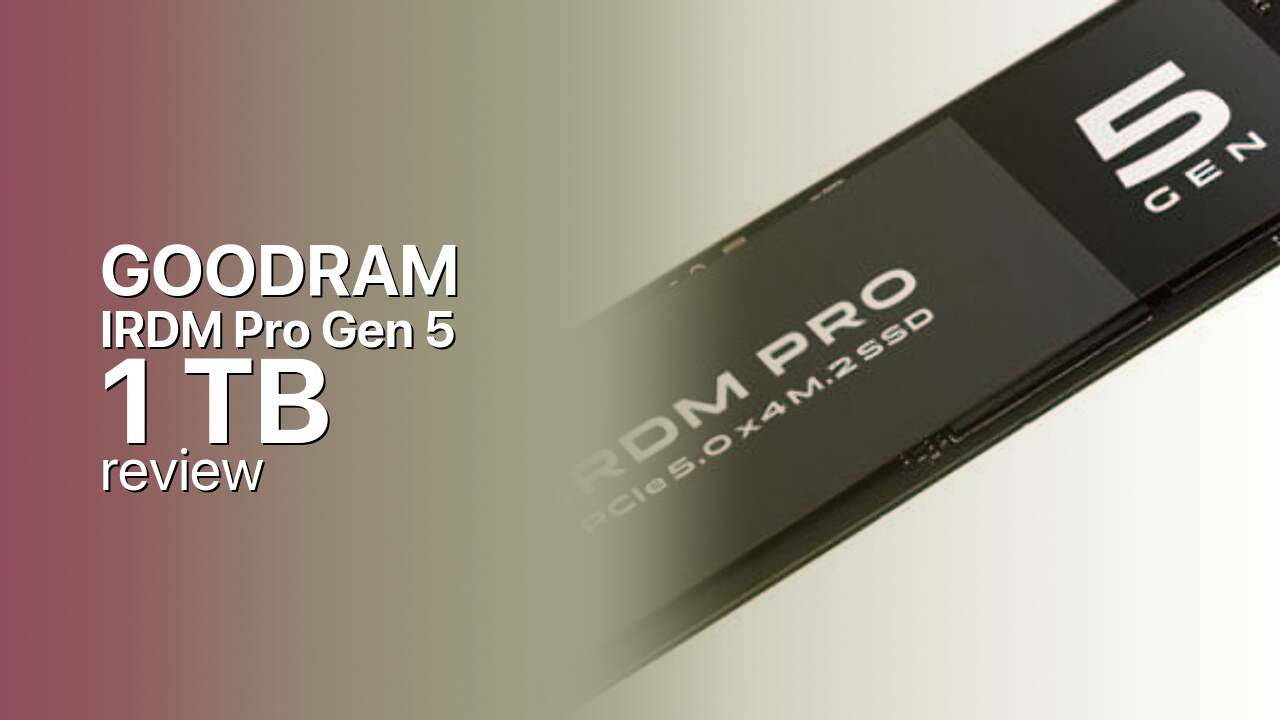
The IRDM Pro Gen 5 1 TB is the smallest of three capacities GOODRAM offers on this platform (the 2 TB and 4 TB variants use the same controller and NAND but post higher write speeds), and it is the one most buyers will weigh against a high-end PCIe 4.0 drive rather than against a 14,000 MB/s flagship. Inside is a familiar Gen5 recipe: Phison's PS5026-E26 controller, an eight-channel 5-core part fabricated on TSMC's 12 nm process, paired with Micron B58R 232-layer TLC running at 2,400 MT/s. A 2 GB LPDDR4 DRAM buffer handles the mapping table, and a pseudo-SLC cache absorbs short write bursts before the drive flushes to native TLC. GOODRAM ships the module as a double-sided M.2 2280 stick with its Graphreeze graphene coating doing the thermal work instead of a metal heatsink.
Because this is the 1 TB capacity, the rated sequential numbers sit below the 2 TB and 4 TB siblings: GOODRAM quotes 11,500 MB/s sequential read and 9,000 MB/s sequential write on the 1 TB, against 12,000 / 11,000 MB/s on the larger capacities. Random performance lands at up to 1,300,000 read IOPS and 1,400,000 write IOPS. Those are still comfortably ahead of any PCIe 4.0 part, but the write deficit versus the 2 TB is worth noting if your workload is write-heavy. Endurance scales with capacity too: 700 TBW on the 1 TB, against 1,400 TBW on the 2 TB and 3,000 TBW on the 4 TB.
The buyer profile here is straightforward: someone on a PCIe 5.0-capable platform (AMD 600-series or Intel 700-series onward) who wants Gen5 sequential throughput without paying for the 2 TB or 4 TB flagship. Double-sided PCB means it fits standard desktop M.2 slots but is not the right pick for a single-sided-only laptop or a PS5 slot that has a flattening heatsink. GOODRAM does not include a metal heatsink, so plan for either the motherboard's own M.2 cooler or a third-party Gen5 heatsink; the graphene layer helps but is not a substitute for active cooling under sustained writes. Direct rivals worth a look include the Crucial T700 1TB, the Corsair MP700 PRO 1TB, and if you want to step down a generation for value, the Samsung 990 Pro 1TB on PCIe 4.0.
Storage Comparisons:
IRDM Pro Gen 5 Performance & Benchmarks
On the 1 TB capacity GOODRAM rates the IRDM Pro Gen 5 for up to 11,500 MB/s sequential read and 9,000 MB/s sequential write over its PCIe 5.0 x4 link, with random performance quoted at up to 1,300,000 read IOPS and 1,400,000 write IOPS. Those sequential reads are nearly double what the best PCIe 4.0 drives can do, and in practice the gap shows up most clearly when moving large files, loading DirectX 12 game assets through DirectStorage, or working with 4K and 8K video footage on a scratch disk. For day-to-day OS use, browsing, and game loading off a single SSD, the difference between 11,500 MB/s and a 7,400 MB/s PCIe 4.0 drive is real but mostly academic; where Gen5 earns its keep is sustained throughput on large blocks.
GOODRAM IRDM Pro Gen 5 1 TB vs M.2 5.0 peers
Switch between sequential throughput and random IOPS to see how this drive stacks up against other M.2 5.0 SSDs in our database. The highlighted bar is the drive on this page — click any other bar to open that drive.
- Corsair MP700 Pro XT 1 TB: 14,900 MB/s read, 14,200 MB/s write
- Corsair MP700 Pro XT 2 TB: 14,900 MB/s read, 14,500 MB/s write
- Corsair MP700 Pro XT 4 TB: 14,900 MB/s read, 14,400 MB/s write
- Crucial T710 1 TB: 14,900 MB/s read, 13,800 MB/s write
- GOODRAM IRDM Pro Gen 5 1 TB (this drive): 11,500 MB/s read, 9,000 MB/s write
As with every Phison E26 drive, the headline sequential figure is a burst number measured in a fresh-out-of-box state against the pseudo-SLC cache. Once that cache fills (the size varies with free space and is not published by GOODRAM), writes settle to the native TLC rate, which on the 1 TB capacity is meaningfully lower than on the 2 TB and 4 TB parts because there are fewer NAND dies to interleave. That matters for anyone writing hundreds of gigabytes in one go, and it does not matter at all for a boot drive or a games library that mostly hosts reads. Independent reviews of E26 drives on this Micron NAND consistently find the platform hits its rated peak on reads but write behavior is cache-dependent; treat the 9,000 MB/s sequential write as a best-case burst, not a sustained rate.
GOODRAM IRDM Pro Gen 5 vs Competitors
See how the IRDM Pro Gen 5 stacks up against other M.2 5.0 drives in our database:
Compare with rival drives:
Endurance, TBW & Warranty
GOODRAM rates the 1 TB IRDM Pro Gen 5 at 700 TBW (Terabytes Written) over the lifetime of the drive and backs it with a 5-year limited warranty, whichever comes first. The TBW figure is the more relevant constraint for most users: 700 TBW equates to roughly 383 GB of writes every single day for five years, which is well beyond what a typical gaming or OS drive sees. A heavy content-creation workload writing 100 GB a day would still take around 19 years to exhaust the endurance rating, so for the 1 TB capacity the warranty term rather than the TBW is the effective limit. GOODRAM (Wilk Elektronik SA, based in Poland) provides the warranty through its European distribution network; buyers outside the EU should confirm RMA handling with the retailer before purchase. The drive's rated MTBF is 1.6 million hours, a population statistic that describes the expected failure rate across a large fleet rather than a promise that any individual unit will run that long, and it is consistent with what other Phison E26 drives on the same Micron 232-layer NAND report.
GOODRAM IRDM Pro Gen 5 1 TB Specifications
| Category | Value |
|---|---|
| Capacity [?] | 1 TB |
| Interface [?] | M.2 5.0 |
| Controller [?] | Phison PS5026-E26 8 Channel |
| Memory type [?] | Micron 232-L |
| DRAM [?] | Yes |
| Read speed (MB/s) [?] | 11500 |
| Write speed (MB/s) [?] | 9000 |
| Read IOPS [?] | 1300000 |
| Write IOPS [?] | 1400000 |
| Endurance (TBW) [?] | 700 |
| MTBF (million hours) [?] | 1600000 |
| Warranty (years) [?] | 5 |
Verdict: Is the IRDM Pro Gen 5 Worth It in 2026?
The GOODRAM IRDM Pro Gen 5 1 TB is the right pick for a buyer on a PCIe 5.0-capable desktop who wants Gen5 sequential reads without paying for the 2 TB flagship, and who is comfortable adding their own M.2 heatsink. Skip it if your motherboard is PCIe 4.0 only (the drive works but you give up the whole reason to buy Gen5) or if your workload is sustained writes measured in hundreds of gigabytes, where the 2 TB and 4 TB capacities hold their write speed and TBW advantage. The direct alternative is the Crucial T700 1TB, which uses the same Phison E26 platform and posts higher rated write speed at 12,400 MB/s, though it tends to run hotter and needs equally serious cooling. As an EU-built, 5-year-warrantied Gen5 entry point with Micron 232-layer TLC and a graphene heat-spreader, the IRDM Pro Gen 5 1 TB is a credible, slightly conservative take on the format rather than a class leader.
+ Pros
- Full PCIe 5.0 x4 bandwidth on 1 TB
- Phison E26 with 2 GB LPDDR4 DRAM
- Micron 232-layer TLC NAND
- 5-year limited warranty
- Graphreeze graphene thermal coating
- DirectStorage compatible
- Cons
- 9,000 MB/s write lags the 2 TB and 4 TB
- 1.3M read IOPS below the larger capacities
- No metal heatsink included
- 700 TBW is the lowest of the three sizes
- Double-sided PCB rules out some single-sided slots
Buy this or similar SSD Storage:



Video Review
Goodram IRDM PRO GEN 5 SSD NVMe M.2 2280 PCIe Gen5 x4 12000 MB/s specs (1TB, 2TB, 4TB)