Gigabyte Aorus Gen5 12000 1TB SSD Review (2026)
Quick answer
The Gigabyte Aorus Gen5 12000 1 TB makes sense for one buyer: an enthusiast on a PCIe 5.0 platform who specifically wants the included Thermal Guard XTREME heatsink and a single-drive 11,700 MB/s read ceiling for DirectStorage-era workloads.
Read: 11700 MB/s Write: 9500 MB/s Endurance: 700 TBW Warranty: 5 years Interface: M.2 5.0
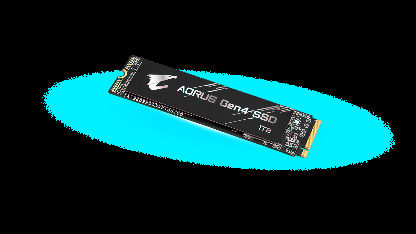
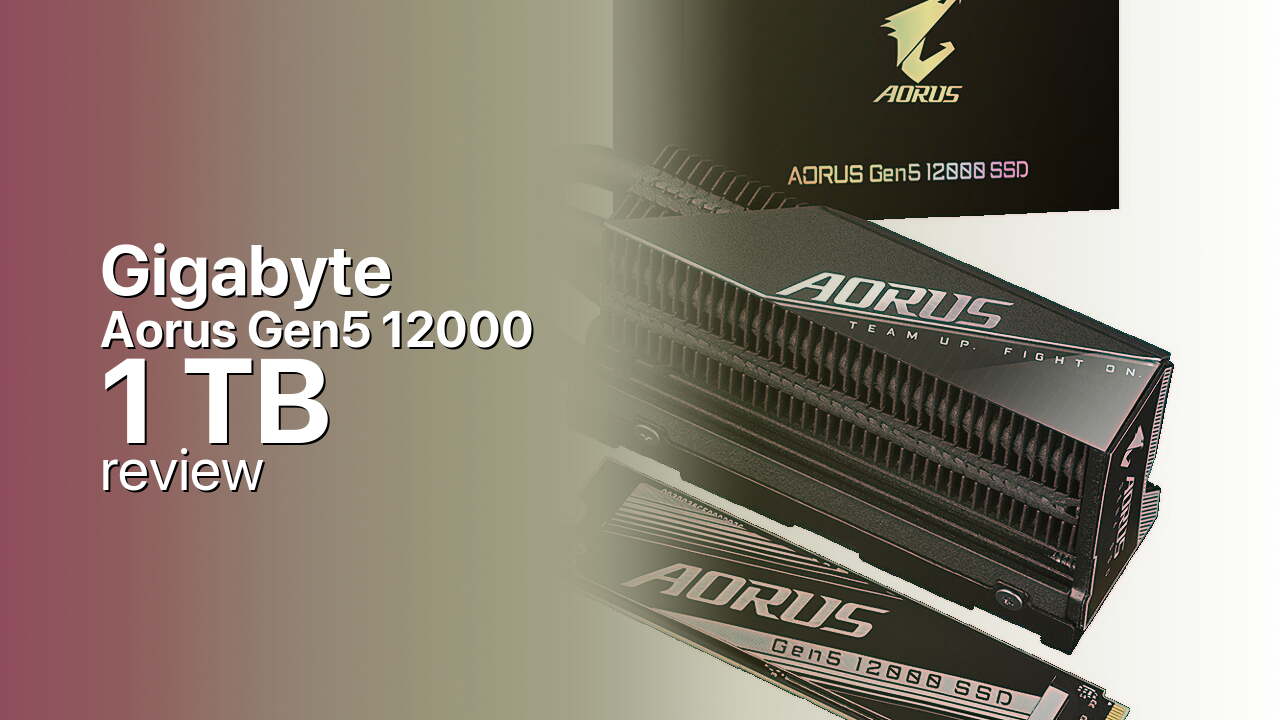
The Gigabyte Aorus Gen5 12000 1 TB is the smaller sibling of Gigabyte's flagship PCIe 5.0 line, pairing a Phison E26 controller with Micron 232-layer TLC for headline 11,700 MB/s reads.
Controller & Memory
The Gigabyte Aorus Gen5 12000 1 TB sits at the entry tier of Gigabyte's PCIe 5.0 lineup, and the capacity matters more here than on any other current NVMe drive. Inside is the familiar Phison PS5026-E26 eight-channel controller paired with Micron 232-layer TLC (B58R FortisFlash) and a 2 GB LPDDR4 DRAM cache. The platform is the same one used by the Crucial T700, Corsair MP700 Pro, Sabrent Rocket 5 and Inland TD510, so the 1 TB Aorus 12000 is a known quantity internally, not a bespoke design.
What makes the 1 TB specific is where it lands in the speed stack. Gigabyte rates this SKU for 11,700 MB/s sequential reads and 9,500 MB/s writes, which is a clear step below the 2 TB model's 12,400 / 11,800 MB/s. The Phison E26 needs two NAND dies per channel to fully stretch its legs, and the 1 TB drive cannot supply that. Independent reviewers consistently find the E26 delivers meaningfully stronger sustained writes at 2 TB and beyond, so the 1 TB is the capacity where the PCIe 5.0 premium buys the least measurable benefit.
The drive ships in a double-sided M.2 2280 form factor with Gigabyte's bulky M.2 Thermal Guard XTREME heatsink included, which matters because the E26 idles warm and spikes hard under sustained writes. Check the published motherboard incompatibility list before buying, as the tall heatsink fouls some VRM heatsinks on ITX and budget boards. This is a desktop-only part in practice, not a laptop or PS5 upgrade (PCIe 5.0 drives do not work in the PS5, and the double-sided PCB plus heatsink height rule out most laptops). Direct rivals at the same tier are the Crucial T700 1 TB, Corsair MP700 1 TB, and at PCIe 4.0 pricing the WD Black SN850X 1 TB which covers most real workloads for less money.
Storage Comparisons:
Aorus Gen5 12000 Performance & Benchmarks
Gigabyte rates the Aorus Gen5 12000 1 TB for up to 11,700 MB/s sequential reads and 9,500 MB/s sequential writes over its PCIe 5.0 x4 link, with random IOPS quoted at the 1.5 million class typical of the Phison E26 platform. Those are burst figures measured in CrystalDiskMark against an empty SLC cache, not what you will see copying a 200 GB game library.
Gigabyte Aorus Gen5 12000 1 TB vs M.2 5.0 peers
Switch between sequential throughput and random IOPS to see how this drive stacks up against other M.2 5.0 SSDs in our database. The highlighted bar is the drive on this page — click any other bar to open that drive.
- Corsair MP700 Pro XT 1 TB: 14,900 MB/s read, 14,200 MB/s write
- Corsair MP700 Pro XT 2 TB: 14,900 MB/s read, 14,500 MB/s write
- Corsair MP700 Pro XT 4 TB: 14,900 MB/s read, 14,400 MB/s write
- Crucial T710 1 TB: 14,900 MB/s read, 13,800 MB/s write
- Gigabyte Aorus Gen5 12000 1 TB (this drive): 11,700 MB/s read, 9,500 MB/s write
The 1 TB capacity is where the E26 runs out of room to hide. TechPowerUp measured the dynamic pseudo-SLC cache at roughly 110 GB on this SKU, after which writes collapse to about 1,900 MB/s while the cache folds back to TLC at around 1,000 MB/s. For a boot drive plus a handful of large games that cache is rarely exhausted, but a video editor dumping 4K proxies will hit the cliff quickly. Independent reviewers at Tom's Hardware concluded that 2 TB is the floor where current PCIe 5.0 drives make sense, and that the 1 TB Aorus 12000 is outclassed by its own 2 TB sibling on sustained writes.
In real-world gaming and OS workloads the bandwidth advantage over PCIe 4.0 is largely theoretical today. DirectStorage titles are the exception, and the E26 firmware here is DirectStorage-optimized, so the drive has some forward-looking headroom. For everything else, the WD Black SN850X and Samsung 990 Pro at PCIe 4.0 remain the smarter spend at the 1 TB capacity point.
Gigabyte Aorus Gen5 12000 vs Competitors
See how the Aorus Gen5 12000 stacks up against other M.2 5.0 drives in our database:
Compare with rival drives:
Endurance, TBW & Warranty
Gigabyte backs the Aorus Gen5 12000 1 TB with a limited 5-year warranty or 700 TBW (Terabytes Written), whichever comes first, with the TBW figure evaluated under JEDEC workload standards. The drive also reports a 1.6 million hour MTBF, which is a population-reliability statistic for the product family rather than a per-drive life expectancy. For context, 700 TBW works out to roughly 383 GB of writes every day for five years, or about 96 years at a more typical 20 GB/day consumer workload, so the warranty term will almost always expire long before endurance does. Endurance is tracked via the Percentage Used SMART attribute (ID 05) in Gigabyte's SSD Toolbox, and the warranty ends when that counter reaches 100 percent or the five-year term elapses, whichever is first. RMA is handled through Gigabyte directly, and the bundled heatsink is covered as part of the product rather than a separate accessory.
Gigabyte Aorus Gen5 12000 1 TB Specifications
| Category | Value |
|---|---|
| Capacity [?] | 1 TB |
| Interface [?] | M.2 5.0 |
| Controller [?] | Phison PS5026-E26 8 Channel |
| Memory type [?] | Micron 232-L TLC |
| DRAM [?] | Yes |
| Read speed (MB/s) [?] | 11700 |
| Write speed (MB/s) [?] | 9500 |
| Read IOPS [?] | 1500000 |
| Write IOPS [?] | 1500000 |
| Endurance (TBW) [?] | 700 |
| MTBF (million hours) [?] | 1600000 |
| Warranty (years) [?] | 5 |
Verdict: Is the Aorus Gen5 12000 Worth It in 2026?
The Gigabyte Aorus Gen5 12000 1 TB makes sense for one buyer: an enthusiast on a PCIe 5.0 platform who specifically wants the included Thermal Guard XTREME heatsink and a single-drive 11,700 MB/s read ceiling for DirectStorage-era workloads. Skip it if you are on PCIe 4.0 today, where a WD Black SN850X 1 TB or Samsung 990 Pro delivers indistinguishable real-world performance for less money, and skip it if you actually need PCIe 5.0 bandwidth, because the 2 TB Aorus 12000 is the capacity where the E26 platform finally justifies its own price. Our honest verdict is that this is a technically excellent drive sold in the one capacity that undersells its own hardware.
+ Pros
- 11,700 MB/s sequential read ceiling
- Phison E26 with 2 GB LPDDR4 DRAM cache
- Micron 232-layer TLC NAND
- Included M.2 Thermal Guard XTREME heatsink
- 5-year warranty or 700 TBW endurance
- DirectStorage-optimized E26 firmware
- Cons
- 1 TB capacity caps sustained writes well below 2 TB
- ~110 GB SLC cache then drops to 1,900 MB/s
- Bulky heatsink fouls some motherboard VRM sinks
- Double-sided PCB rules out most laptops
- Not compatible with PS5
Buy this or similar SSD Storage:



Video Review
Gigabyte Aorus Gen5 12000 SSD 2TB M.2 NVMe PCIe 5.0 x4 specifications (1TB, 2TB)