HP FX700 2TB: TweakTown's fastest QLC drive tested (2026)
Quick answer
The HP FX700 2TB suits gamers and content hoarders who want genuinely fast rated speeds, real capacity, and strong warranty backing without paying TLC-drive prices - and it's the exact capacity independent reviewers singled out as the fastest QLC they'd tested.
Read: 7200 MB/s Write: 6200 MB/s Endurance: 800 TBW Warranty: 5 years Interface: M.2 4.0 x 4
The HP FX700 2TB is the capacity TweakTown specifically reviewed and called the fastest QLC SSD it had tested, backed by a genuine 5-year warranty.
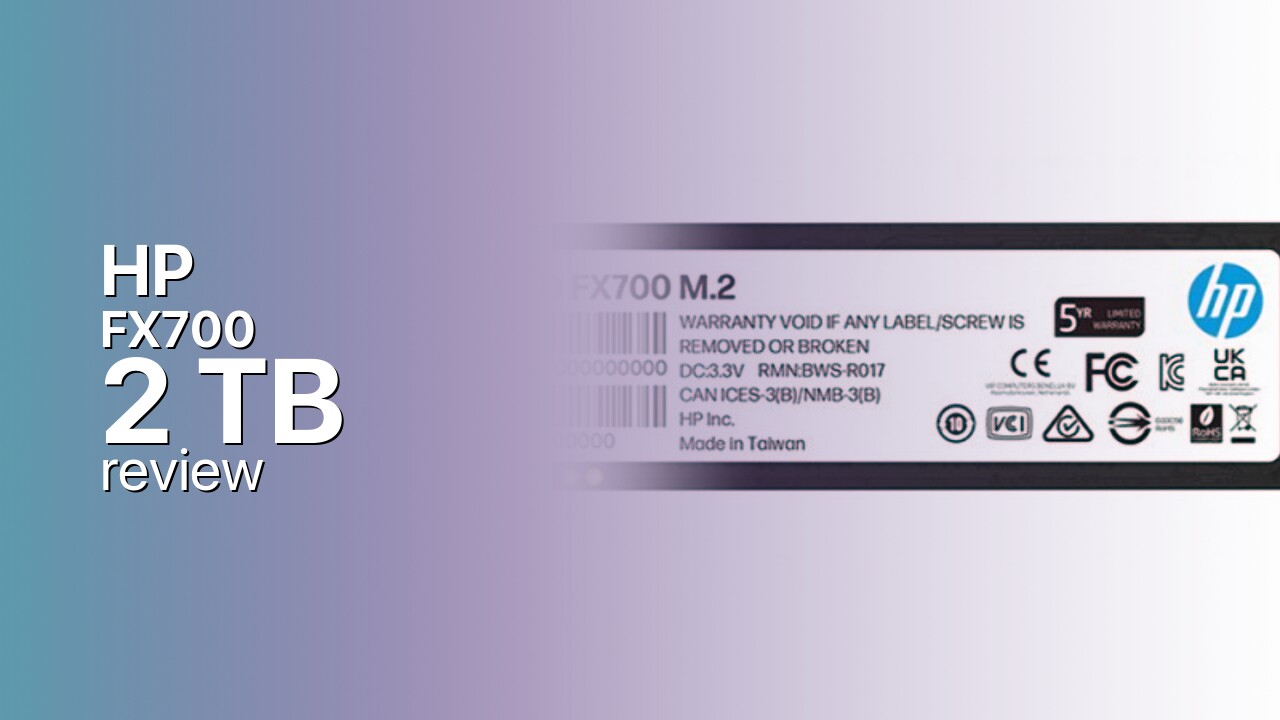
Controller & Memory
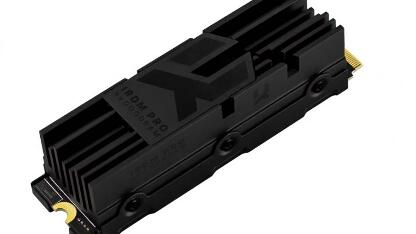
HP pairs a Maxio MAP1602A-F3C four-channel controller with YMTC's 232-layer QLC NAND on the FX700, skipping a dedicated DRAM chip but including a 0.5mm graphene thermal pad in the box. It connects over PCIe 4.0 x4 with NVMe 2.0 in a single-sided M.2 2280 form factor, and HP's own materials pitch it toward both gaming and lighter content-creation workflows.
At 2 TB, the FX700 hits the same 7,200/6,200 MB/s sequential ratings as the 1TB and 4TB models - only the 512GB capacity runs slower - while endurance scales up to 800 TBW, double the 1TB model's 400 TBW, under the same 5-year warranty. This is also the exact capacity TweakTown tested for its 'fastest QLC ever tested' review, so its reputation for the line is grounded in this specific SKU rather than borrowed from a different capacity's numbers.
Its single-sided PCB and included thermal pad make the FX700 2TB a strong fit for laptops and the PS5, which HP explicitly markets it for as external expansion storage. At this capacity it competes with other fast QLC and aggressive-cache drives like the Crucial P3 Plus 2TB and Samsung 990 EVO Plus 2TB, both of which are more widely stocked at major Western retailers but don't clearly beat its review reputation.
Storage Comparisons:
FX700 Performance & Benchmarks
HP rates the FX700 2TB at up to 7,200 MB/s sequential reads and 6,200 MB/s sequential writes over PCIe 4.0 x4, and the official datasheet lists random performance at 1,050,000 read IOPS and 721,000 write IOPS. That read-IOPS figure is the highest in the whole FX700 line and is what anchored TweakTown's 'fastest QLC ever tested' verdict for this specific capacity.
HP FX700 2 TB vs M.2 4.0 x 4 peers
Switch between sequential throughput and random IOPS to see how this drive stacks up against other M.2 4.0 x 4 SSDs in our database. The highlighted bar is the drive on this page — click any other bar to open that drive.
- Patriot Viper PV593 1 TB: 14,500 MB/s read, 14,000 MB/s write
- Patriot Viper PV593 2 TB: 14,500 MB/s read, 14,000 MB/s write
- Patriot Viper PV593 4 TB: 14,500 MB/s read, 14,000 MB/s write
- Patriot Viper PV573 2 TB: 14,000 MB/s read, 12,000 MB/s write
- HP FX700 2 TB (this drive): 7,200 MB/s read, 6,200 MB/s write
QLC NAND is typically the weak point in a drive's sustained write performance, since it leans harder on its SLC write cache than TLC does. Once a large sustained transfer exhausts that cache on the 2TB FX700, write speeds drop more noticeably than they would on a TLC-based rival, though the larger capacity gives the cache more absolute headroom before that happens. For gaming, content libraries, and moderate file transfers, the FX700 2TB delivers speeds that outrun many TLC drives in the same price range, with power draw low enough to suit laptop use as well as desktops.
HP FX700 vs Competitors
See how the FX700 stacks up against other M.2 4.0 x 4 drives in our database:
Compare with rival drives:
Endurance, TBW & Warranty
HP rates the FX700 2TB at 800 TBW of total write endurance, backed by a 5-year limited warranty according to the official specification sheet. At a typical 20-50 GB of writes per day, that endurance budget lasts roughly 44 to 110 years before hitting the rated limit, far beyond the drive's realistic service life, so endurance is not a practical concern despite QLC's lower per-cell durability than TLC. The MTBF rating is 2,000,000 hours, a statistical reliability figure describing failure rates across a large population of drives rather than a promise for any individual unit.
The 5-year warranty term is a genuine strength for a QLC drive at this price and capacity, matching or beating several TLC-based competitors.
HP FX700 2 TB Specifications
| Category | Value |
|---|---|
| Capacity [?] | 2 TB |
| Interface [?] | M.2 4.0 x 4 |
| Controller [?] | Maxio MAP1602A-F3C 4 Channel |
| Memory type [?] | YMTC 232-L QLC |
| DRAM [?] | No |
| Read speed (MB/s) [?] | 7200 |
| Write speed (MB/s) [?] | 6200 |
| Read IOPS [?] | 1050000 |
| Write IOPS [?] | 721000 |
| Endurance (TBW) [?] | 800 |
| MTBF (million hours) [?] | 2000000 |
| Warranty (years) [?] | 5 |
Verdict: Is the FX700 Worth It in 2026?
The HP FX700 2TB suits gamers and content hoarders who want genuinely fast rated speeds, real capacity, and strong warranty backing without paying TLC-drive prices - and it's the exact capacity independent reviewers singled out as the fastest QLC they'd tested. It's a weaker choice for professionals doing constant large sustained writes, where QLC's smaller effective cache margin shows up sooner than on a TLC-based rival like the Samsung 990 EVO Plus. Buyers who want a more widely available alternative at a similar QLC price point should consider the Crucial P3 Plus 2TB. Overall, the FX700 2TB backs up its strong review reputation with genuinely solid specs.
+ Pros
- 7,200 MB/s sequential reads on PCIe 4.0
- 1,050,000 read IOPS, the fastest in the FX700 line
- 800 TBW endurance backed by a 5-year warranty
- Single-sided design with included graphene thermal pad
- Reviewed as the fastest QLC SSD TweakTown had tested
- Cons
- QLC NAND has lower per-cell endurance than TLC
- DRAM-less design relies on Host Memory Buffer
- Manufactured by Biwin as an HP-branded ODM product
- Sustained writes past the SLC cache trail TLC rivals
Buy this or similar SSD Storage:



Video Review
Обзор PCIe 4.0 SSD HP FX900 Pro 1TB (4A3U0AA#AAB)