HP FX700 512GB: the entry capacity, and slower for it (2026)
Quick answer
The HP FX700 512GB suits budget builders who want a boot drive or light gaming setup and don't need the FX700 line's headline speed, since that 7,200/6,200 MB/s figure only applies to the 1TB and larger capacities.
Read: 6300 MB/s Write: 3100 MB/s Endurance: 200 TBW Warranty: 5 years Interface: M.2 4.0 x 4
The HP FX700 512GB is the entry capacity in HP's QLC PCIe 4.0 lineup, trading noticeably slower writes than its 1TB and larger siblings for a lower price and a genuine 5-year warranty.
Controller & Memory
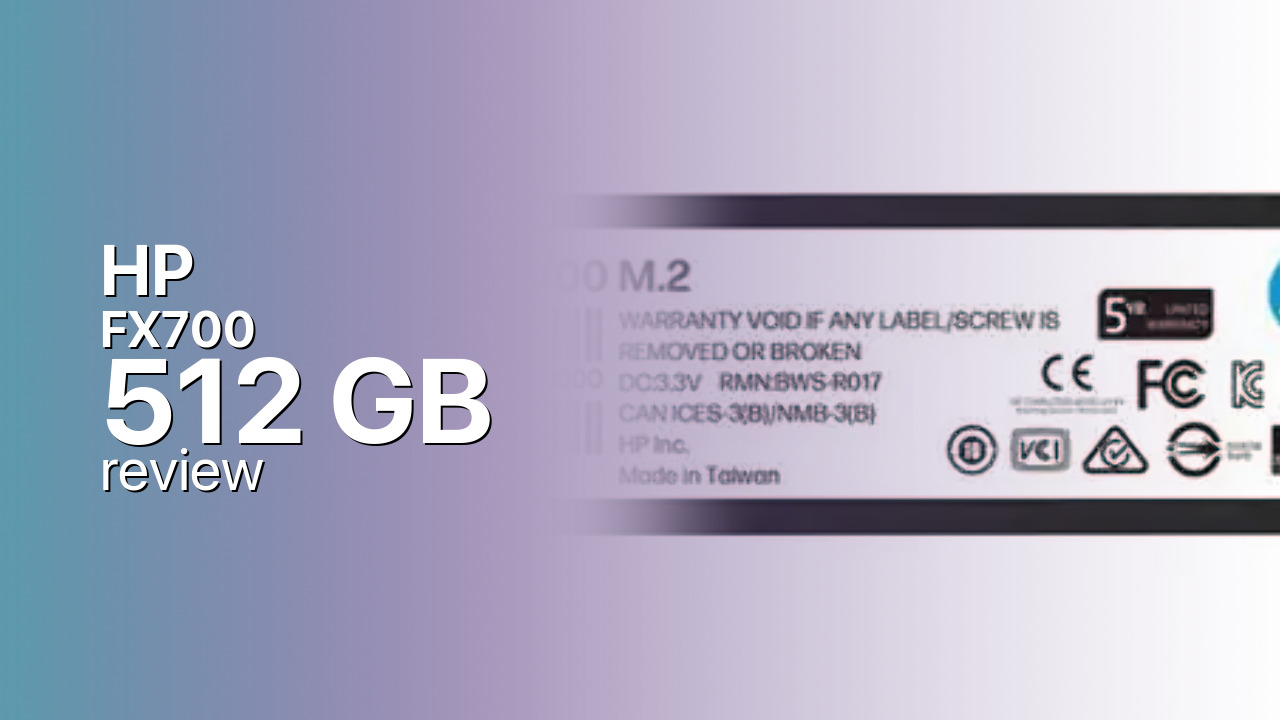
HP pairs a Maxio MAP1602A-F3C four-channel controller with YMTC's 232-layer QLC NAND on the FX700, skipping a dedicated DRAM chip but including a 0.5mm graphene thermal pad in the box. It connects over PCIe 4.0 x4 with NVMe 2.0 in a single-sided M.2 2280 form factor.
Importantly, HP's own datasheet shows the 512GB FX700 running well behind the rest of the line: 6,300 MB/s reads and just 3,100 MB/s writes, versus 7,200/6,200 MB/s on the 1TB, 2TB, and 4TB capacities. That gap is common on QLC drives with fewer NAND dies to stripe across at the smallest capacity, and it means HP's headline '7,200 MB/s' marketing speed simply doesn't apply here. Endurance scales down accordingly too, at 200 TBW versus 400 TBW on the 1TB model, still under the same 5-year warranty.
Its single-sided PCB and included thermal pad still make the FX700 512GB a reasonable fit for laptops and the PS5, and the drive's rated read speed still comfortably clears Sony's PS5 storage guidance. At this capacity and price it lines up against smaller-capacity budget rivals like the Crucial P3 Plus 500GB and WD Blue SN580 500GB, both of which are worth comparing directly since the FX700's speed advantage over TLC rivals shrinks substantially at 512GB.
Storage Comparisons:
FX700 Performance & Benchmarks
HP rates the FX700 512GB at up to 6,300 MB/s sequential reads and 3,100 MB/s sequential writes over PCIe 4.0 x4 - both notably lower than the 7,200/6,200 MB/s figures often quoted for the FX700 line, which apply only to the 1TB and larger capacities. Random IOPS remain strong for the segment at 567,000 reads and 586,000 writes per HP's datasheet, so everyday responsiveness holds up better than the sequential write number alone would suggest.
HP FX700 512 GB vs M.2 4.0 x 4 peers
Switch between sequential throughput and random IOPS to see how this drive stacks up against other M.2 4.0 x 4 SSDs in our database. The highlighted bar is the drive on this page — click any other bar to open that drive.
- Patriot Viper PV593 1 TB: 14,500 MB/s read, 14,000 MB/s write
- Patriot Viper PV593 2 TB: 14,500 MB/s read, 14,000 MB/s write
- Patriot Viper PV593 4 TB: 14,500 MB/s read, 14,000 MB/s write
- Patriot Viper PV573 2 TB: 14,000 MB/s read, 12,000 MB/s write
- HP FX700 512 GB (this drive): 6,300 MB/s read, 3,100 MB/s write
As a QLC, DRAM-less drive, the 512GB FX700 leans on an SLC write cache that's smaller in absolute terms than on the larger capacities, so it fills sooner during a sustained transfer and write speed drops toward the lower native ceiling more quickly. For a boot drive, light gaming, and general desktop use this is rarely noticeable, but buyers planning frequent large file transfers should budget for the 1TB model instead, where both the sequential and cache-exhaustion numbers are considerably better.
HP FX700 vs Competitors
See how the FX700 stacks up against other M.2 4.0 x 4 drives in our database:
Compare with rival drives:
Endurance, TBW & Warranty
HP rates the FX700 512GB at 200 TBW of total write endurance, backed by a 5-year limited warranty according to the official specification sheet. At a typical 20-50 GB of writes per day, that endurance budget lasts roughly 11 to 27 years before hitting the rated limit, comfortably beyond the drive's realistic service life even at half the larger capacities' rated TBW. The MTBF rating is 2,000,000 hours, a statistical reliability figure describing failure rates across a large population of drives rather than a promise for any individual unit.
The 5-year warranty term matches the rest of the FX700 line and is a genuine strength for a budget QLC drive at this capacity, regardless of the lower sequential write speed.
HP FX700 512 GB Specifications
| Category | Value |
|---|---|
| Capacity [?] | 512 GB |
| Interface [?] | M.2 4.0 x 4 |
| Controller [?] | Maxio MAP1602A-F3C 4 Channel |
| Memory type [?] | YMTC 232-L QLC |
| DRAM [?] | No |
| Read speed (MB/s) [?] | 6300 |
| Write speed (MB/s) [?] | 3100 |
| Read IOPS [?] | 567000 |
| Write IOPS [?] | 586000 |
| Endurance (TBW) [?] | 200 |
| MTBF (million hours) [?] | 2000000 |
| Warranty (years) [?] | 5 |
Verdict: Is the FX700 Worth It in 2026?
The HP FX700 512GB suits budget builders who want a boot drive or light gaming setup and don't need the FX700 line's headline speed, since that 7,200/6,200 MB/s figure only applies to the 1TB and larger capacities. It's a weaker choice for anyone expecting the marketed flagship speed, or for buyers doing frequent large file transfers, where the 3,100 MB/s write ceiling and smaller SLC cache show up quickly. Buyers who specifically want the FX700's full rated performance should step up to the 1TB model instead. Overall, the 512GB FX700 is a reasonable budget pick backed by a strong 5-year warranty, provided expectations are set by its actual, capacity-specific numbers.
+ Pros
- 6,300 MB/s sequential reads on PCIe 4.0
- 5-year manufacturer warranty
- Single-sided design with included graphene thermal pad
- Strong random IOPS relative to its sequential speed
- Cons
- Write speed drops to 3,100 MB/s, well below larger FX700 capacities
- QLC NAND has lower per-cell endurance than TLC
- DRAM-less design relies on Host Memory Buffer
- Smaller SLC cache exhausts sooner on large transfers
Buy this or similar SSD Storage:
Video Review
[컴퓨존] [HP] FX700 M.2 NVMe 2280 [512GB QLC] 구매후기