Imation Q971 4TB: a budget QLC PCIe 4.0 NVMe drive (2026)
Quick answer
The Imation Q971 4TB fits buyers who want a large PCIe 4.0 game or media library on a budget and don't need sustained write performance beyond casual file transfers.
Read: 5000 MB/s Write: 4500 MB/s Endurance: 600 TBW Warranty: 3 years Interface: M.2 4.0 x 4
The Imation Q971 4TB is a budget, DRAM-less PCIe 4.0 NVMe drive that trades TLC NAND for QLC to make a large-capacity upgrade more affordable.
Controller & Memory
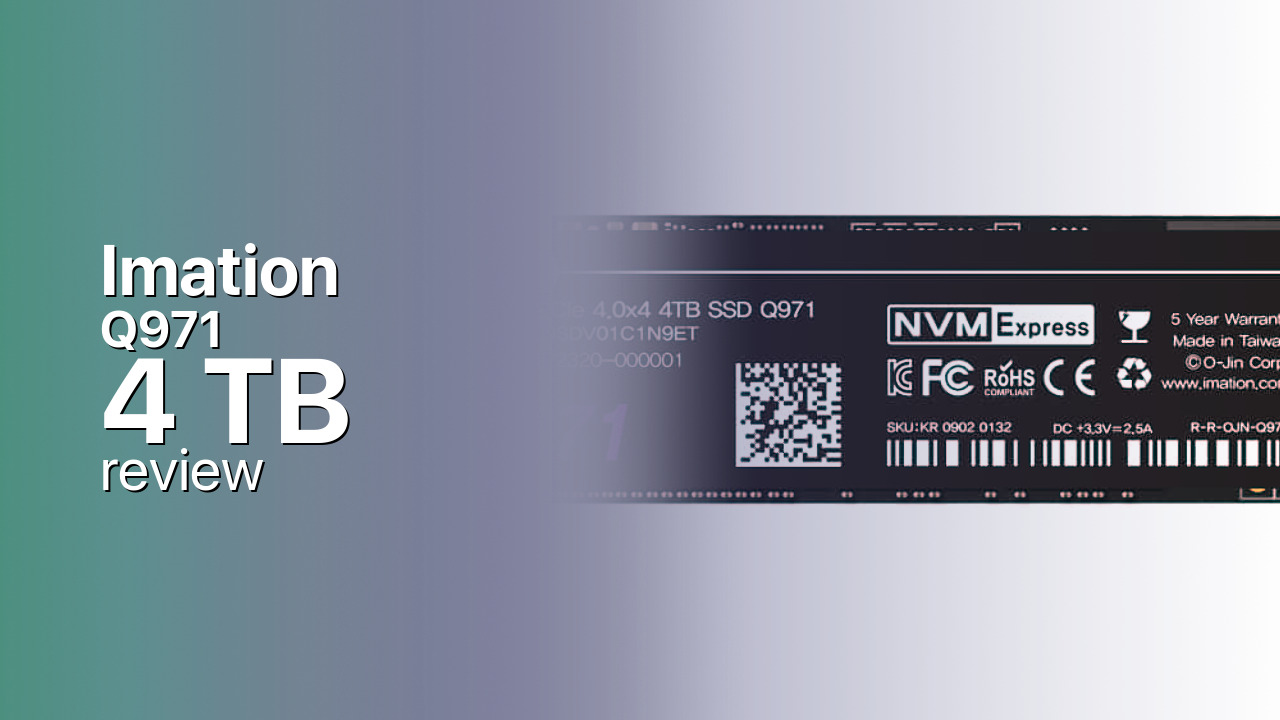
Imation builds the Q971 around a Phison PS5021-E21 four-channel controller paired with Micron QLC NAND and no onboard DRAM chip, relying on Host Memory Buffer instead to keep costs down. It connects over PCIe 4.0 x4 in a standard M.2 2280 body just 2.15 mm thick, with no heatsink included in the box - a deliberately stripped-down bill of materials aimed at buyers who want capacity over headline speed.
The Q971 line also ships in 512 GB, 1 TB, and 2 TB capacities, and Imation publishes the same 5,000 MB/s read / 4,500 MB/s write rating across the range rather than scaling numbers up with capacity, which is common for QLC-based families where the controller, not the NAND, sets the sequential ceiling. It sits below Imation's own Z971 and Z981 series, which pair faster Phison controllers with TLC NAND for buyers who need more consistent sustained performance.
At 2.15 mm thick with no heatsink, the Q971 fits laptops, thin desktops, and the PS5's internal M.2 slot without clearance issues, though a desktop build doing sustained heavy writes benefits from an aftermarket M.2 heatsink. On price and capacity it competes most directly with the Crucial P3 Plus 4TB, another QLC, DRAM-less PCIe 4.0 drive, while TLC alternatives like the WD Blue SN580 cost more per gigabyte but hold sustained write speed more consistently.
Storage Comparisons:
Q971 Performance & Benchmarks
Imation rates the Q971 4TB at up to 5,000 MB/s sequential reads and 4,500 MB/s sequential writes over PCIe 4.0 x4, comfortably ahead of any SATA drive and competitive with many TLC-based rivals for burst transfers. Random IOPS figures aren't published for this model, so buyers should treat any specific number seen elsewhere with caution.
Imation Q971 4 TB vs M.2 4.0 x 4 peers
Switch between sequential throughput and random IOPS to see how this drive stacks up against other M.2 4.0 x 4 SSDs in our database. The highlighted bar is the drive on this page — click any other bar to open that drive.
- Patriot Viper PV593 1 TB: 14,500 MB/s read, 14,000 MB/s write
- Patriot Viper PV593 2 TB: 14,500 MB/s read, 14,000 MB/s write
- Patriot Viper PV593 4 TB: 14,500 MB/s read, 14,000 MB/s write
- Patriot Viper PV573 2 TB: 14,000 MB/s read, 12,000 MB/s write
- Imation Q971 4 TB (this drive): 5,000 MB/s read, 4,500 MB/s write
As a QLC, DRAM-less design, the Q971 leans on an SLC write cache to reach its rated speeds; QLC NAND typically has a smaller usable cache as a share of total capacity than TLC, and write speeds drop more noticeably once that cache empties during a large sustained transfer. For everyday tasks - loading games, general file storage, moving modest batches of files - this rarely becomes visible, which makes the drive a reasonable fit for its main use case: a large, mostly-read game or media library rather than a high-throughput working drive. Buyers regularly writing hundreds of gigabytes at a stretch, such as video editors dumping raw 4K footage, will notice the QLC cache limit more than they would on a TLC competitor.
Imation Q971 vs Competitors
See how the Q971 stacks up against other M.2 4.0 x 4 drives in our database:
Compare with rival drives:
Endurance, TBW & Warranty
Imation rates the Q971 4TB at 600 TBW of total write endurance. At a typical 20-50 GB of writes per day, that budget lasts roughly 33 to 82 years before hitting the rated limit - far longer than most buyers will own the drive, so endurance isn't a practical concern for normal desktop or gaming use, even though 600 TBW is on the modest side for a 4TB capacity. The MTBF rating is 1,500,000 hours, a statistical reliability figure describing failure rates across a large population of drives rather than a guarantee for any single unit.
Warranty coverage on this listing runs 3 years, though a Korean retailer's listing for the 2TB model in the same Q971 line shows 5 years of coverage, suggesting warranty terms may vary by region or point of sale rather than following one global policy. Buyers should confirm the exact warranty period with their retailer before purchase.
Imation Q971 4 TB Specifications
| Category | Value |
|---|---|
| Capacity [?] | 4 TB |
| Interface [?] | M.2 4.0 x 4 |
| Controller [?] | Phison PS5021-E21 4 Channel |
| Memory type [?] | Micron 166-L QLC |
| DRAM [?] | No |
| Read speed (MB/s) [?] | 5000 |
| Write speed (MB/s) [?] | 4500 |
| Read IOPS [?] | 5000000 |
| Write IOPS [?] | 4500000 |
| Endurance (TBW) [?] | 600 |
| MTBF (million hours) [?] | 1500000 |
| Warranty (years) [?] | 3 |
Verdict: Is the Q971 Worth It in 2026?
The Imation Q971 4TB fits buyers who want a large PCIe 4.0 game or media library on a budget and don't need sustained write performance beyond casual file transfers. It's a weaker choice for video editors or anyone doing frequent large sustained writes, where QLC's smaller SLC cache and DRAM-less design show their limits sooner than on a TLC drive. Buyers who need steadier sustained performance at a similar capacity should look at the WD Blue SN580, or stay in the QLC tier with the similarly specced Crucial P3 Plus 4TB. Overall, the Q971 4TB is a reasonable capacity-per-dollar pick for bulk storage, provided the buyer confirms the actual warranty term with their retailer first.
+ Pros
- 5,000 MB/s sequential reads on PCIe 4.0
- 4TB capacity at a QLC price point
- Ultra-thin 2.15 mm M.2 2280 form factor
- 1,500,000-hour MTBF rating
- Fits PS5 and thin laptops without a heatsink
- Cons
- QLC NAND drops off faster than TLC once cache fills
- No included heatsink for sustained desktop loads
- Warranty length appears to vary by region or retailer
- Random IOPS figures not published by Imation
- 600 TBW is modest for a 4TB drive
Buy this or similar SSD Storage:
Video Review
NISSAN GTR In Racing Games