Integral Ultima Pro X 2TB Review — Full Speed at High Capacity (2026)
Quick answer
The Integral Ultima Pro X 2TB suits owners of Gen3-era systems who want 2 TB without dropping below the family's flagship speeds — game libraries, video projects, and bulk photo archives all fit its 3,400/3,000 MB/s profile and 1,550 TBW budget.
Read: 3400 MB/s Write: 3000 MB/s Endurance: 1550 TBW Warranty: 3 years Interface: M.2 3.0 x 4
The Integral Ultima Pro X 2TB keeps the range's full 3,400/3,000 MB/s rating at high capacity — a DRAM-backed Phison E12 build with 1,550 TBW of endurance behind it.
Controller & Memory
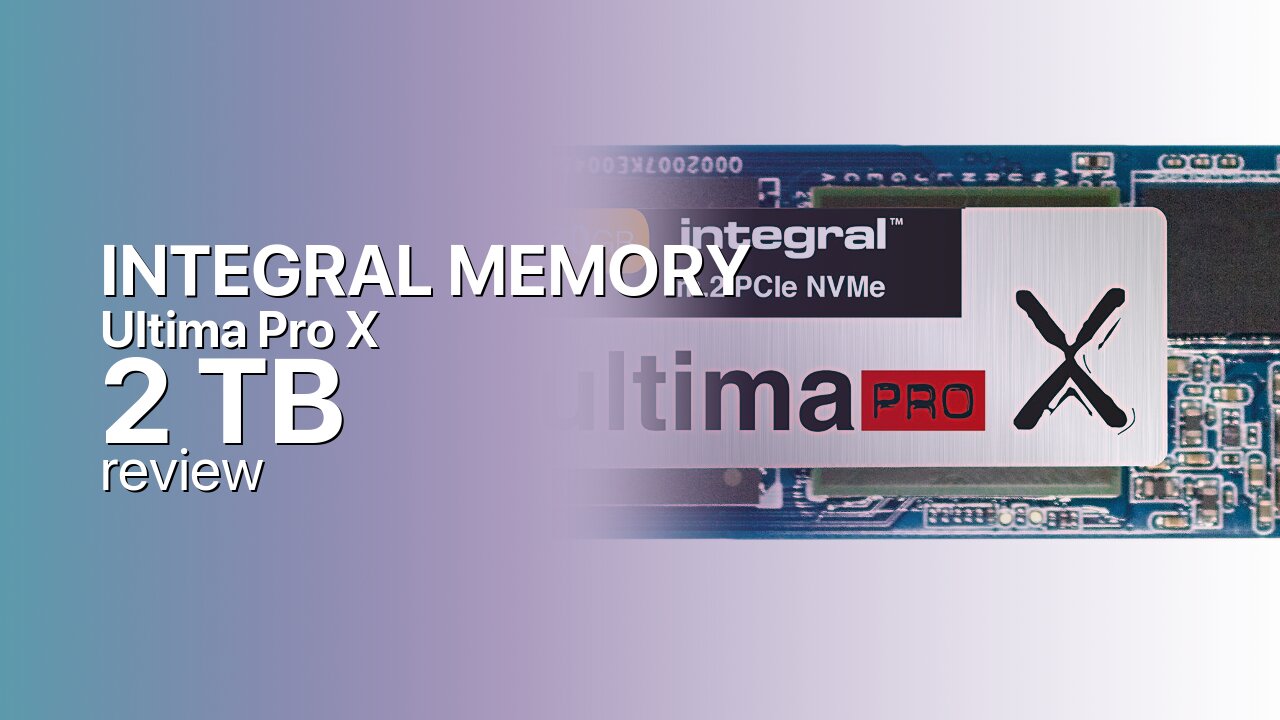
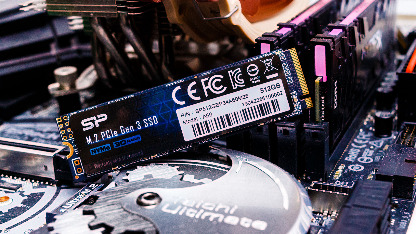
The Integral Ultima Pro X 2TB — sold under part code INSSD2TM280NUPX2 as the UltimaPro X Version 2 — is the high-capacity heart of Integral's Gen3 NVMe line. Inside sits a Phison E12 controller with DRAM backing, 3D TLC NAND, and a PCIe 3.1 x4 link compliant with NVMe 1.3. Integral rates it at 3,400 MB/s sequential reads and 3,000 MB/s writes, matching the range-topping 4TB, alongside 480K random-read and 680K random-write IOPS. Unusually for the tier, the drive adds 256-bit AES hardware encryption with TCG Opal 2.0 support, and Integral publishes a per-capacity datasheet covering speeds, IOPS, power, and endurance for all nine capacities in the family.
The Version 2 tag matters. The original UltimaPro X launched in 2019 as an MLC-based design in 120 GB to 960 GB capacities rated up to 2,900/2,200 MB/s; the Version 2 switched to 3D TLC, stretched the range from 240 GB to 4 TB, and lifted the headline speeds. Integral lists both a 1920 GB part and this 2048 GB 2TB part, and the two are not interchangeable: the 1920 GB sibling is capped at 2,700 MB/s writes but carries a 3,115 TBW endurance rating — twice this drive's 1,550 TBW. The 2TB is the faster and larger drive; the 1920 GB is the longer-lived one. Every Version 2 capacity is a double-sided M.2 2280 board within a 3.8 mm height, so a populated PCB sits on both faces.
For Gen3-era hardware — pre-2020 desktop boards, Intel NUCs, and older Ultrabooks with an M.2 2280 slot — the rivals are familiar. Corsair's MP510 runs the same E12 platform with a 3,480/3,000 MB/s rating and a 5-year warranty, while Samsung's 970 EVO Plus trades on 3,500/3,300 MB/s and a wider retail footprint. The UltimaPro X 2TB counters with TCG Opal 2.0 encryption and endurance documentation few of its peers publish. It is a legacy product now: retail stock has largely dried up since Integral's line-up moved on, so this is a hunt-the-remaining-stock purchase rather than a default recommendation.
Storage Comparisons:
Ultima Pro X Performance & Benchmarks
Integral rates the 2TB at 3,400 MB/s sequential reads, 3,000 MB/s writes, and 480K/680K random read/write IOPS — the same headline figures the 4TB flagship carries, and the joint-fastest combination in the family. Against a SATA SSD's 550 MB/s ceiling the difference is practical, not academic: game installs, Windows updates, and photo libraries move in a fraction of the time, and the 680K random-write rating keeps the drive responsive when the operating system, browser, and applications share the disk. DirectStorage-style game streaming leans on exactly this combination of high sequential reads and strong random writes.
INTEGRAL MEMORY Ultima Pro X 2 TB vs M.2 3.0 x 4 peers
Switch between sequential throughput and random IOPS to see how this drive stacks up against other M.2 3.0 x 4 SSDs in our database. The highlighted bar is the drive on this page — click any other bar to open that drive.
- ADATA SX 8800 Pro 512 GB: 3,500 MB/s read, 2,700 MB/s write
- ADATA SX 8800 Pro 1 TB: 3,500 MB/s read, 2,700 MB/s write
- ADATA XPG Spectrix S40G RGB 256 GB: 3,500 MB/s read, 3,000 MB/s write
- ADATA XPG Spectrix S40G RGB 512 GB: 3,500 MB/s read, 3,000 MB/s write
- INTEGRAL MEMORY Ultima Pro X 2 TB (this drive): 3,400 MB/s read, 3,000 MB/s write
Two caveats temper the headline numbers. Like every TLC drive in this class, the E12 platform absorbs burst writes into a pseudo-SLC cache, and sustained transfers beyond the cache settle to lower native TLC rates — a non-event for boot-and-games duty, but visible in multi-hundred-gigabyte copy jobs. Second, advertised speeds are conditioned: Integral's own footnote warns that performance varies with the host device. Independent coverage of the family is thin — French site Cowcotland's early-2020 reviews of the 960 GB variants are among the few published tests — so treat these figures as manufacturer ratings rather than measured results.
INTEGRAL MEMORY Ultima Pro X vs Competitors
See how the Ultima Pro X stacks up against other M.2 3.0 x 4 drives in our database:
Compare with rival drives:
Endurance, TBW & Warranty
Integral backs the UltimaPro X Version 2 family with a 3-year limited warranty or the drive's TBW rating, whichever arrives first. For the 2TB that budget is 1,550 TB — at 50 GB of writes per day it stretches to roughly 85 years, so the 3-year term is the practical limit for almost any buyer. MTBF is rated at 1.8 million hours, a JEDEC-methodology population statistic rather than a promise for any individual drive. The curiosity is the neighbouring 1920 GB part: Integral's datasheet rates it at 3,115 TBW, double this drive's budget in a smaller capacity, so endurance-focused buyers should weigh the pair before choosing. Claims run through Integral's UK support operation with proof of purchase.
INTEGRAL MEMORY Ultima Pro X 2 TB Specifications
| Category | Value |
|---|---|
| Capacity [?] | 2 TB |
| Interface [?] | M.2 3.0 x 4 |
| Controller [?] | Phison PS5012-E12 8 Channel |
| Memory type [?] | 3D TLC |
| DRAM [?] | Yes |
| Read speed (MB/s) [?] | 3400 |
| Write speed (MB/s) [?] | 3000 |
| Read IOPS [?] | 480000 |
| Write IOPS [?] | 680000 |
| Endurance (TBW) [?] | 1550 |
| MTBF (million hours) [?] | 1800000 |
| Warranty (years) [?] | 3 |
Verdict: Is the Ultima Pro X Worth It in 2026?
The Integral Ultima Pro X 2TB suits owners of Gen3-era systems who want 2 TB without dropping below the family's flagship speeds — game libraries, video projects, and bulk photo archives all fit its 3,400/3,000 MB/s profile and 1,550 TBW budget. Skip it on a PCIe 4.0 board, where a WD Black SN850X 2TB rated at 7,300 MB/s is the modern answer, and skip it if warranty length matters most — Corsair's MP510 covers the same E12 platform for five years. The 1920 GB sibling remains the endurance pick at 3,115 TBW. We judge it a sensible legacy buy only when the remaining stock undercuts current Gen4 2 TB drives.
+ Pros
- 3,400 MB/s reads and 3,000 MB/s writes
- 1,550 TBW endurance rating
- 680K random-write IOPS rating
- DRAM-backed Phison E12 platform
- TCG Opal 2.0 AES-256 hardware encryption
- Full per-capacity datasheet published
- Cons
- 3-year warranty trails the MP510's 5 years
- Half the 1920 GB sibling's endurance budget
- Double-sided PCB inside a 3.8 mm height
- No heatsink included
- Legacy product with limited retail stock
Buy this or similar SSD Storage:
Video Review
M.2 2230 NVME SSD GEN4 | Integral Memory