Intel Optane DC P5800X 800GB — The Fastest SSD Ever Made (2026)
Quick answer
The Intel Optane DC P5800X 800 GB is a product from a storage future that will not arrive.
Read: 7400 MB/s Write: 7400 MB/s Endurance: 146000 TBW Warranty: 5 years Interface: U.2 2.5" or E1.S
The Intel Optane DC P5800X 800GB doubles the capacity of the entry-level Optane flagship while retaining the same 7,400 MB/s symmetric throughput, sub-10-microsecond latency, and extraordinary 100 DWPD endurance rating.
Controller & Memory
The 800 GB Intel Optane DC P5800X is the mid-capacity offering in the final and fastest Optane SSD family ever produced. Like the 400 GB model, it is built on Intel's second-generation 3D XPoint (Optane) persistent memory — a fundamentally non-NAND storage medium that supports in-place writes, bit-level addressing, and latency measured in single-digit microseconds. The drive pairs this media with a single-core 1.1 GHz ARM Cortex-R7 controller behind a PCIe 4.0 x4 interface, delivering 7,400 MB/s sequential throughput in both directions, sustained indefinitely with no write cliff, no cache exhaustion, and no garbage-collection performance degradation. Random 4K performance is rated at up to 1.55 million read IOPS and 1.6 million write IOPS, with low-queue-depth random reads exceeding 450,000 IOPS at QD1 — roughly 25 times what the best NAND SSDs can achieve at the same queue depth.
The 800 GB capacity doubles the usable storage of the 400 GB model while maintaining the identical performance envelope. Endurance scales linearly to 100 DWPD — 80 TB of writes per day, or approximately 146,000 TBW over the 5-year warranty period. To put that figure in context: the highest-endurance consumer NAND SSD ever sold (a 2 TB Phison E16 TLC drive at 3,600 TBW) could be written to exhaustion 40 times over and still not match the P5800X 800 GB's rated endurance. The 800 GB capacity also makes the drive more practical for use cases that require both Optane-class performance and a meaningful working set size — database indices that exceed 400 GB, larger write-cache layers in front of all-flash arrays, and AI/ML data pipelines with larger hot-data footprints.
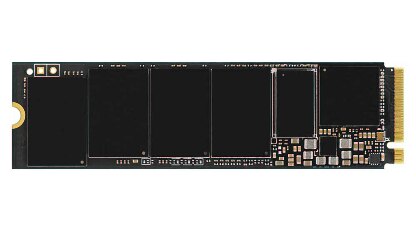
Physically, the P5800X 800 GB shares the same 2.5-inch U.2 (SFF-8639) 15 mm form factor as the 400 GB model, requiring a U.2-compatible motherboard backplane or a U.2-to-M.2/PCIe adapter for installation in systems without native U.2 ports. Power consumption ranges from 18–21 W under load, demanding active airflow in server or workstation chassis. Intel's discontinuation of Optane media production in 2022 means the P5800X family represents the end of the line for 3D XPoint technology; remaining inventory is managed by Solidigm (SK Hynix) and no successor products are planned. For the enterprise workloads that justify its cost — high-frequency trading, write-intensive database logging, latency-bound caching tiers — the P5800X 800 GB remains unmatched and is likely to remain so for the foreseeable future.
Storage Comparisons:
DC P5800X Performance & Benchmarks
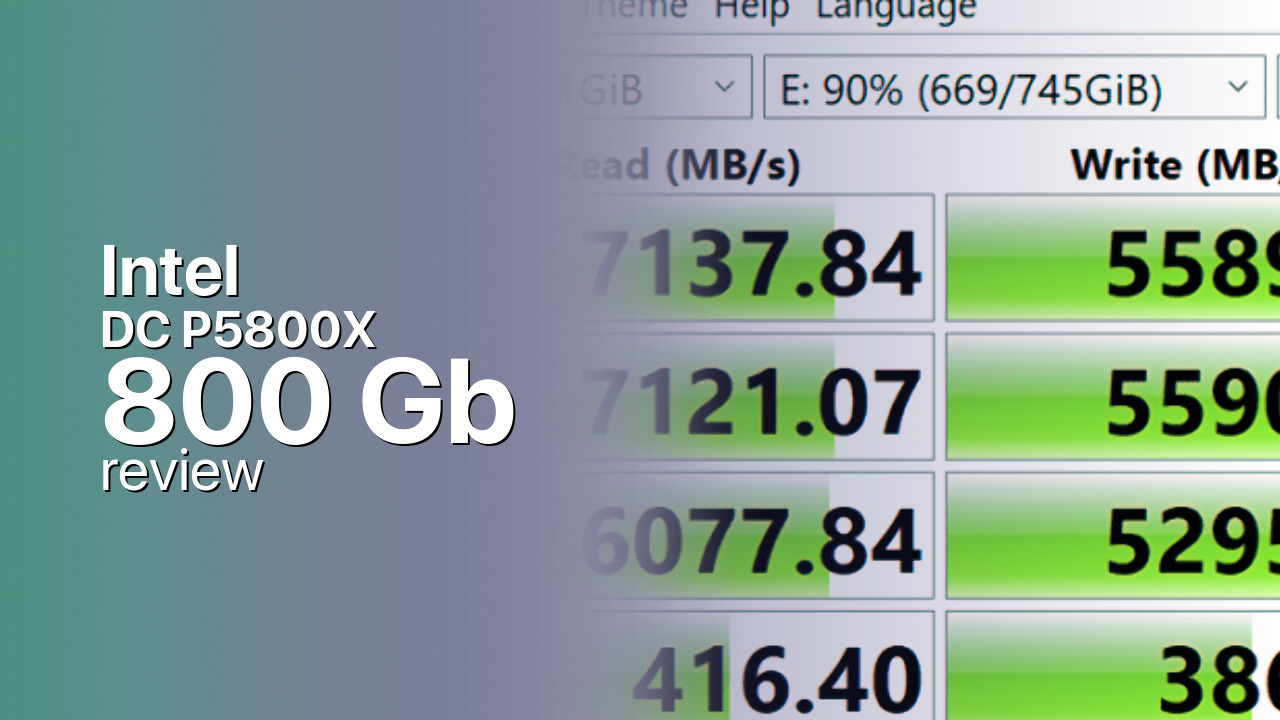
The P5800X 800 GB delivers performance identical to the 400 GB model in every metric, with the capacity doubling providing a larger working set without any throughput penalty. Sequential reads and writes saturate the PCIe 4.0 x4 interface at 7,400 MB/s in both directions, sustained indefinitely — a full-drive 800 GB sequential write completes at 7,400 MB/s from start to finish with no speed transitions. Random 4K read at QD1 reaches 450,000–500,000 IOPS, and random 4K write at QD1 hits 350,000–400,000 IOPS, both figures representing performance that no NAND SSD of any generation or price can match. The low-queue-depth dominance stems from Optane's ~5–7 microsecond read latency, which is roughly 10–20x lower than the 50–80 microsecond latency of a fast NAND SSD and approaches the ~0.1 microsecond latency of DRAM.
Intel DC P5800X 800 GB vs U.2 2.5" or E1.S peers
Switch between sequential throughput and random IOPS to see how this drive stacks up against other U.2 2.5" or E1.S SSDs in our database. The highlighted bar is the drive on this page — click any other bar to open that drive.
- Intel DC P5800X 800 GB (this drive): 7,400 MB/s read, 7,400 MB/s write
- Intel DC P5800X 400 GB: 7,400 MB/s read, 7,400 MB/s write
- Intel DC P5800X 1.6 TB: 7,200 MB/s read, 6,200 MB/s write
In mixed-workload scenarios — the realistic pattern for databases, virtualisation hosts, and storage controllers — the P5800X excels because its performance does not degrade under simultaneous reads and writes. NAND SSDs suffer from read/write interference: an ongoing write operation can stall pending reads because the NAND die is busy programming. Optane's in-place write capability eliminates this interference, allowing reads and writes to proceed concurrently at near-full speed. StorageReview measured the 800 GB P5800X at over 2 million mixed random 4K IOPS (70/30 read/write), a figure that no NAND drive approaches even at peak single-workload performance. Thermally, the 800 GB model's higher NAND-equivalent package count slightly increases power draw at full load (21 W versus 18 W for the 400 GB), but the U.2 enclosure's thermal mass and the requirement for forced airflow keep the drive comfortably within its 0–85 °C operating range in any properly cooled server chassis.
Endurance, TBW & Warranty
Intel warrants the DC P5800X 800 GB for 5 years with an endurance rating of 100 drive writes per day (DWPD). This equates to 80 TB of sustained writes per day, or approximately 146,000 TBW over the full warranty period. For comparison, the most durable consumer NVMe SSD at 2 TB carries 3,600 TBW — the P5800X 800 GB can write that entire endurance budget roughly 40 times over. The endurance is a direct consequence of 3D XPoint's physics: the chalcogenide glass storage medium changes resistance state in response to applied current without the cumulative oxide-layer damage that NAND's Fowler-Nordheim tunnelling mechanism inflicts on floating-gate and charge-trap cells. Optane media endurance is measured in tens of millions of write cycles per cell versus NAND's thousands. Intel's enterprise warranty programme provides advance replacement and dedicated technical support channels; following the Solidigm transition, buyers should confirm current warranty service arrangements through their enterprise distribution channel.
Intel DC P5800X 800 GB Specifications
| Category | Value |
|---|---|
| Capacity [?] | 800 GB |
| Interface [?] | U.2 2.5" or E1.S |
| Controller [?] | Intel |
| Memory type [?] | Intel Optane 2nd Gen |
| DRAM [?] | No |
| Read speed (MB/s) [?] | 7400 |
| Write speed (MB/s) [?] | 7400 |
| Read IOPS [?] | 1550000 |
| Write IOPS [?] | 1600000 |
| Endurance (TBW) [?] | 146000 |
| MTBF (million hours) [?] | 2 |
| Warranty (years) [?] | 5 |
Verdict: Is the DC P5800X Worth It in 2026?
The Intel Optane DC P5800X 800 GB is a product from a storage future that will not arrive. It is the fastest SSD ever manufactured, combining PCIe 4.0 interface bandwidth with Optane's unique low-latency, high-endurance, symmetric-performance characteristics, and it occupies a performance tier that no NAND-based product — consumer or enterprise, current or planned — can reach. At 800 GB, it provides enough capacity to serve as a practical working volume for latency-sensitive enterprise workloads rather than merely a caching or logging target, while retaining the full 100 DWPD endurance that makes write endurance a non-issue for any realistic deployment. The P5800X is also a dead-end product: with 3D XPoint production ended and no successor technology on any manufacturer's roadmap, it is the last of its kind. For the narrow set of workloads that need what only Optane can provide, the P5800X 800 GB is worth every dollar of its four-figure price. For everyone else, a high-end NAND NVMe SSD at one-tenth the cost per gigabyte is the rational choice.
+ Pros
- Fastest SSD ever made — no NAND drive approaches it
- 7,400 MB/s symmetric sustained reads and writes
- 100 DWPD endurance — 146,000 TBW over 5 years
- ~5–7 μs latency vs. 50–80 μs for NAND
- 800 GB capacity suits larger working-set workloads
- No performance degradation under mixed read/write loads
- Cons
- Enterprise pricing — $2,000+ at launch
- U.2 15 mm form factor requires compatible infrastructure
- 18–21 W power draw mandates active cooling
- Optane discontinued — no future products or long-term supply
- Enterprise-only warranty and support channels
Buy this or similar SSD Storage:



Video Review
The Storage of the Gods: A Deep Dive Into the Intel Optane P5800X