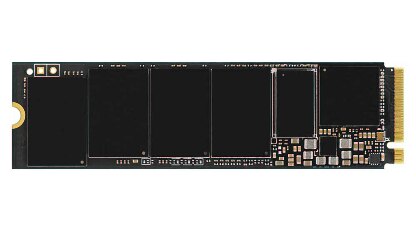
Kioxia BG4 1TB - M.2 2230 PCIe 3.0 NVMe SSD (2026)
Quick answer
The Kioxia BG4 1 TB is the conservative pick for an M.2 2230 upgrade in handhelds and ultrabooks where battery life and thermal headroom matter more than peak throughput.
Read: 2300 MB/s Write: 1800 MB/s Endurance: 960 TBW Warranty: 5 years Interface: M.2 3.0 x 4 2230 S3
The Kioxia BG4 1TB is a tiny single-package M.2 2230 NVMe used heavily by laptop OEMs and as a popular Steam Deck and ROG Ally upgrade target - 2,300 MB/s reads from a 96-layer BiCS4 TLC HMB design.
Controller & Memory
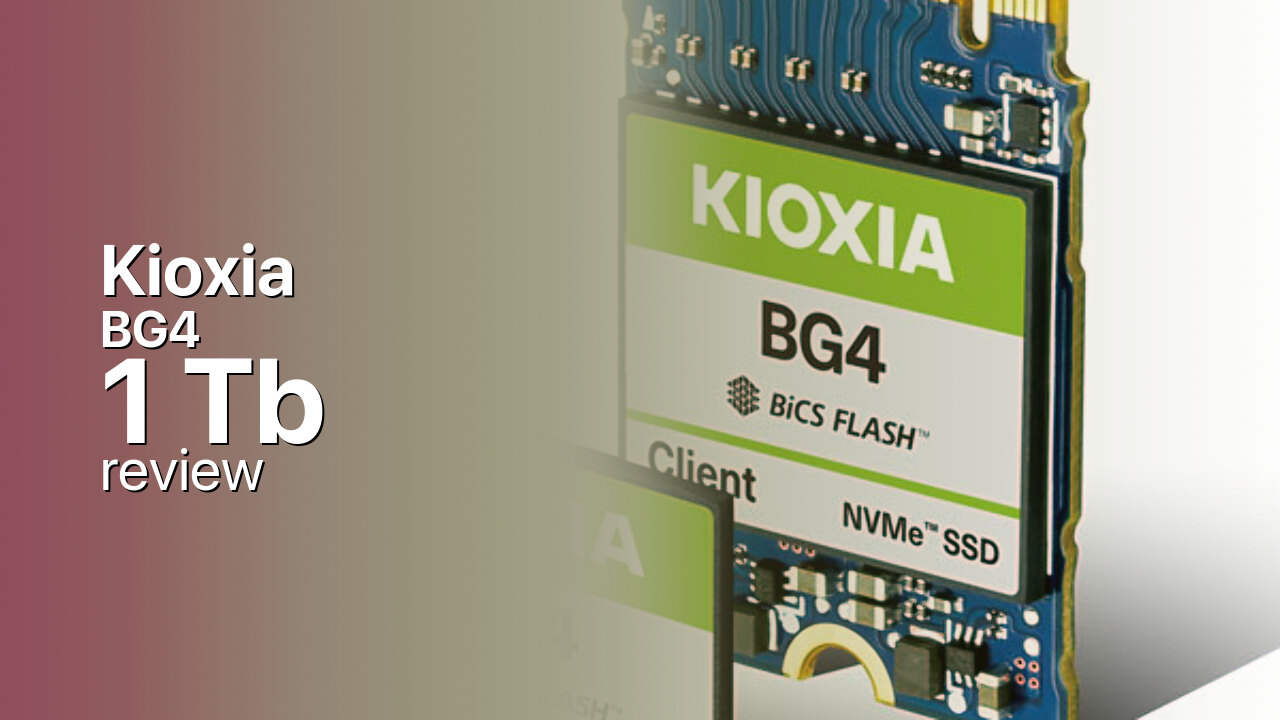
The Kioxia BG4 1 TB (KBG40ZNS1T02) packs an in-house Kioxia eight-channel NVMe controller, 96-layer BiCS4 3D TLC NAND, and the host system's Host Memory Buffer (HMB) capability onto a single M.2 2230 module measuring 22 by 30 millimetres. It is the OEM successor to the BG3 (PCIe 3.0 x2) and uses the full PCIe 3.0 x4 interface for materially higher peak speeds. The compact 2230 form factor is the drive's main selling point: it slots cleanly into space-constrained devices including the Steam Deck, Steam Deck OLED, ASUS ROG Ally, Lenovo Legion Go, several Microsoft Surface variants, and the M.2 2230 slot on numerous business and ultrabook laptops.
Kioxia ships the BG4 in 128 GB, 256 GB, 512 GB, and 1 TB capacities, plus a surface-mount M.2 1620 BGA package for direct-to-board OEM integration. The 1 TB you see here is the highest-capacity removable BG4 module and currently the standard upgrade target for handhelds because the factory configurations ship at 256 GB or 512 GB. The product is officially an OEM-only design, so it is sold via system integrators, second-source distributors such as drivesolutions.com, and surplus channels on Amazon and eBay rather than through Kioxia's retail line.
Direct rivals at the M.2 2230 form factor are the WD Black SN770M 1 TB (PCIe 4.0, faster but warmer), the Sabrent Rocket 2230 (PCIe 4.0), the Corsair MP600 Mini 1 TB (PCIe 4.0), and the Kioxia BG5 1 TB (the BG4's PCIe 4.0 successor). Within those, the BG4 sits at the conservative end of the field - PCIe 3.0 only, no on-board DRAM - which trades raw speed for the lowest power consumption of any 1 TB 2230 drive on the market.
Storage Comparisons:
BG4 Performance & Benchmarks
Manufacturer ratings for the BG4 1 TB land at 2,300 MB/s sequential reads and 1,800 MB/s sequential writes, with random performance up to 390,000 read and 200,000 write IOPS at high queue depths. Reviewers at KitGuru, StorageReview, and The SSD Review consistently measured CrystalDiskMark sequential reads within a few percent of the rating, with strong random-read performance for an HMB design - the BG4's read IOPS is unusually high for a DRAM-less drive of its era.
Kioxia BG4 1 TB vs M.2 3.0 x 4 2230 S3 peers
Switch between sequential throughput and random IOPS to see how this drive stacks up against other M.2 3.0 x 4 2230 S3 SSDs in our database. The highlighted bar is the drive on this page — click any other bar to open that drive.
- Kioxia BG4 1 TB (this drive): 2,300 MB/s read, 1,800 MB/s write
- Kioxia BG4 128 GB: 2,300 MB/s read, 1,800 MB/s write
- Kioxia BG4 256 GB: 2,300 MB/s read, 1,800 MB/s write
- Kioxia BG4 512 GB: 2,300 MB/s read, 1,800 MB/s write
Sustained writes show the limitation: with no on-board DRAM and the dense BGA package limiting thermal dissipation, the BG4 falls into TLC direct-write rates fairly quickly under continuous load. Reviewers observed write performance dropping below 800 MB/s after the SLC cache exhausts on a near-full drive. For a handheld upgrade or laptop boot drive that profile is invisible - game level loads, application launches, and OS responsiveness all benefit from the high random-read rating. For sustained capture or large dataset moves, plan around the limit. Active power consumption peaks around 3.7 W (typical), which is one of the BG4's strengths in handheld devices: it consumes less power than the WD Black SN770M and stays cooler in the Steam Deck's tight thermal envelope.
Endurance, TBW & Warranty
Because the BG4 is an OEM-only product, warranty length depends on the channel through which the drive was purchased. Devices shipped from a system integrator (Dell, HP, Lenovo, Microsoft Surface, Valve, ASUS) carry the host-device warranty, typically one to two years. Drives bought as bare modules through second-source resellers may carry a shorter limited warranty (often one year) or no warranty at all - check the seller's listing carefully before purchase. Kioxia itself does not publish a consumer TBW figure for the BG4 in its public product brief, and there is no direct-to-Kioxia consumer RMA channel for an OEM module. For mission-critical use, plan a backup target and treat the BG4 as a reliable but unwarranted upgrade rather than a serviceable consumer drive. The published MTBF rating is 1.5 million hours.
Kioxia BG4 1 TB Specifications
| Category | Value |
|---|---|
| Capacity [?] | 1 TB |
| Interface [?] | M.2 3.0 x 4 2230 S3 |
| Controller [?] | Toshiba |
| Memory type [?] | Kioxia 96-L TLC |
| DRAM [?] | HMB |
| Read speed (MB/s) [?] | 2300 |
| Write speed (MB/s) [?] | 1800 |
| Read IOPS [?] | 390000 |
| Write IOPS [?] | 200000 |
| Endurance (TBW) [?] | 960 |
| MTBF (million hours) [?] | 1.5 |
| Warranty (years) [?] | 5 |
Verdict: Is the BG4 Worth It in 2026?
The Kioxia BG4 1 TB is the conservative pick for an M.2 2230 upgrade in handhelds and ultrabooks where battery life and thermal headroom matter more than peak throughput. Steam Deck, ROG Ally, and Legion Go owners who want longer runtime should consider the BG4 over the WD Black SN770M 1 TB or Corsair MP600 Mini 1 TB, both of which are faster but warmer and more power-hungry. Skip the BG4 if your priority is peak performance for a desktop-class workload, or if you need a stronger warranty channel - in either case, the Kioxia BG5 1 TB (PCIe 4.0, same form factor) or WD Black SN770M 1 TB are better fits. As a low-power, low-heat, mid-speed 2230 NVMe, the BG4 1 TB remains one of the cleanest handheld upgrades on the market.
+ Pros
- 2,300 MB/s reads in M.2 2230 form factor
- 390,000 IOPS rated random reads
- Low 3.7 W typical power for handheld battery life
- Stays cool in Steam Deck and ROG Ally thermal envelopes
- Kioxia in-house 96-layer BiCS4 TLC NAND
- Single-package design eases handheld installation
- Cons
- PCIe 3.0 only, slower than BG5 successor and SN770M
- DRAM-less HMB design lags on heavy random writes
- OEM-only distribution complicates retail warranty
- No published TBW endurance rating from Kioxia
- Sustained writes drop below 800 MB/s after SLC cache
Buy this or similar SSD Storage:



Video Review
The TINY 1TB SSD