KLEVV CRAS C925G 512GB review: budget speed with staying power (2026)
Quick answer
The CRAS C925G 512GB suits two buyers particularly well: budget builders who want near-flagship Gen4 read speeds without flagship money, and owners of aging SATA or PCIe 3 systems chasing a painless responsiveness jump - the five-year warranty and 600 TBW rating de-risk either purchase.
Read: 7400 MB/s Write: 6200 MB/s Endurance: 600 TBW Warranty: 5 years Interface: M.2 4.0 x 4
The KLEVV CRAS C925G 512GB brings flagship-grade 7,400 MB/s reads, 600 TBW of endurance and a five-year warranty to the budget end of PCIe 4.0 storage.
Controller & Memory
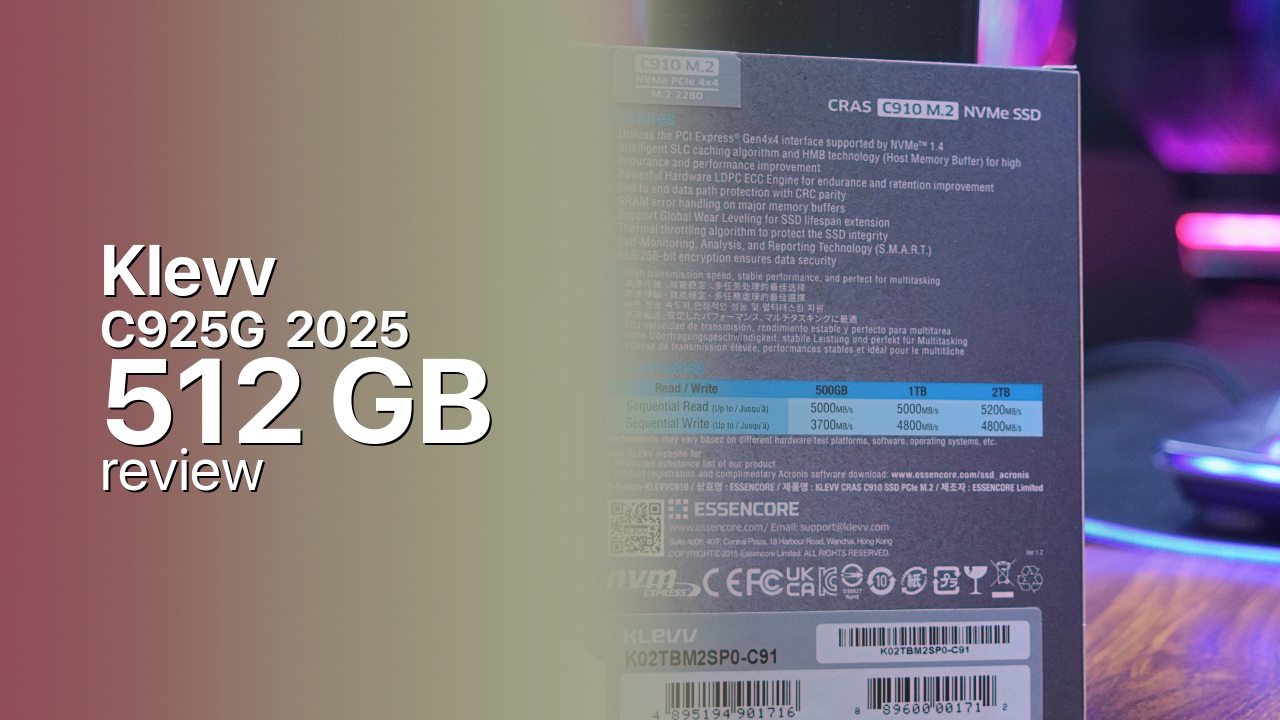
The CRAS C925G is KLEVV's refreshed take on its well-received C925, pairing the Maxio MAP1602 - a 12nm quad-channel DRAM-less controller - with strictly-selected SK Hynix 238-layer 3D TLC NAND. Everything runs over PCIe 4.0 x4 with NVMe 2.0 support, mapping tables live in system memory through Host Memory Buffer, and an intelligent SLC caching algorithm absorbs everyday writes. The board is single-sided M.2 2280, and KLEVV ships each drive wearing an ultra-thin copper-graphene composite heatsink the company credits with roughly 15 percent lower temperatures than its older aluminium design.
At the entry capacity this drive keeps the same headline read rating as its siblings - up to 7,400 MB/s - though writes are tiered lower here, at 6,200 MB/s against 6,300 MB/s for 1 TB and 6,500 MB/s for 2 TB. Random figures stand at 670K reads and 980K writes IOPS for this size. Endurance deserves special mention: 600 TBW at the smallest capacity is generous for a budget drive, scaling to 1,200 and then 2,400 TBW up the range, all under one five-year warranty.
Internally it closely mirrors drives like the Lexar NM790, which combines the same controller family with similar Hynix NAND, while reviewers at Basic Tutorials have benchmarked the line alongside the Crucial P3 Plus. The C925G's counter-argument rests on its high official endurance ratings, long warranty, and included graphene heatsink - a 2.8 mm stack total that slips into laptops, small-form-factor builds and console bays without clearance drama.
Storage Comparisons:
C925G 2025 Performance & Benchmarks
KLEVV rates this capacity at up to 7,400 MB/s sequential reads and 6,200 MB/s sequential writes over PCIe 4.0 x4, plus 670,000 random-read and 980,000 random-write IOPS. Those numbers sit close to the practical ceiling of the Gen4 interface, and independent testing makes them credible: Tech4Gamers measured peaks around 7,378/6,383 MB/s on the 2 TB model, while Basic Tutorials' 2 TB sample landed a few hundred megabytes under spec in CrystalDiskMark yet still outpaced the Crucial P3 Plus sequentially in AS SSD. Expect the same character at this smaller size, with lower write ratings: excellent burst speed, strong 4K latency, and throughput that sags once the pseudo-SLC cache fills during very large sustained transfers.
Klevv C925G 2025 512 GB vs M.2 4.0 x 4 peers
Switch between sequential throughput and random IOPS to see how this drive stacks up against other M.2 4.0 x 4 SSDs in our database. The highlighted bar is the drive on this page — click any other bar to open that drive.
- Patriot Viper PV593 1 TB: 14,500 MB/s read, 14,000 MB/s write
- Patriot Viper PV593 2 TB: 14,500 MB/s read, 14,000 MB/s write
- Patriot Viper PV593 4 TB: 14,500 MB/s read, 14,000 MB/s write
- Patriot Viper PV573 2 TB: 14,000 MB/s read, 12,000 MB/s write
- Klevv C925G 2025 512 GB (this drive): 7,400 MB/s read, 6,200 MB/s write
Daily use tells a simpler story: Windows boots in seconds, games stream without stutter, and the controller's L1.2 low-power state helps notebook battery life. Sustained professional writes expose the DRAM-less ceiling - after enough continuous data the cache exhausts and speed falls toward native TLC rates until recovery. Reviewers of the platform report that HMB handles ordinary multitasking smoothly on modern systems.
Klevv C925G 2025 vs Competitors
See how the C925G 2025 stacks up against other M.2 4.0 x 4 drives in our database:
Compare with rival drives:
Endurance, TBW & Warranty
KLEVV backs the entire CRAS C925G line with a five-year limited warranty and rates this 512 GB version at 600 TBW of total host writes. That endurance figure stands out in the budget segment, where 400-500 TBW is more typical, and at a normal 20-50 GB written per day the allowance would take decades to exhaust. Coverage ends at whichever comes first: five years or the terabyte limit. The platform adds hardware LDPC error correction, global wear leveling, end-to-end CRC data path protection and thermal throttling safeguards, with detailed reviews of the line also noting sudden power-loss protection. KLEVV's official product sheet quotes no MTBF figure, so treat any precise number you see elsewhere as unofficial.
Klevv C925G 2025 512 GB Specifications
| Category | Value |
|---|---|
| Capacity [?] | 512 GB |
| Interface [?] | M.2 4.0 x 4 |
| Controller [?] | Maxio Technology MAP1602-F3C |
| Memory type [?] | SK Hynix 238-L 4D TLC |
| DRAM [?] | No |
| Read speed (MB/s) [?] | 7400 |
| Write speed (MB/s) [?] | 6200 |
| Read IOPS [?] | 670000 |
| Write IOPS [?] | 980000 |
| Endurance (TBW) [?] | 600 |
| MTBF (million hours) [?] | 2000000 |
| Warranty (years) [?] | 5 |
Verdict: Is the C925G 2025 Worth It in 2026?
The CRAS C925G 512GB suits two buyers particularly well: budget builders who want near-flagship Gen4 read speeds without flagship money, and owners of aging SATA or PCIe 3 systems chasing a painless responsiveness jump - the five-year warranty and 600 TBW rating de-risk either purchase. Skip it if you push constant multi-hundred-gigabyte video workloads, where any DRAM-less design eventually throttles and a DRAM-equipped alternative serves better. Also weigh the 1 TB step-up seriously: it costs proportionally little more, doubles endurance to 1,200 TBW, and adds 100 MB/s of write headroom. As pure value propositions go, though, few budget drives can match this specification sheet.
+ Pros
- Rated 7,400 MB/s reads, near the Gen4 ceiling
- 600 TBW endurance, generous for the budget class
- Five-year limited warranty across all capacities
- Copper-graphene heatsink pre-installed, just 2.8 mm thick
- Single-sided layout fits laptops and consoles
- Cons
- Write rating trails the 2 TB model by 300 MB/s
- DRAM-less design leans on system memory via HMB
- Sustained writes slow after SLC cache exhausts
- Entry capacity offers the least endurance headroom
Buy this or similar SSD Storage:



Video Review
STOP Overspending On YOUR SSD! 😲 #gamingpc #pcbuild #pcbuildtips #ssd #samsungssd #kingstonssd