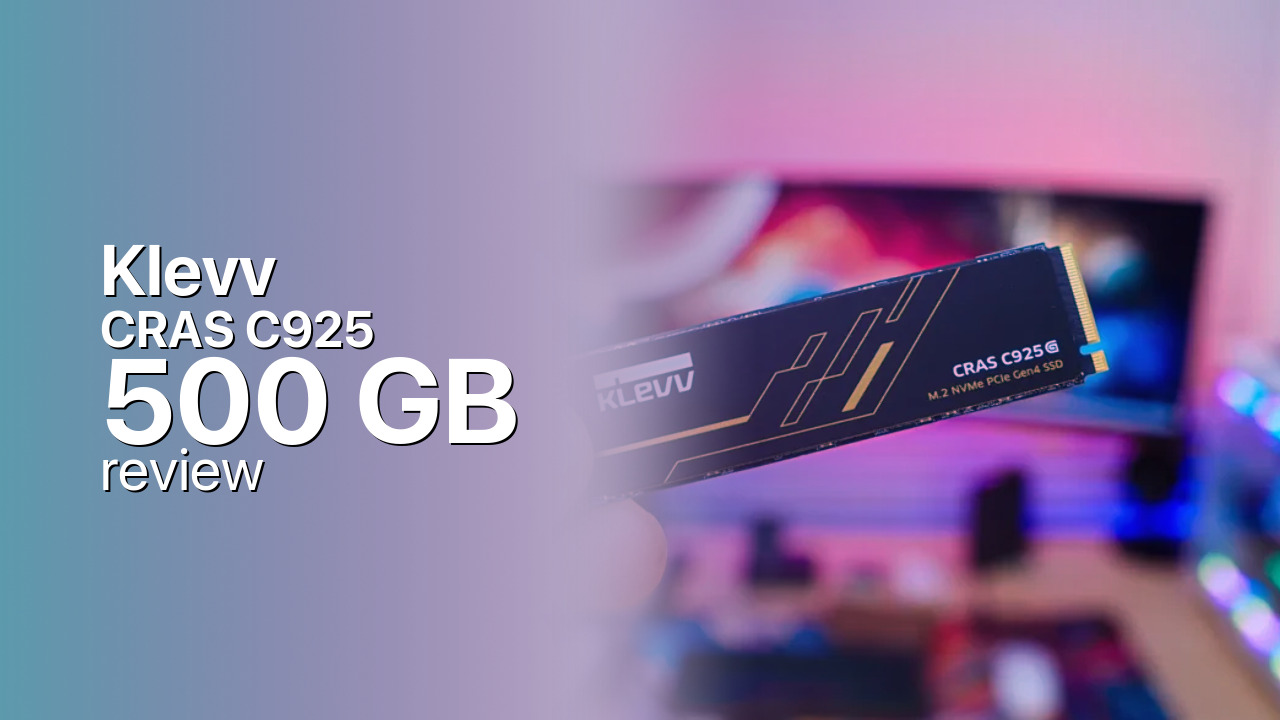
Klevv CRAS C925 500GB: A Steady Budget PCIe 4.0 Pick (2026)
Quick answer
The Klevv CRAS C925 500GB makes sense for anyone who wants a PCIe 4.0 boot or storage-expansion drive at a budget price and cares more about long-term endurance than chart-topping benchmarks; it's a solid fit for a laptop upgrade, a Mini PC, or a secondary PS5 drive.
Read: 7400 MB/s Write: 6200 MB/s Endurance: 600 TBW Warranty: 5 years Interface: M.2 4.0 x 4
The Klevv CRAS C925 500GB is a DRAM-less PCIe 4.0 NVMe drive that trades outright speed for genuinely strong endurance in its price class.
Controller & Memory
Inside the Klevv CRAS C925 500GB is a Maxio MAP1602 controller paired with 238-layer 3D TLC NAND and no dedicated DRAM chip; the drive leans on Host Memory Buffer (HMB) technology to keep its mapping tables fast. It runs over a PCIe 4.0 x4 link using the NVMe 1.4 protocol, ships in the standard single-sided M.2 2280 form factor, and includes AES 256-bit hardware encryption for data-at-rest protection. The single-sided PCB keeps the drive thin and runs a bit cooler than double-sided designs, since there are no components on the back to trap heat.
The C925 sits in Klevv's mainstream tier, positioned above the entry-level C910 and below the flagship C930. It comes in 500 GB, 1 TB, and 2 TB capacities, and this 500 GB model is the slowest of the three on sustained writes, since fewer NAND dies means less parallelism; the 1 TB and 2 TB versions post higher write and IOPS numbers on the same controller and NAND generation.
Being single-sided and heatsink-free out of the box, the C925 500GB fits laptops, Mini PCs, and the PlayStation 5's M.2 slot without any thermal-clearance headaches. Klevv positions it against similarly priced DRAM-less PCIe 4.0 rivals like the WD Black SN770 and Crucial P3 Plus; the C925's selling point next to those is its unusually generous TBW rating for a budget-tier drive rather than outright speed.
Storage Comparisons:
CRAS C925 Performance & Benchmarks
The 500 GB Klevv CRAS C925 is rated for up to 7,400 MB/s sequential reads and 6,200 MB/s sequential writes, with up to 670,000 IOPS on random reads and 980,000 IOPS on random writes. Those are the smallest-capacity numbers in the C925 range; the 1 TB and 2 TB models climb to 6,300 MB/s and 6,500 MB/s write respectively, since they can spread writes across more NAND dies in parallel.
Klevv CRAS C925 500 GB vs M.2 4.0 x 4 peers
Switch between sequential throughput and random IOPS to see how this drive stacks up against other M.2 4.0 x 4 SSDs in our database. The highlighted bar is the drive on this page — click any other bar to open that drive.
- Patriot Viper PV593 1 TB: 14,500 MB/s read, 14,000 MB/s write
- Patriot Viper PV593 2 TB: 14,500 MB/s read, 14,000 MB/s write
- Patriot Viper PV593 4 TB: 14,500 MB/s read, 14,000 MB/s write
- Patriot Viper PV573 2 TB: 14,000 MB/s read, 12,000 MB/s write
- Klevv CRAS C925 500 GB (this drive): 7,400 MB/s read, 6,200 MB/s write
Like nearly every DRAM-less, HMB-based drive, the C925 leans on SLC caching to hit its peak sequential-write number; once sustained transfers exceed the cache, throughput drops toward the NAND's native TLC write speed, and that cache is proportionally smaller on a 500 GB drive than on the 1 TB or 2 TB models. Buyers moving very large files, like 100 GB+ game installs or video exports, will notice the fall-off sooner than owners of a bigger capacity. For everyday use, booting Windows, loading games, general file work, read speed and random IOPS matter more than sustained sequential writes, and there the drive performs in line with other mainstream PCIe 4.0 NVMe drives. Independent reviewers have generally found the C925 line delivers competent, if unremarkable, real-world performance for its price bracket rather than class-leading numbers.
Klevv CRAS C925 vs Competitors
See how the CRAS C925 stacks up against other M.2 4.0 x 4 drives in our database:
Compare with rival drives:
Endurance, TBW & Warranty
Klevv rates the 500 GB CRAS C925 at 600 TBW and backs it with a 5-year limited warranty, generous for a budget-tier DRAM-less drive, and one of the specific things Tom's Hardware called out as a genuine standout in its review. At a realistic 20-30 GB per day write workload, 600 TBW works out to roughly 55-80 years before the drive reaches its rated endurance limit, well beyond both the warranty period and the practical lifespan of the rest of the PC around it. Klevv also lists a 2,000,000-hour MTBF figure, though that's a population-level statistical average across many drives rather than a promise about any single unit's lifespan. Warranty service runs through Klevv's regional RMA process rather than the retailer directly, so keep your purchase receipt on hand.
Klevv CRAS C925 500 GB Specifications
| Category | Value |
|---|---|
| Capacity [?] | 500 GB |
| Interface [?] | M.2 4.0 x 4 |
| Controller [?] | Maxio MAP1602 |
| Memory type [?] | TLC |
| DRAM [?] | No |
| Read speed (MB/s) [?] | 7400 |
| Write speed (MB/s) [?] | 6200 |
| Read IOPS [?] | 670000 |
| Write IOPS [?] | 980000 |
| Endurance (TBW) [?] | 600 |
| MTBF (million hours) [?] | 2000000 |
| Warranty (years) [?] | 5 |
Verdict: Is the CRAS C925 Worth It in 2026?
The Klevv CRAS C925 500GB makes sense for anyone who wants a PCIe 4.0 boot or storage-expansion drive at a budget price and cares more about long-term endurance than chart-topping benchmarks; it's a solid fit for a laptop upgrade, a Mini PC, or a secondary PS5 drive. Buyers who move huge files constantly, like 4K video editors working directly off the drive, should skip it and look at a DRAM-equipped model instead, since the C925's SLC cache runs out faster on this smaller 500 GB capacity. If outright sustained write speed matters more than endurance headroom, the WD Black SN770 is worth comparing at a similar price. Overall this is a dependable, unglamorous drive: not the fastest PCIe 4.0 SSD at its price, but one of the more durable ones, backed by a genuinely useful 5-year warranty.
+ Pros
- 600 TBW endurance, high for a budget drive
- 5-year manufacturer warranty
- 7,400 MB/s sequential reads on PCIe 4.0
- Single-sided M.2 2280 fits laptops and PS5
- AES 256-bit hardware encryption included
- Good power efficiency in independent testing
- Cons
- 500GB write speed trails the 1TB and 2TB models
- No DRAM cache, relies on HMB
- SLC cache exhausts sooner on this smaller capacity
- No heatsink included out of the box
Buy this or similar SSD Storage:



Video Review
KLEVV CRAS XR5 RGB Series, LPCAMM2 Module, CRAS C925, Genuine G560 NVMe Gen5 SSD Launched @ Computex