Mushkin Helix-L 960GB Review — A Legacy Budget NVMe, Revisited (2026)
Quick answer
Buy the Mushkin Helix-L 960GB only in its natural habitat: a clearance-bin find for reviving an older Gen3 laptop or desktop that needs a real NVMe boot drive and TLC endurance on a strict budget.
Read: 2110 MB/s Write: 1700 MB/s Warranty: 3 years Interface: M.2 3.0 x 4
The Mushkin Helix-L 960GB is a 2018-vintage budget NVMe that still covers Gen3 basics — DRAM-less HMB design, TLC NAND and a 3-year warranty.
Controller & Memory
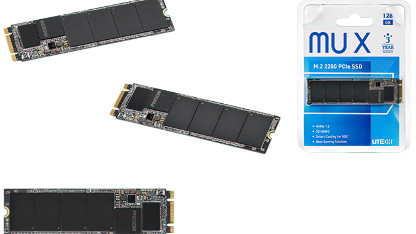
The Mushkin Helix-L 960GB belongs to a moment when NVMe pricing first collapsed into SATA territory. Announced at CES 2018 and sold through the following years, the Helix-L is Mushkin's low-cost take on Silicon Motion's SM2263XT: a four-channel PCIe 3.0 controller running DRAM-less, with a 64 MB Host Memory Buffer standing in for a DRAM package and Micron 64-layer TLC storing the data. The 960 GB variant carries the MKNSSDHL960GB-D8 part number, sits on a single-sided M.2 2280 board, and uses the PCIe 3.0 x4 link with NVMe 1.3.
Mushkin's Helix-L sizing was always idiosyncratic — the documented range is 250 GB, 500 GB and 1 TB, with this 960 GB SKU sold alongside them — and the ratings moved over the years. Early sheets advertised 1,700/1,500 MB/s across the family; the later -D8 revision lists 2,110 MB/s reads and 1,700 MB/s writes for the top capacities, which is the figure Mushkin's own 960 GB listing carries. Tom's Hardware's per-capacity table puts endurance at 150, 300 and 600 TBW for the 250 GB through 1 TB models, with no TBW published for the 960 GB specifically.
Today the drive is a legacy purchase: most retail listings show out of stock, and reviewers' comparisons — Toshiba's OCZ RC100, ADATA's Gammix S11, the Patriot Hellfire — have all aged out of production too. Its remaining audience is the revive-and-reuse crowd: an older Gen3 laptop or desktop that deserves a proper NVMe boot drive and a Helix-L surfaces at a clearance price. Against current budget drives like the WD Blue SN570 it trails on speed, warranty length and availability, so context is everything here.
Storage Comparisons:
Helix-L Performance & Benchmarks
Mushkin's current rating for the 960 GB Helix-L is up to 2,110 MB/s sequential reads and 1,700 MB/s writes, with the launch-era sheets having quoted 1,700/1,500 MB/s — both figures refer to this family, revision-dependent. Random performance is rated at 280K reads and 250K writes with HMB engaged on Mushkin's spec sheet, though Tom's Hardware and TechPowerUp list 240K/260K for the largest capacities, so treat the figures as capacity-dependent manufacturer numbers rather than guarantees.
MUSHKIN Helix-L 960 GB vs M.2 3.0 x 4 peers
Switch between sequential throughput and random IOPS to see how this drive stacks up against other M.2 3.0 x 4 SSDs in our database. The highlighted bar is the drive on this page — click any other bar to open that drive.
- ADATA SX 8800 Pro 512 GB: 3,500 MB/s read, 2,700 MB/s write
- ADATA SX 8800 Pro 1 TB: 3,500 MB/s read, 2,700 MB/s write
- ADATA XPG Spectrix S40G RGB 256 GB: 3,500 MB/s read, 3,000 MB/s write
- ADATA XPG Spectrix S40G RGB 512 GB: 3,500 MB/s read, 3,000 MB/s write
- MUSHKIN Helix-L 960 GB (this drive): 2,110 MB/s read, 1,700 MB/s write
Character matters more than peaks on a drive like this. The 64 MB Host Memory Buffer keeps everyday responsiveness close to DRAM-equipped drives, and Tom's Hardware's testing of the 1 TB sibling found surprisingly good behavior in a 50 GB real-world folder transfer, averaging around 526 MB/s — competitive with far pricier names of the era. The other side is sustained load: the reviewers' consistent complaint, and a listed con at Tom's Hardware, is weak prosumer and sustained performance. TechPowerUp's database describes a large dynamic SLC write cache — roughly 137 GB on the 1 TB — after which throughput settles to native TLC rates until the cache recovers. For boot duty, applications and gaming loads that pattern is invisible; for repeated large file writes it is exactly what the cons column warns about.
MUSHKIN Helix-L vs Competitors
See how the Helix-L stacks up against other M.2 3.0 x 4 drives in our database:
Compare with rival drives:
Endurance, TBW & Warranty
Mushkin covers the Helix-L with a 3-year limited warranty — the shortest mainstream coverage of its day, at a time when most rivals had moved to 5 years. Endurance is where the fine print thins out further: Mushkin publishes no TBW rating for the 960 GB SKU, so the honest statement is that the official write budget for this capacity is unpublished. The 1 TB sibling is rated 600 TBW, a figure Tom's Hardware noted matched the Samsung 970 EVO and WD Black SN750 of the era, and the identical 1,024 GB raw NAND suggests similar headroom — but that is inference, not a published rating. TechPowerUp's database lists 1.5 million hours MTBF for the family, a population statistic rather than a per-drive promise. Claims run through Mushkin's standard support channels with proof of purchase.
MUSHKIN Helix-L 960 GB Specifications
| Category | Value |
|---|---|
| Capacity [?] | 960 GB |
| Interface [?] | M.2 3.0 x 4 |
| Controller [?] | Silicon Motion SM2263XT |
| Memory type [?] | 3D TLC |
| DRAM [?] | No |
| Read speed (MB/s) [?] | 2110 |
| Write speed (MB/s) [?] | 1700 |
| Read IOPS [?] | 280000 |
| Write IOPS [?] | 250000 |
| Endurance (TBW) [?] | n/a |
| MTBF (million hours) [?] | n/a |
| Warranty (years) [?] | 3 |
Verdict: Is the Helix-L Worth It in 2026?
Buy the Mushkin Helix-L 960GB only in its natural habitat: a clearance-bin find for reviving an older Gen3 laptop or desktop that needs a real NVMe boot drive and TLC endurance on a strict budget. Skip it for any new build — current budget drives such as the WD Blue SN570 deliver more speed, 5-year warranties and published endurance ratings, and the Helix-L's 3-year coverage and unpublished 960 GB TBW are real compromises. The Toshiba OCZ RC100 and ADATA Gammix S11 it was reviewed against have exited the market with it, leaving newer value drives as the sane alternative. As a relic, it behaves; as a deliberate purchase in 2026, the market has moved on.
+ Pros
- Rated up to 2,110 MB/s reads, 1,700 MB/s writes
- TLC NAND, not QLC
- Single-sided M.2 2280 fits thin laptops
- Large dynamic SLC write cache (~137 GB on the 1TB)
- HMB keeps everyday responsiveness close to DRAM drives
- Cons
- 3-year warranty — shorter than most rivals
- TBW rating not published for the 960GB SKU
- Weak sustained performance per reviewers
- Gen3 speeds trail current budget Gen4 drives
- Largely out of stock — legacy availability
Buy this or similar SSD Storage:



Video Review
Mushkin Helix: high-performance PCIe SSD on the basis of the 3D MLC NAND