Orico O7000 4TB Review — Bulk Gen4 at the Budget Edge (2026)
Quick answer
Buy the Orico O7000 4TB when the mission is maximum terabytes per dollar without leaving the Gen4 fast lane: media archives, home servers, and full game libraries all suit its 7,000/6,600 MB/s ratings, 2,400 TBW endurance, and the thin PCB that fits machines bulk drives usually cannot.
Read: 7000 MB/s Write: 6600 MB/s Endurance: 2400 TBW Warranty: 5 years Interface: M.2 4.0 x 4
The Orico O7000 4TB tops its budget line with 2,400 TBW of endurance and 7,000 MB/s reads, all packed into a remarkably thin 2 mm, 6-gram PCB.
Controller & Memory
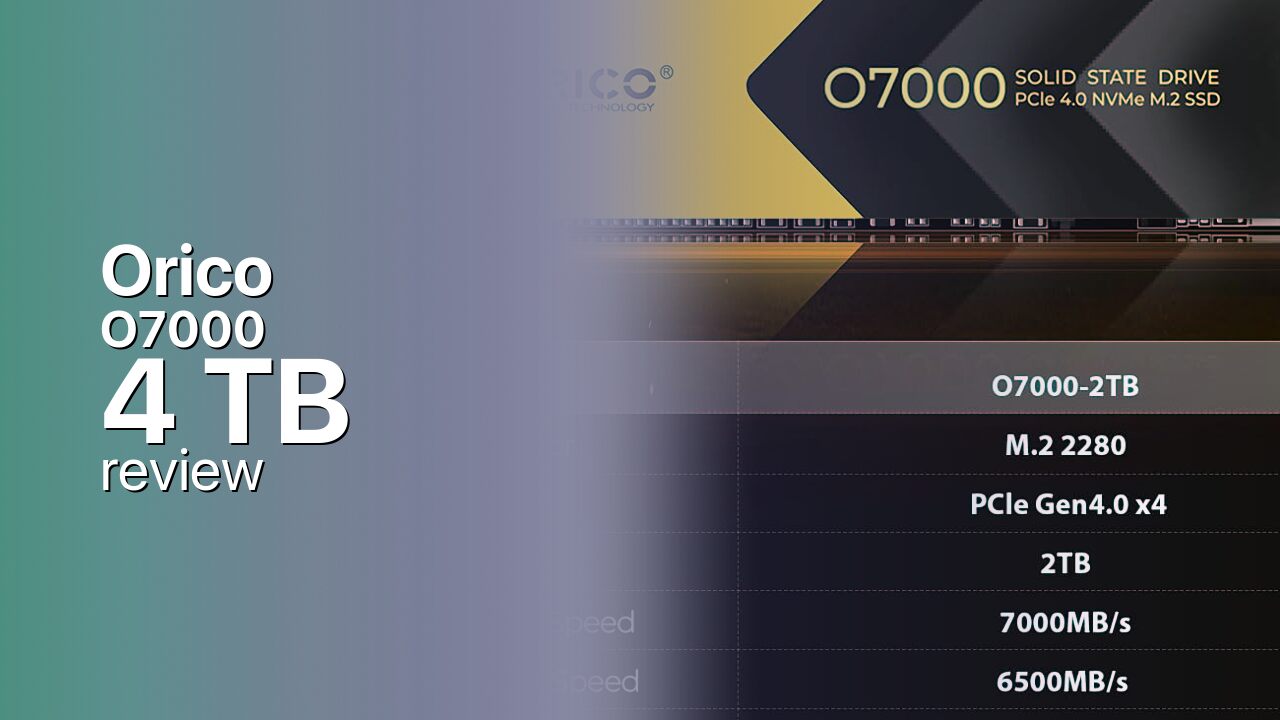
The Orico O7000 4TB closes the line at the capacity where budget drives usually make their biggest compromises, and it mostly refuses to: the same DRAM-less Maxio-class platform as its siblings, YMTC TLC behind it, and the line's full ratings of 7,000 MB/s reads and 6,600 MB/s writes over PCIe 4.0 x4. The physical design remains the range's signature — a 2 mm-thick, 5-to-6-gram PCB that, at four terabytes, is thinner than many 1 TB drives manage. For laptop upgrades and small-form-factor builds, that is not a trivia point; it is the difference between fitting and not.
Endurance is where the capacity makes its case: 2,400 TBW under a 5-year limited warranty, completing the line's clean 600 TBW-per-terabyte scaling from 300 TBW at 512 GB through 600 TBW at 1 TB and 1,200 TBW at 2 TB. That rating matches or beats name-brand bulk drives, and it matters at 4 TB because this is the capacity people buy to keep for a decade. The bracket is competitive — the Silicon Power UD90 and Kingston NV3 push the same value formulas, and the platform-adjacent Lexar NM790 4TB out-rates it at 7,400/6,500 MB/s with 3,000 TBW, typically for more money.
The buyer is an archive builder, a media hoard, a home server, or a gamer whose library has simply won the argument with smaller drives. What the 4 TB O7000 is not: a professional scratch disk (the DRAM-less design and unpublished random specs disqualify it), or a completely no-questions purchase (Orico's support network is young, so the retailer's return policy stays relevant). Within those bounds, it is a lot of fast storage for the money.
Storage Comparisons:
O7000 Performance & Benchmarks
The 4 TB O7000 carries the line ratings unchanged: 7,000 MB/s sequential reads and 6,600 MB/s writes over PCIe 4.0 x4, with no random IOPS figures published in Orico's documentation. Those sequential numbers sit within a few percent of the fastest Gen4 drives ever sold, and at 4 TB they are at their most believable — the most parallelized NAND in the line behind the same controller, and the largest pseudo-SLC cache absorbing bursts before native TLC rates ever appear.
Orico O7000 4 TB vs M.2 4.0 x 4 peers
Switch between sequential throughput and random IOPS to see how this drive stacks up against other M.2 4.0 x 4 SSDs in our database. The highlighted bar is the drive on this page — click any other bar to open that drive.
- Patriot Viper PV593 1 TB: 14,500 MB/s read, 14,000 MB/s write
- Patriot Viper PV593 2 TB: 14,500 MB/s read, 14,000 MB/s write
- Patriot Viper PV593 4 TB: 14,500 MB/s read, 14,000 MB/s write
- Patriot Viper PV573 2 TB: 14,000 MB/s read, 12,000 MB/s write
- Orico O7000 4 TB (this drive): 7,000 MB/s read, 6,600 MB/s write
Bulk capacity softens the usual DRAM-less caveats. Transfers that would exhaust a smaller drive's cache — library migrations, archive imports, home-server writes — mostly stay inside the fast zone here, and HMB keeps random performance respectable for everyday multitasking. The thin PCB concentrates the thermal question: denser NAND in a 2 mm envelope wants airflow or a motherboard heatsink for sustained heavy work, though for read-heavy archive duty the drive barely warms. Chinese press benchmarking of the line measured sequential performance at or slightly above the rated figures, and TechRadar's review of the family concluded the performance-to-price balance simply works. For pure read-heavy bulk storage, that is exactly the profile that matters.
Orico O7000 vs Competitors
See how the O7000 stacks up against other M.2 4.0 x 4 drives in our database:
Compare with rival drives:
Endurance, TBW & Warranty
Orico rates the O7000 4TB at 2,400 TBW under a 5-year limited warranty, whichever arrives first — the range's maximum, quadrupling the 512 GB tier and doubling the 1 TB model while maintaining the clean 600 TBW-per-terabyte scaling. At a heavy 40 GB written per day, that budget stretches past sixteen decades, so even archival workloads will never test the ceiling within the warranty term. The rated MTBF is 1.5 million hours across the line, a fleet-level reliability statistic rather than a promise about any individual drive. The 5-year coverage drew specific praise from TechPowerUp's database as excellent for the class; as ever with Orico, the younger support network keeps the seller's return window practically relevant.
Orico O7000 4 TB Specifications
| Category | Value |
|---|---|
| Capacity [?] | 4 TB |
| Interface [?] | M.2 4.0 x 4 |
| Controller [?] | Maxio MAP1602A |
| Memory type [?] | YMTC 232-L TLC |
| DRAM [?] | No |
| Read speed (MB/s) [?] | 7000 |
| Write speed (MB/s) [?] | 6600 |
| Read IOPS [?] | |
| Write IOPS [?] | |
| Endurance (TBW) [?] | 2400 |
| MTBF (million hours) [?] | 1500000 |
| Warranty (years) [?] | 5 |
Verdict: Is the O7000 Worth It in 2026?
Buy the Orico O7000 4TB when the mission is maximum terabytes per dollar without leaving the Gen4 fast lane: media archives, home servers, and full game libraries all suit its 7,000/6,600 MB/s ratings, 2,400 TBW endurance, and the thin PCB that fits machines bulk drives usually cannot. Skip it for sustained professional writes — the DRAM-less design and unpublished random specs are real limits — and weigh brand assurance carefully if this drive is meant to be the only copy of anything. The Lexar NM790 4TB is the faster platform sibling with more endurance for a premium, the Kingston NV3 trades on brand familiarity, and the Silicon Power UD90 fights the same discount war. As the top of the O7000 range, it is the model that makes the strongest case.
+ Pros
- 7,000 MB/s reads and 6,600 MB/s writes
- 2,400 TBW endurance with 5-year warranty
- Thin 2 mm, 6 g PCB at full 4 TB capacity
- Clears Sony's PS5 speed recommendation
- Largest pseudo-SLC cache in the O7000 line
- Cons
- No DRAM cache on the PCB
- Random IOPS ratings unpublished by Orico
- Younger brand with a smaller support network
- Sustained writes settle below the burst rating
Buy this or similar SSD Storage:
Video Review
ORICO o7000 vs WD Black SN850x - Should you spend more on an SSD?