ADATA Legend 850 2 TB: A High-Capacity DRAM-less PCIe 4.0 NVMe SSD (2026)
Quick answer
Pick the ADATA Legend 850 2 TB for a high-capacity PCIe 4.0 boot-and-storage drive on a budget, where the 1,200 TBW endurance, full 4,500 MB/s write throughput, and larger SLC cache earn their keep against the smaller capacities in the line.
Read: 5000 MB/s Write: 4500 MB/s Endurance: 1200 TBW Warranty: 5 years Interface: M.2 4.0 x 4
The ADATA Legend 850 2 TB is the top-capacity variant in a DRAM-less PCIe 4.0 line that pairs a Silicon Motion SM2269XTF controller with 3D TLC NAND and Host Memory Buffer technology, delivering 5,000 MB/s reads and 4,500 MB/s writes across a two-terabyte footprint without the cost of an onboard DRAM cache.
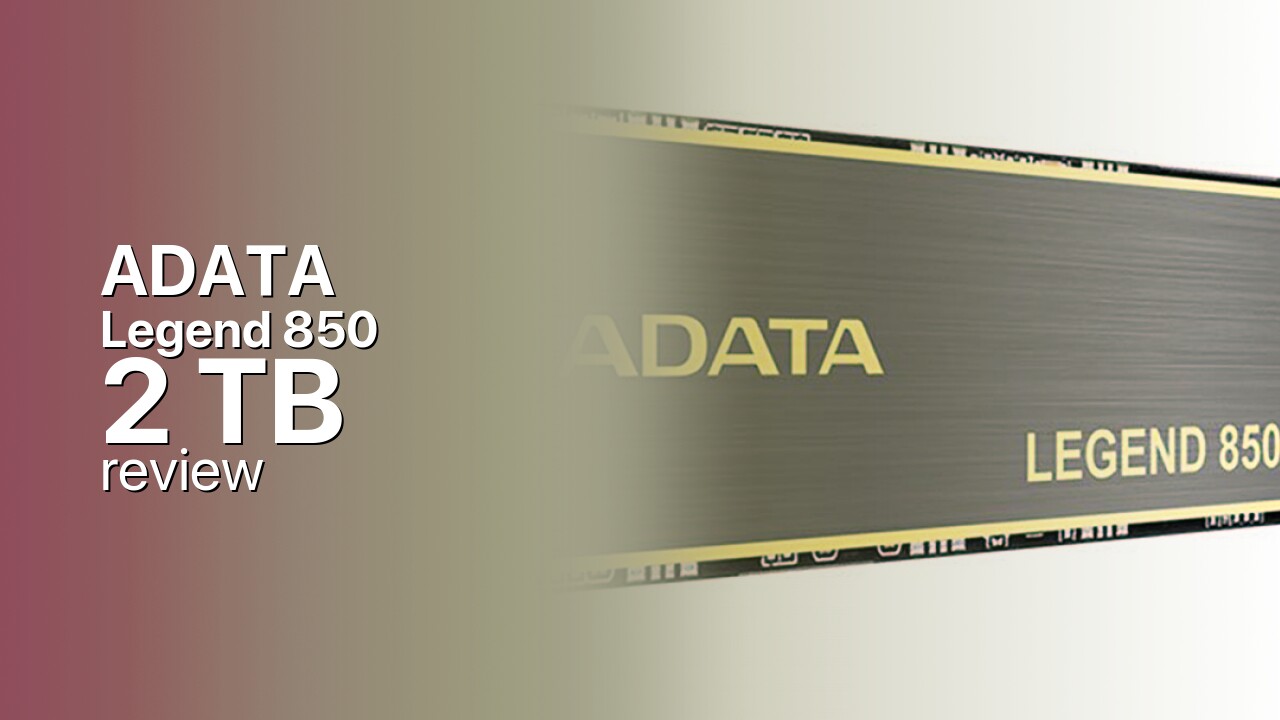
Controller & Memory
The ADATA Legend 850 2 TB runs a Silicon Motion SM2269XTF four-channel controller paired with 3D TLC NAND on an M.2 2280 PCB. The SM2269XTF is a DRAM-less design that relies on Host Memory Buffer technology, reserving a portion of the host system's RAM for its flash translation layer instead of carrying a dedicated DDR chip. That architectural choice trims bill-of-materials cost and idle power consumption at the expense of a modest latency penalty under heavy sustained random writes, a trade-off that makes sense for a budget PCIe 4.0 drive where most of the target workload is reads, not writes.
ADATA sells the Legend 850 in 512 GB, 1 TB, and 2 TB capacities, and the 2 TB variant sits at the top of the stack with the same 5,000 MB/s read and 4,500 MB/s write ceilings as the 1 TB sibling. The 512 GB variant drops to 2,700 MB/s writes due to lower NAND channel utilisation from its half-populated PCB, so stepping up to the 2 TB not only doubles the capacity of the 1 TB but also keeps the full write throughput intact. Endurance scales with capacity in this line: 500 TBW on the 512 GB, 600 TBW on the 1 TB, and 1,200 TBW on the 2 TB, giving the flagship twice the rated lifespan of the mid-capacity model and a consistent 600 TBW-per-terabyte ratio across the upper half of the stack.
The 2 TB capacity also brings a larger SLC write cache than the smaller variants, since the controller can allocate more of the available TLC NAND as a high-speed write buffer. That means sustained sequential writes stay at the full 4,500 MB/s ceiling for longer before the drive folds back to native TLC write speeds, a meaningful advantage for anyone who regularly moves large files, game libraries, or video projects onto the drive. The larger cache also helps random write performance hold up better under mixed workloads, though the SM2269XTF's four-channel layout and HMB ceiling still place it a tier below eight-channel DRAM-cached Gen4 drives in pure throughput.
On the compatibility front, the drive fits any M.2 NVMe slot with backward compatibility to PCIe 3.0 at reduced bandwidth, and it clears the physical dimensions for Sony's PS5 expansion bay, though its 5,000 MB/s read rating sits 500 MB/s below Sony's 5,500 MB/s recommendation. In practice the PS5 accepts the drive without issue, and ADATA's own testing reports roughly 4,000 MB/s inside the console, still well ahead of the internal storage baseline. AES 256-bit hardware encryption is included, a feature sometimes omitted on entry-level Gen4 drives. The natural competitors in the 2 TB budget DRAM-less PCIe 4.0 segment are the WD Blue SN580 2 TB, which trades the SM2269XTF for a Western Digital in-house controller with 900 TBW endurance, and the Silicon Power UD90 2 TB, which uses a Phison E21T controller with a matching 1,200 TBW rating. The Crucial P3 2 TB sits in a similar price band but cuts endurance to 440 TBW on QLC NAND, making the Legend 850's TLC a durability differentiator for a boot-and-storage drive that is expected to last through multiple system upgrades.
Storage Comparisons:
Legend 850 Performance & Benchmarks
Rated sequential performance on the ADATA Legend 850 2 TB is 5,000 MB/s reads and 4,500 MB/s writes over a PCIe 4.0 x4 link, backed by up to 380,000 random read IOPS and 530,000 random write IOPS. Those figures place the drive in the middle of the DRAM-less PCIe 4.0 segment: reads max out what the SM2269XTF's four-channel architecture can extract from four PCIe 4.0 lanes, while writes at 4,500 MB/s match the 1 TB sibling and sit well ahead of the 512 GB variant's 2,700 MB/s ceiling. ADATA's own PS5 testing reports roughly 4,000 MB/s sequential reads inside the console, a step down from the 5,000 MB/s PC figure but still comfortably ahead of the PS5's internal storage.
ADATA Legend 850 2 TB vs M.2 4.0 x 4 peers
Switch between sequential throughput and random IOPS to see how this drive stacks up against other M.2 4.0 x 4 SSDs in our database. The highlighted bar is the drive on this page — click any other bar to open that drive.
- Patriot Viper PV593 1 TB: 14,500 MB/s read, 14,000 MB/s write
- Patriot Viper PV593 2 TB: 14,500 MB/s read, 14,000 MB/s write
- Patriot Viper PV593 4 TB: 14,500 MB/s read, 14,000 MB/s write
- Patriot Viper PV573 2 TB: 14,000 MB/s read, 12,000 MB/s write
- ADATA Legend 850 2 TB (this drive): 5,000 MB/s read, 4,500 MB/s write
In real-world use the 2 TB Legend 850 behaves like a competent HMB drive with the added headroom of a larger SLC cache. The controller's dynamic cache allocation borrows a generous slice of the 2 TB TLC pool as a high-speed write buffer, so bursty desktop workloads, game installs, and large file transfers stay at the full 4,500 MB/s write ceiling longer than on the 512 GB or 1 TB models. Game load times are indistinguishable from a DRAM-cached PCIe 4.0 drive in blind testing because the bottleneck shifts to CPU and asset decompression long before the SSD's random-read latency becomes the limiting factor. For a content creator who regularly ingests large video files or a gamer who shuffles a multi-hundred-gigabyte library, the 2 TB Legend 850's larger cache and full write throughput make it the only variant in the line that can credibly double as a scratch disk, though a DRAM-cached eight-channel Gen4 drive would still outpace it under sustained mixed loads. For a boot-and-storage drive that spends most of its time reading, the 2 TB Legend 850 delivers PCIe 4.0 bandwidth at a price point that undercuts DRAM-cached alternatives by a meaningful margin.
ADATA Legend 850 vs Competitors
See how the Legend 850 stacks up against other M.2 4.0 x 4 drives in our database:
Compare with rival drives:
Endurance, TBW & Warranty
ADATA covers the Legend 850 2 TB with a five-year limited warranty, capped at 1,200 TBW, whichever comes first. That 1,200 TBW rating is the top of the Legend 850 endurance ladder and exactly double the 600 TBW assigned to the 1 TB variant, which means the 2 TB model carries a consistent 600 TBW-per-terabyte ratio that matches the mid-capacity sibling. At a moderate consumer workload of 20 GB of writes per day, the NAND would take roughly 164 years to exhaust the rated endurance; even a heavy 100 GB-per-day routine clears 32 years, so the five-year warranty term will expire long before the flash wears out. ADATA rates the drive at up to 1.5 million hours MTBF, a population-level reliability statistic that describes expected failure rates across a large fleet rather than the lifespan of any single unit. The Legend 850 also supports AES 256-bit hardware encryption, a feature often absent on entry-level PCIe 4.0 drives, and the five-year warranty term matches what ADATA offers across the entire Legend 850 line regardless of capacity.
ADATA Legend 850 2 TB Specifications
| Category | Value |
|---|---|
| Capacity [?] | 2 TB |
| Interface [?] | M.2 4.0 x 4 |
| Controller [?] | Silicon Motion SM2269XTF 4 Channel |
| Memory type [?] | 3D TLC |
| DRAM [?] | HMB |
| Read speed (MB/s) [?] | 5000 |
| Write speed (MB/s) [?] | 4500 |
| Read IOPS [?] | 380000 |
| Write IOPS [?] | 530000 |
| Endurance (TBW) [?] | 1200 |
| MTBF (million hours) [?] | 1500000 |
| Warranty (years) [?] | 5 |
Verdict: Is the Legend 850 Worth It in 2026?
Pick the ADATA Legend 850 2 TB for a high-capacity PCIe 4.0 boot-and-storage drive on a budget, where the 1,200 TBW endurance, full 4,500 MB/s write throughput, and larger SLC cache earn their keep against the smaller capacities in the line. Skip it for a pure speed play where a DRAM-cached eight-channel Gen4 drive would deliver lower latency under sustained mixed loads, and pass on it for a PlayStation 5 if staying above Sony's 5,500 MB/s recommended read floor matters without the caveat. The closest alternatives in the 2 TB budget HMB PCIe 4.0 tier are the WD Blue SN580 2 TB, which offers a WD controller with 900 TBW endurance at a similar price, and the Silicon Power UD90 2 TB, which pairs a Phison E21T controller with a matching 1,200 TBW rating. The Legend 850 2 TB does not rewrite the rulebook for DRAM-less Gen4 drives, but it delivers the largest capacity in its line with no write-speed compromise, double the endurance of the 1 TB model, and a five-year warranty, making it a quietly sensible choice for a storage-heavy build that values terabytes per dollar over peak benchmark scores.
+ Pros
- 5,000 MB/s sequential reads and 4,500 MB/s writes on PCIe 4.0
- 1,200 TBW endurance, double the 1 TB variant
- Larger SLC cache sustains full write speed longer than smaller capacities
- AES 256-bit hardware encryption included
- Five-year warranty across the entire Legend 850 line
- 2 TB capacity at a budget DRAM-less price point
- Cons
- No onboard DRAM cache, HMB only
- Read speed slightly below Sony's PS5 recommendation
- Four-channel controller trails eight-channel DRAM-cached Gen4 drives under mixed loads
- May use a double-sided PCB at 2 TB, complicating fitment in the thinnest laptops
- No included heatsink
Buy this or similar SSD Storage:
Video Review
REVIEW (2026): ADATA 2TB SSD Legend 850. First Look.