Patriot Viper VPN110 512 GB: PCIe 3.0 gaming NVMe with DRAM and heatshield (2026)
Quick answer
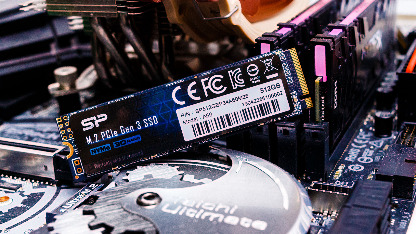
The Patriot Viper VPN110 512 GB is a well-rounded PCIe 3.0 x4 gaming NVMe drive: the proven Phison E12S controller, a real DRAM cache, Kioxia 64-layer 3D TLC NAND, an 800 TBW endurance rating, a 3-year warranty, and a low-profile graphene heatshield.
Read: 3300 MB/s Write: 3000 MB/s Endurance: 800 TBW Warranty: 3 years Interface: M.2 3.0 x 4
The Patriot Viper VPN110 512 GB is a PCIe 3.0 x4 NVMe SSD built on the Phison PS5012-E12S controller with a DRAM cache and Kioxia 64-layer 3D TLC NAND, rated 3,300 MB/s reads and 3,000 MB/s writes with 800 TBW of endurance and a 3-year warranty. It ships with a low-profile graphene heatshield.
Controller & Memory
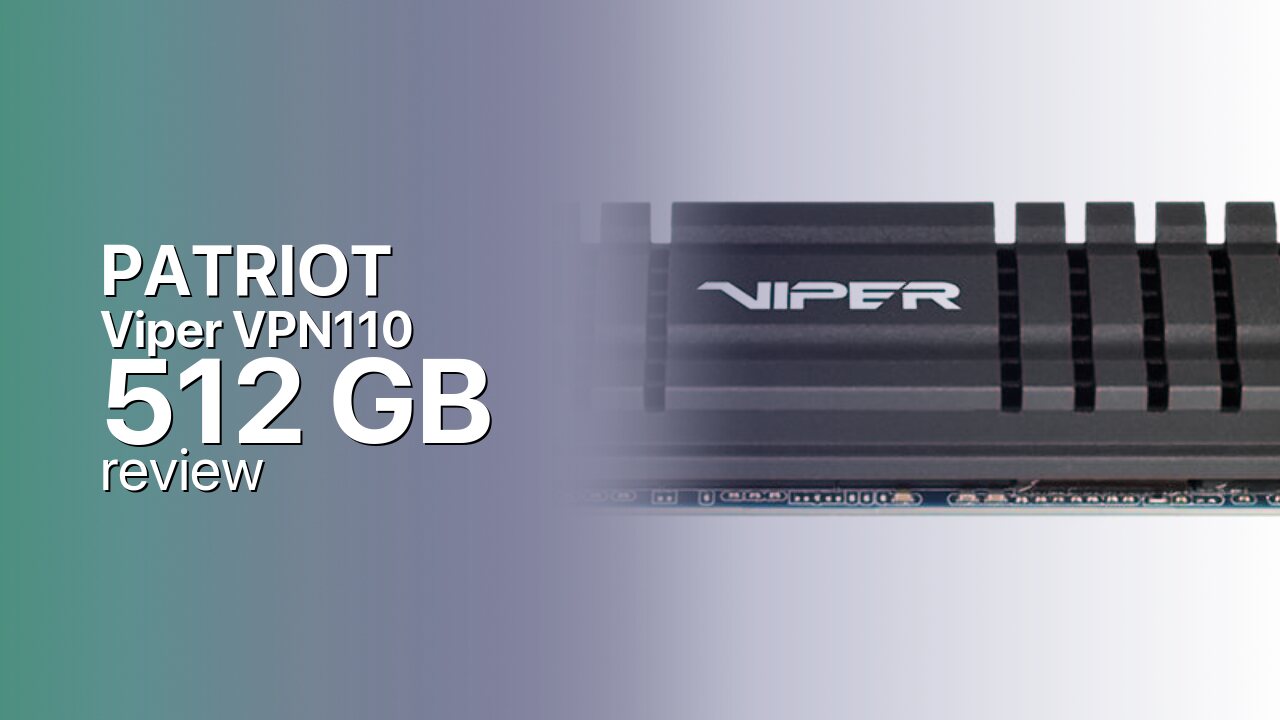
The Viper VPN110 is part of Patriot's Viper Gaming line and is, in hardware terms, the VPN100 with an added graphene heatshield label. Both use the Phison PS5012-E12S — an eight-channel controller (four CE per channel) with dual ARM Cortex-R5 cores and a dedicated DRAM cache — paired with Kioxia 64-layer 3D TLC NAND. The DRAM holds the logical-to-physical mapping table in dedicated memory, giving more consistent random-access latency than the DRAM-less budget drives it competes with.
At 512 GB this is a mainstream-capacity Gen3 drive. The graphene heatshield is a thin thermal label rather than a tall heatsink, so it keeps the drive within standard M.2 height and fits laptops and consoles' clearance, while helping spread heat under load. As a PCIe 3.0 drive it runs near the interface ceiling on a Gen3 board and competes with the Samsung 970 EVO Plus, WD Black SN750, and Sabrent Rocket.
This is a Gen3 product and should be judged as one. On a PCIe 4.0 or 5.0 motherboard the VPN110 still runs at PCIe 3.0 speeds, with no benefit from the newer bus, so buyers wanting Gen4 throughput should choose a Gen4 drive. For a PCIe 3.0 system that wants a DRAM-equipped TLC gaming drive, the VPN110 is a sensible option where it remains available.
Storage Comparisons:
Viper VPN110 Performance & Benchmarks
The Viper VPN110 512 GB is rated at 3,300 MB/s sequential reads and 3,000 MB/s sequential writes over PCIe 3.0 x4, with 600,000 random read and 600,000 random write IOPS at 4K. Reads are close to the practical ceiling of the Gen3 interface.
PATRIOT Viper VPN110 512 GB vs M.2 3.0 x 4 peers
Switch between sequential throughput and random IOPS to see how this drive stacks up against other M.2 3.0 x 4 SSDs in our database. The highlighted bar is the drive on this page — click any other bar to open that drive.
- ADATA SX 8800 Pro 512 GB: 3,500 MB/s read, 2,700 MB/s write
- ADATA SX 8800 Pro 1 TB: 3,500 MB/s read, 2,700 MB/s write
- ADATA XPG Spectrix S40G RGB 256 GB: 3,500 MB/s read, 3,000 MB/s write
- ADATA XPG Spectrix S40G RGB 512 GB: 3,500 MB/s read, 3,000 MB/s write
- PATRIOT Viper VPN110 512 GB (this drive): 3,300 MB/s read, 3,000 MB/s write
For the workloads users actually feel — booting, launching applications, loading games — the DRAM cache and random-I/O performance matter more than peak sequential bandwidth, and the E12S handles them well. The 512 GB capacity carries a moderate SLC write cache; sustained transfers larger than the cache fall back to native TLC write speed, which is normal behaviour for a TLC drive at this capacity. The graphene heatshield helps the drive avoid thermal throttling during longer writes in warm enclosures.
PATRIOT Viper VPN110 vs Competitors
See how the Viper VPN110 stacks up against other M.2 3.0 x 4 drives in our database:
Compare with rival drives:
Endurance, TBW & Warranty
Patriot covers the Viper VPN110 with a 3-year warranty. The 512 GB model is rated for 800 TBW (terabytes written), matching the identically-equipped VPN100, and coverage ends at whichever limit comes first: three years from purchase or 800 TBW of cumulative writes.
At a typical 30 GB of writes per day, reaching 800 TBW would take more than 70 years, so the 3-year term is the binding limit for any realistic consumer workload. Even at a sustained 100 GB per day the endurance rating spans roughly 22 years. The TBW ceiling is not a practical concern for desktop or laptop use; the warranty length is.
PATRIOT Viper VPN110 512 GB Specifications
| Category | Value |
|---|---|
| Capacity [?] | 512 GB |
| Interface [?] | M.2 3.0 x 4 |
| Controller [?] | Phison PS5012-E12S |
| Memory type [?] | Kioxia TLC |
| DRAM [?] | Yes |
| Read speed (MB/s) [?] | 3300 |
| Write speed (MB/s) [?] | 3000 |
| Read IOPS [?] | 600000 |
| Write IOPS [?] | 600000 |
| Endurance (TBW) [?] | 800 |
| MTBF (million hours) [?] | 2000000 |
| Warranty (years) [?] | 3 |
Verdict: Is the Viper VPN110 Worth It in 2026?
The Patriot Viper VPN110 512 GB is a well-rounded PCIe 3.0 x4 gaming NVMe drive: the proven Phison E12S controller, a real DRAM cache, Kioxia 64-layer 3D TLC NAND, an 800 TBW endurance rating, a 3-year warranty, and a low-profile graphene heatshield.
It belongs in a PCIe 3.0 system, where its DRAM-equipped design edges out DRAM-less budget rivals and its heatshield aids thermals in tight builds. Buyers on PCIe 4.0 or 5.0 platforms who want peak speed should pick a Gen4 drive, and those wanting more capacity should look at the 1 TB or 2 TB VPN110. As a 512 GB Gen3 upgrade, it is a solid, value-oriented choice.
+ Pros
- Phison PS5012-E12S controller with a dedicated DRAM cache
- Kioxia 64-layer 3D TLC NAND rather than QLC
- 3,300/3,000 MB/s, near the PCIe 3.0 x4 ceiling
- 800 TBW endurance with a 3-year warranty
- Low-profile graphene heatshield included
- DRAM cache, unlike many DRAM-less budget rivals
- Cons
- PCIe 3.0 only — no benefit on Gen4 or Gen5 platforms
- Sustained write drops to TLC speed once the SLC cache fills
- 512 GB is a tight primary drive for a large modern game library
- Gen4 drives are often similarly priced on current platforms
- Heatshield is a thin label, not a full heatsink
Buy this or similar SSD Storage:
Video Review
✅Patriot Viper VPN100 512GB M.2 NVMe SSD Review