Silicon Power UD85 250GB Review — Entry-Level Gen4 Done Right (2026)
Quick answer
Buy the Silicon Power UD85 250GB as a cheap, dependable boot disk: 3,300 MB/s reads, Micron TLC, a 5-year warranty and a single-sided board that fits anything.
Read: 3300 MB/s Write: 1300 MB/s Endurance: 140 TBW Warranty: 5 years Interface: M.2 4.0 x 4
The Silicon Power UD85 250GB is a textbook entry-level PCIe 4.0 drive — 3,300 MB/s reads, 140 TBW endurance and a 5-year warranty for builders who mostly need a quick OS disk.
Controller & Memory
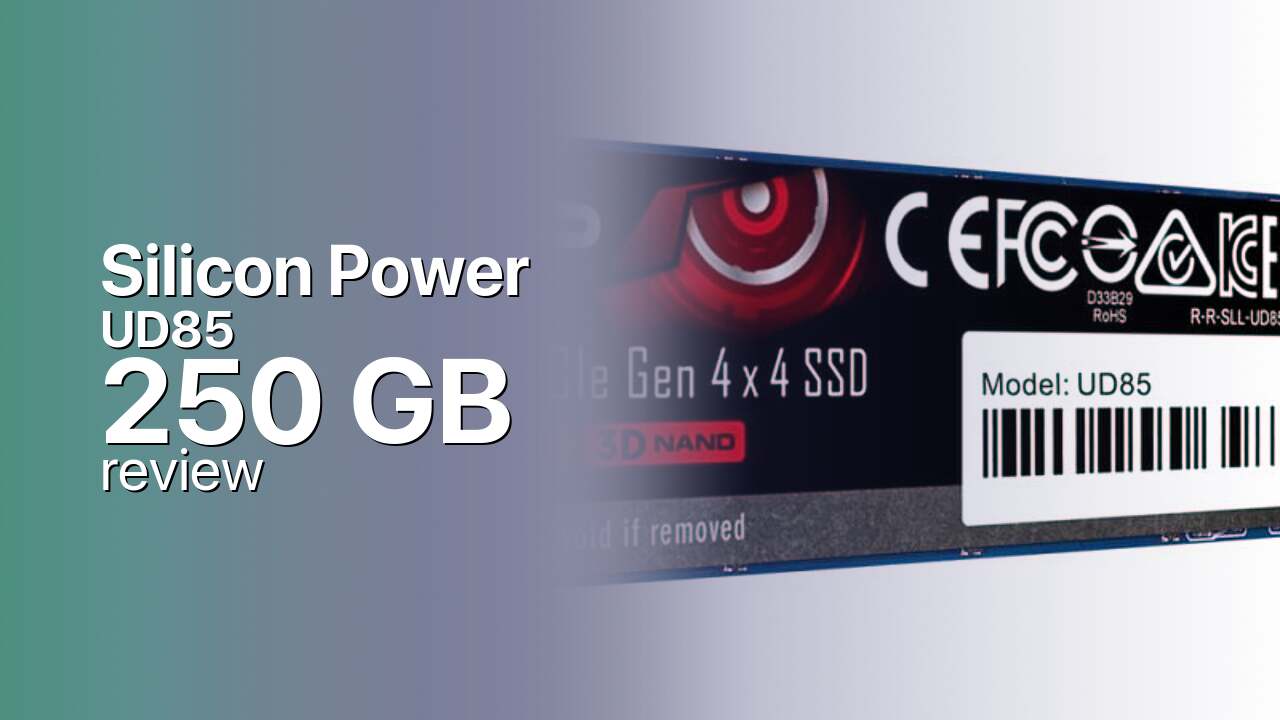
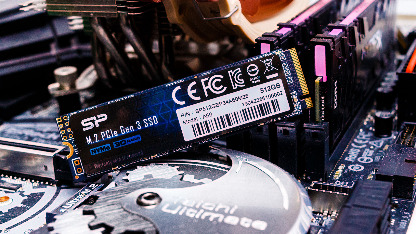
The Silicon Power UD85 250GB pairs Phison's entry-level PS5019-E19-35 controller with Micron 176-layer 3D TLC behind a PCIe 4.0 x4, NVMe 1.4 interface. It is a DRAM-less design that leans on the Host Memory Buffer feature to borrow system RAM for its flash translation tables, and the board is single-sided at 22 x 80 x 3.5 mm and about 8 grams, so it drops into any M.2 2280 slot including thin laptops. TechPowerUp's teardown of the 250 GB model found two 1-Tbit Micron B47R packages and no DRAM on the board.
Positioning matters more than silicon here. The UD85 family runs from 250 GB up to 4 TB, and the 250 GB model sits at the bottom: its 3,300/1,300 MB/s rating trails the 3,600/2,800 MB/s that the 2 TB version carries, and the 1 TB and 4 TB variants even switch to a different Phison controller. That makes this the boot-disk configuration — an operating system, an office suite and some spare room — rather than a game-library drive. No heatsink is included, and Madshrimps' testing of the larger UD85 models found the E19T platform warms during prolonged writes, so a ventilated M.2 slot is worth planning for. The PS5 is out of the question at 250 GB, and Sony's 5,500 MB/s read guidance sits far above this rating anyway.
The competition at this tier is the Crucial P3 Plus, Kingston NV3 and WD Blue SN580. The P3 Plus often undercuts on price but uses QLC flash, where the UD85's Micron TLC holds a genuine endurance and sustained-write advantage. The NV3 and SN580 run the same DRAM-less recipe with similar ratings, so the UD85's case rests on TLC provenance and Silicon Power's 5-year coverage.
Storage Comparisons:
UD85 Performance & Benchmarks
Silicon Power rates the 250 GB UD85 at 3,300 MB/s sequential reads and 1,300 MB/s sequential writes, and publishes no random IOPS rating for it. In practice, 3,300 MB/s loads Windows quickly, roughly halves level-loading versus any SATA drive, and feels indistinguishable from 7,000 MB/s drives in everyday desktop work. The 1,300 MB/s write rating is the honest limit: installing a 100 GB game or offloading a card of 4K footage takes noticeably longer than on a 5,000 MB/s-class drive.
Silicon Power UD85 250 GB vs M.2 4.0 x 4 peers
Switch between sequential throughput and random IOPS to see how this drive stacks up against other M.2 4.0 x 4 SSDs in our database. The highlighted bar is the drive on this page — click any other bar to open that drive.
- Patriot Viper PV593 1 TB: 14,500 MB/s read, 14,000 MB/s write
- Patriot Viper PV593 2 TB: 14,500 MB/s read, 14,000 MB/s write
- Patriot Viper PV593 4 TB: 14,500 MB/s read, 14,000 MB/s write
- Patriot Viper PV573 2 TB: 14,000 MB/s read, 12,000 MB/s write
- Silicon Power UD85 250 GB (this drive): 3,300 MB/s read, 1,300 MB/s write
Like every DRAM-less drive, the UD85 absorbs burst writes into a pseudo-SLC cache carved from the TLC, then settles to native flash rates once the cache fills. On a 250 GB model that cache is small, so multi-hundred-gigabyte transfers slow down visibly; for boot-and-office duty it is a non-event. Madshrimps' review of the 2 TB UD85 found the E19T platform running warm during prolonged writes and recommended good ventilation — sensible advice for any bare, heatsink-free M.2 drive, though the 250 GB card's lighter workload makes throttling less likely. DirectStorage titles benefit from the Gen4 read path, but this is a drive bought for system responsiveness, not for sustained throughput records.
Silicon Power UD85 vs Competitors
See how the UD85 stacks up against other M.2 4.0 x 4 drives in our database:
Compare with rival drives:
Endurance, TBW & Warranty
Silicon Power covers the UD85 with a 5-year limited warranty, and TechPowerUp lists the 250 GB model at 140 TBW of rated endurance — whichever limit arrives first. For perspective, writing 20 GB per day, more than a typical desktop generates, would exhaust that budget in about 19 years, so the warranty term is the realistic ceiling. The 1.5-million-hour MTBF in the spec table is a population statistic across a drive fleet, not a promise for any individual unit. Silicon Power handles warranty claims through its regional support channels with proof of purchase, and most buyers in practice start with the retailer. The endurance budget is backed by the same Micron TLC the family uses at larger capacities, which is the quiet advantage over the QLC flash some budget rivals ship.
Silicon Power UD85 250 GB Specifications
| Category | Value |
|---|---|
| Capacity [?] | 250 GB |
| Interface [?] | M.2 4.0 x 4 |
| Controller [?] | Phison E19T |
| Memory type [?] | Micron 3D TLC |
| DRAM [?] | No |
| Read speed (MB/s) [?] | 3300 |
| Write speed (MB/s) [?] | 1300 |
| Read IOPS [?] | n/a |
| Write IOPS [?] | n/a |
| Endurance (TBW) [?] | 140 |
| MTBF (million hours) [?] | 1500000 |
| Warranty (years) [?] | 5 |
Verdict: Is the UD85 Worth It in 2026?
Buy the Silicon Power UD85 250GB as a cheap, dependable boot disk: 3,300 MB/s reads, Micron TLC, a 5-year warranty and a single-sided board that fits anything. Skip it as a primary game drive — 250 GB holds barely two modern titles and the 1,300 MB/s write rating makes large installs sluggish. If the budget stretches, the Crucial P3 Plus 500 GB (mind its QLC flash) or Silicon Power's faster UD90 line buy more breathing room for similar money. The TLC-over-QLC argument is the strongest reason to pick the UD85 over the P3 Plus at this tier. As an entry into PCIe 4.0 storage, it does its one job competently and never pretends to be more.
+ Pros
- 3,300 MB/s reads on PCIe 4.0
- 140 TBW endurance with 5-year warranty
- Micron 176-layer TLC, not QLC
- Single-sided 8 g PCB fits thin laptops
- MTBF rated at 1.5 million hours
- Cons
- Writes rated at just 1,300 MB/s
- No DRAM cache and no heatsink included
- 250 GB fills after two modern game installs
- Controller runs warm during prolonged writes
Buy this or similar SSD Storage:
Video Review
Самый бюджетный PCIe 4.0 - обзор SSD Silicon Power UD85 250GB (SP250GBP44UD8505)