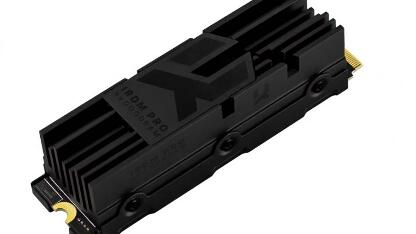
Silicon Power US75 2TB Review — The Value Gen4 Sweet Spot (2026)
Quick answer
Buy the Silicon Power US75 2TB as the default pick of its line: it is the reviewed capacity, rated at the family-best 7,400/6,500 MB/s, backed by 1,200 TBW of endurance, TLC flash and a thermally undemanding platform that Tom's Hardware endorsed for everyday gaming.
Read: 7400 MB/s Write: 6500 MB/s Endurance: 1200 TBW Warranty: 5 years Interface: M.2 4.0 x 4
The Silicon Power US75 2TB is the capacity where its platform clicks — full 7,400/6,500 MB/s ratings, 1,200 TBW endurance and reviewers' nod as an everyday-gamer pick.
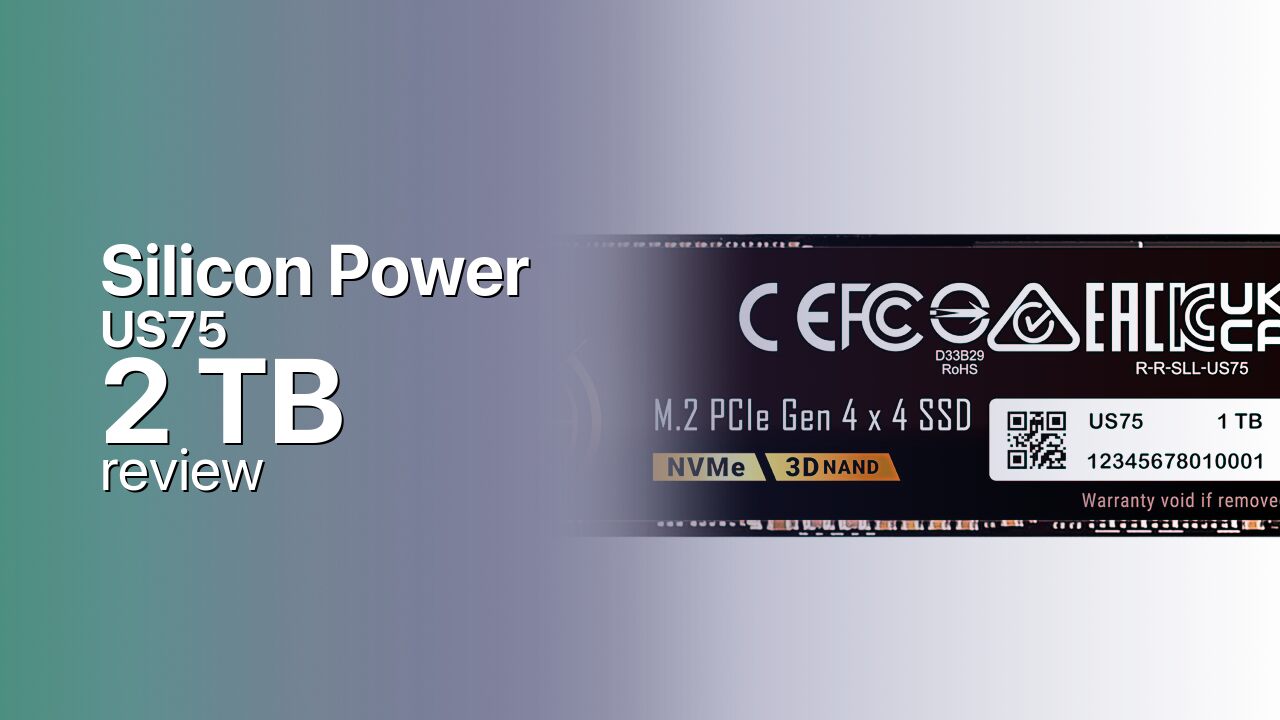
Controller & Memory
The Silicon Power US75 2TB runs Maxio's MAP1602 four-channel controller DRAM-less with Host Memory Buffer, four YMTC 232-layer 3D TLC packages behind it, and NVMe 1.4 over PCIe 4.0 x4. Tom's Hardware's teardown of this exact model found controller, power circuitry and four NAND packages with no DRAM on the board. Silicon Power's spec table rates the 2 TB at 7,400 MB/s sequential reads and 6,500 MB/s writes — the family's best rating, shared with the 4 TB model and 500 MB/s above what the 1 TB variant writes.
This is the capacity reviewers chose to test, and their verdicts are consistent: Tom's Hardware called it a practical choice for the everyday gamer, FunkyKit measured roughly 30 degrees Celsius at idle and unremarkable, cool thermals, and TechRadar framed the line as fast storage for creators and gamers that undercuts its rivals. The endurance budget scales with the praise — 1,200 TBW under a 5-year warranty, twice the 1 TB model's figure. The card is bare and slim at 22.0 x 80.0 x 3.6 mm and 8 grams; Silicon Power's catalog adds a heatsink-equipped US75 SKU for buyers who want cooling pre-fitted.
Its natural rivals are the Lexar NM790, which shares the MAP1602-plus-YMTC recipe with the same ratings, and the Crucial P3 Plus and Kingston NV3, which undercut on price — the P3 Plus notably with QLC flash where the US75 fields TLC. At 2 TB the US75's case is simple: flagship-class paper specs, TLC endurance and cool-running behavior at a mainstream price.
Storage Comparisons:
US75 Performance & Benchmarks
Silicon Power rates the 2 TB US75 at 7,400 MB/s sequential reads and 6,500 MB/s writes, with no official IOPS figure published. That read rating is the top of the PCIe 4.0 band, and independent testing backs the paper numbers' character: Tom's Hardware's review of this model delivered a positive practical verdict for gaming duty, while FunkyKit's benchmarking showed strong sequential results with cool operation throughout. Game installs, level streaming and DirectStorage titles get the full Gen4 treatment; OS and application responsiveness is indistinguishable from any flagship.
Silicon Power US75 2 TB vs M.2 4.0 x 4 peers
Switch between sequential throughput and random IOPS to see how this drive stacks up against other M.2 4.0 x 4 SSDs in our database. The highlighted bar is the drive on this page — click any other bar to open that drive.
- Patriot Viper PV593 1 TB: 14,500 MB/s read, 14,000 MB/s write
- Patriot Viper PV593 2 TB: 14,500 MB/s read, 14,000 MB/s write
- Patriot Viper PV593 4 TB: 14,500 MB/s read, 14,000 MB/s write
- Patriot Viper PV573 2 TB: 14,000 MB/s read, 12,000 MB/s write
- Silicon Power US75 2 TB (this drive): 7,400 MB/s read, 6,500 MB/s write
The DRAM-less architecture handles its business through Host Memory Buffer and a pseudo-SLC cache. At 2 TB the cache is large enough that most buyers never see the transition to native TLC write rates — it takes a multi-hundred-gigabyte continuous transfer to exhaust it, after which throughput settles to a slower but steady native rate. Thermals are the family's quiet achievement: roughly 30 degrees Celsius idle per FunkyKit's measurements and headroom under sustained load per Tom's Hardware, all without a heatsink. In a ventilated case the bare card is entirely self-sufficient; in a GPU-adjacent slot or a console bay, the heatsink SKU or an aftermarket cooler adds margin.
Silicon Power US75 vs Competitors
See how the US75 stacks up against other M.2 4.0 x 4 drives in our database:
Compare with rival drives:
Endurance, TBW & Warranty
Silicon Power backs the US75 2TB with a 5-year limited warranty rated to 1,200 TBW, whichever arrives first — confirmed by TechPowerUp's database entry, B&H's retail listing and Madshrimps' coverage of the same figure. That endurance budget equals about 657 GB of writes per day across the full warranty term; at a demanding 100 GB per day the drive would still run more than 32 years against its rating, so the 5-year term is the practical limit. The MTBF is rated at 1.5 million hours per Silicon Power's spec sheet — a fleet statistic, not a per-unit lifespan promise. Capacities around it scale to 300 TBW (512 GB), 600 TBW (1 TB) and 2,400 TBW (4 TB). Claims run through Silicon Power's regional support channels with proof of purchase.
Silicon Power US75 2 TB Specifications
| Category | Value |
|---|---|
| Capacity [?] | 2 TB |
| Interface [?] | M.2 4.0 x 4 |
| Controller [?] | Maxio MAP1602 |
| Memory type [?] | YMTC 232-L TLC |
| DRAM [?] | No |
| Read speed (MB/s) [?] | 7400 |
| Write speed (MB/s) [?] | 6500 |
| Read IOPS [?] | n/a |
| Write IOPS [?] | n/a |
| Endurance (TBW) [?] | 1200 |
| MTBF (million hours) [?] | 1500000 |
| Warranty (years) [?] | 5 |
Verdict: Is the US75 Worth It in 2026?
Buy the Silicon Power US75 2TB as the default pick of its line: it is the reviewed capacity, rated at the family-best 7,400/6,500 MB/s, backed by 1,200 TBW of endurance, TLC flash and a thermally undemanding platform that Tom's Hardware endorsed for everyday gaming. Skip it if a heatsink must be in the box — the XS75 covers that — or for sustained professional write loads, where a DRAM-equipped flagship earns its price. Against the Lexar NM790 it is a coin flip on hardware; against the QLC-based Crucial P3 Plus, the TLC endurance argument wins. At 2 TB, this is one of the better-executed value Gen4 packages. Between the two near-identical hardware twins, reviewers have actually tested this one — that counts for something.
+ Pros
- 7,400/6,500 MB/s family-best rating at 2 TB
- 1,200 TBW endurance with 5-year warranty
- Cool operation: roughly 30 C idle per review testing
- YMTC 232-layer TLC, not QLC
- Slim 8 g single-sided board fits any M.2 slot
- Cons
- DRAM-less design on the standard card
- No heatsink included on the standard card
- Sustained writes drop below rated speed after the SLC cache
- NAND batches can vary between retail units
Buy this or similar SSD Storage:



Video Review
🚀 Silicon Power US75 SSD Review | The BEST Gen4 NVME SSD for Under $100!