Silicon Power US75 4TB Review — Bulk Gen4 Storage, Bare and Simple (2026)
Quick answer
Buy the Silicon Power US75 4TB when the goal is a large game library or archive volume with real Gen4 speed and no premium: 7,000/6,500 MB/s ratings, 2,400 TBW of endurance, TLC flash and a slim bare board that fits secondary slots with ease.
Read: 7000 MB/s Write: 6500 MB/s Endurance: 2400 TBW Warranty: 5 years Interface: M.2 4.0 x 4
The Silicon Power US75 4TB tops its line with 7,000/6,500 MB/s ratings and 2,400 TBW of endurance — bulk Gen4 storage on an 8-gram bare board.
Controller & Memory
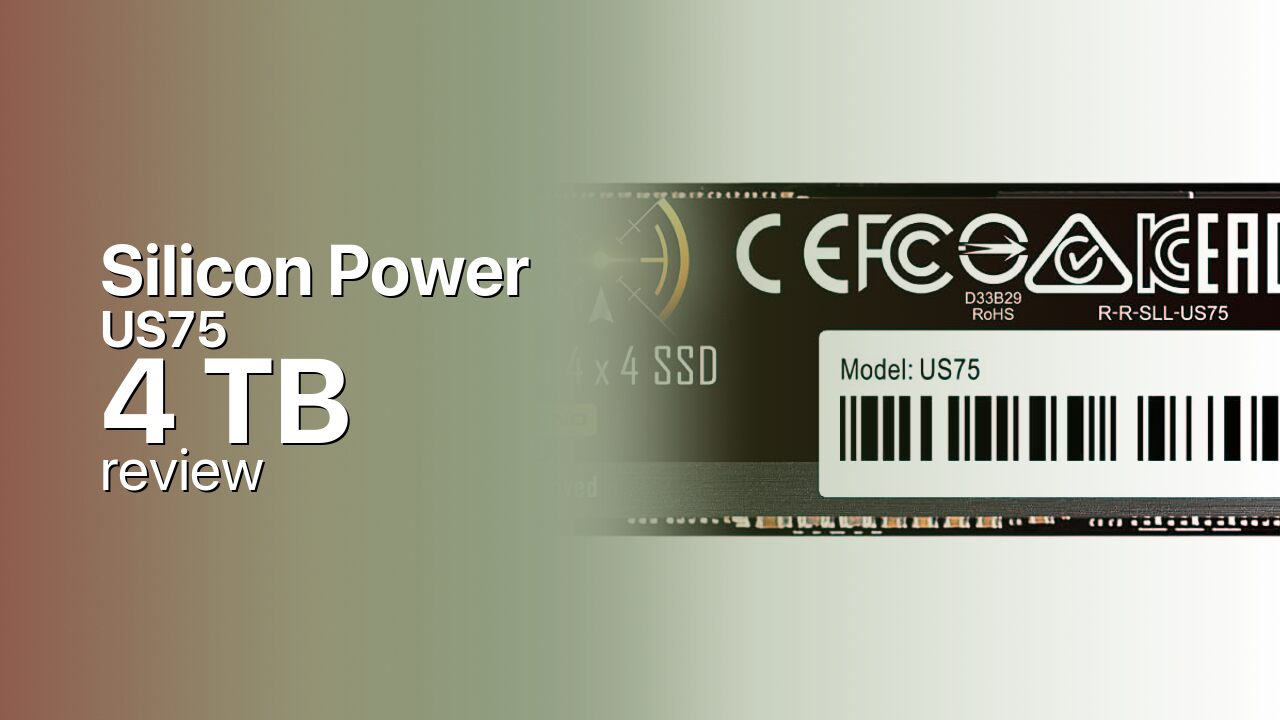
The Silicon Power US75 4TB is the largest capacity of the line, running Maxio's MAP1602 four-channel controller DRAM-less with Host Memory Buffer and YMTC 232-layer 3D TLC behind it over PCIe 4.0 x4. Silicon Power's spec table rates it at 7,000 MB/s sequential reads and 6,500 MB/s writes — the full write rating, with reads stepping down 400 MB/s from the 7,400 MB/s that the 1 TB and 2 TB models carry. Endurance is the line's largest: 2,400 TBW under a 5-year warranty, confirmed by TechPowerUp and Wccftech's launch coverage.
At 4 TB the drive's job changes from boot disk to bulk storage: a complete Steam or console-side library, a photo and video archive, or a secondary project volume. The slim bare card — 22.0 x 80.0 x 3.6 mm, 8 grams, single-sided — suits secondary M.2 slots in towers and NAS-style builds, and Silicon Power's heatsink-equipped US75 SKU exists for slots without airflow. Tom's Hardware's testing of the 2 TB sibling found the platform runs efficiently and cool, and the 4 TB model spreads writes across more NAND packages, which helps both sustained throughput and per-package heat.
The competition at 4 TB splits into two camps: the Lexar NM790 4TB runs essentially the same MAP1602-plus-YMTC recipe, while the Crucial P3 Plus 4TB undercuts on price with QLC flash and its endurance rating shows it. The WD Black SN850X 4TB is the flagship alternative with DRAM and deeper review coverage. The US75's argument is TLC endurance and full write ratings at value-tier money.
Storage Comparisons:
US75 Performance & Benchmarks
Silicon Power rates the 4 TB US75 at 7,000 MB/s sequential reads and 6,500 MB/s writes, with no official IOPS figure published. Reads remain firmly in the top Gen4 band — the 400 MB/s reduction versus the 1 TB and 2 TB models is invisible in any real workload — while the 6,500 MB/s write rating matches the 2 TB model and moves a 100 GB game in well under two minutes of burst time. As a bulk volume, what matters is how the drive behaves when the SLC cache is gone, and here the 4 TB capacity is at its best: the pseudo-SLC cache spans a large data pool, so mixed workloads rarely exhaust it, and sustained transfers settle to a steady native TLC rate rather than collapsing.
Silicon Power US75 4 TB vs M.2 4.0 x 4 peers
Switch between sequential throughput and random IOPS to see how this drive stacks up against other M.2 4.0 x 4 SSDs in our database. The highlighted bar is the drive on this page — click any other bar to open that drive.
- Patriot Viper PV593 1 TB: 14,500 MB/s read, 14,000 MB/s write
- Patriot Viper PV593 2 TB: 14,500 MB/s read, 14,000 MB/s write
- Patriot Viper PV593 4 TB: 14,500 MB/s read, 14,000 MB/s write
- Patriot Viper PV573 2 TB: 14,000 MB/s read, 12,000 MB/s write
- Silicon Power US75 4 TB (this drive): 7,000 MB/s read, 6,500 MB/s write
The DRAM-less Host Memory Buffer architecture keeps translation tables in system RAM, and with 4 TB of flash the tables grow — reviewers of the smaller models found the platform's responsiveness solid, and the same firmware scales up. Thermals follow the family pattern: Tom's Hardware and FunkyKit both documented cool, efficient operation without a heatsink, and the 4 TB card's greater package count spreads the same heat further. In a tower with any airflow the bare card is self-sufficient; for a sealed or GPU-adjacent slot, the heatsink SKU adds margin. Independent benchmarks of this exact 4 TB variant remain scarce, so the manufacturer ratings stand as the reference.
Silicon Power US75 vs Competitors
See how the US75 stacks up against other M.2 4.0 x 4 drives in our database:
Compare with rival drives:
Endurance, TBW & Warranty
Silicon Power covers the US75 4TB with a 5-year limited warranty rated to 2,400 TBW, whichever arrives first — confirmed by TechPowerUp's database entry and Wccftech's coverage of the 4 TB launch. That endurance budget equals about 1.3 TB of writes every day across the full warranty term; even a heavy 200 GB-per-day archive workload would run more than 32 years against the rating, so the 5-year term is the practical limit. The MTBF is rated at 1.5 million hours per Silicon Power's spec sheet — a fleet-level statistic, not a promise for any individual card. Sibling capacities carry 300, 600 and 1,200 TBW. Claims go through Silicon Power's regional support network with proof of purchase, with retailers handling most first-line returns.
Silicon Power US75 4 TB Specifications
| Category | Value |
|---|---|
| Capacity [?] | 4 TB |
| Interface [?] | M.2 4.0 x 4 |
| Controller [?] | Maxio MAP1602 |
| Memory type [?] | YMTC 232-L TLC |
| DRAM [?] | No |
| Read speed (MB/s) [?] | 7000 |
| Write speed (MB/s) [?] | 6500 |
| Read IOPS [?] | n/a |
| Write IOPS [?] | n/a |
| Endurance (TBW) [?] | 2400 |
| MTBF (million hours) [?] | 1500000 |
| Warranty (years) [?] | 5 |
Verdict: Is the US75 Worth It in 2026?
Buy the Silicon Power US75 4TB when the goal is a large game library or archive volume with real Gen4 speed and no premium: 7,000/6,500 MB/s ratings, 2,400 TBW of endurance, TLC flash and a slim bare board that fits secondary slots with ease. Skip it for professional sustained-write duty — a DRAM-equipped drive such as the WD Black SN850X handles those better — and check the fine print if QLC pricing elsewhere looks tempting, because the endurance gap at 4 TB is enormous. Against the Lexar NM790 4TB it is essentially the same hardware; choose on price and availability. As bulk TLC storage, this is a competent, well-warrantied package.
+ Pros
- 2,400 TBW endurance with 5-year warranty
- Full 6,500 MB/s write rating at 4 TB
- Large SLC cache headroom on a 4 TB population
- Slim 8 g single-sided board fits secondary slots
- YMTC 232-layer TLC, not QLC
- Cons
- Reads rated below the 1 TB and 2 TB models
- DRAM-less design on the standard card
- No heatsink included on the standard card
- NAND batches can vary between retail units
Buy this or similar SSD Storage:



Video Review
🚀 Silicon Power US75 SSD Review | The BEST Gen4 NVME SSD for Under $100!