Silicon Power XS75 4TB Review — A Whole Game Library Under One Heatsink (2026)
Quick answer
Buy the Silicon Power XS75 4TB when the goal is one drive that ends storage juggling — a complete PS5 library, a Steam collection, or a footage archive — with 7,000/6,500 MB/s ratings, 3,000 TBW of endurance and a factory heatsink that fits the console's clearance rules.
Read: 7000 MB/s Write: 6500 MB/s Endurance: 3000 TBW Warranty: 5 years Interface: M.2 4.0 x 4
The Silicon Power XS75 4TB is the archive-sized end of the XPOWER line — 7,000/6,500 MB/s ratings, 3,000 TBW endurance and a PS5-ready heatsink included.
Controller & Memory
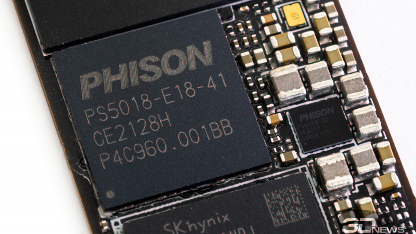
The Silicon Power XS75 4TB tops the XPOWER heatsink line: MAXIO's MAP1602A-F3C four-channel controller in a DRAM-less Host Memory Buffer configuration, TLC NAND with intelligent SLC caching, and NVMe 2.0 over PCIe 4.0 x4. At 4 TB the drive carries the family's full 7,000/6,500 MB/s rating — only the 1 TB variant is derated — and Silicon Power's official TBW document assigns it 3,000 TBW of endurance under a 5-year warranty, the largest budget in the lineup.
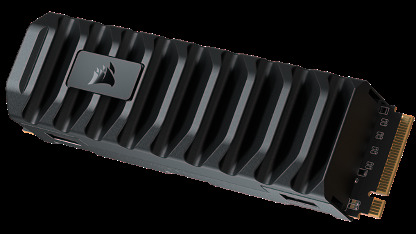
Four terabytes changes what the drive is for. In a PS5, it ends storage management entirely: the factory heatsink (24.6 x 80 x 10.8 mm, 33 grams) fits Sony's 110 x 25 x 11.25 mm limit, and the capacity holds a full console library including the storage-hungry 100 GB-plus titles. In a creator PC it serves as a project scratch disk or footage archive, where the heatsink's thermal headroom matters more than anywhere else on a DRAM-less drive. Madshrimps' review of the 2 TB sibling confirmed the platform's MAP1602A-F3C and TLC hardware and found the large cooler keeps temperatures at bay even without active airflow — the 4 TB card adds more NAND packages under the same cooler.
The competition at 4 TB with a heatsink is short: the WD Black SN850X heatsink edition and Crucial T500 are the established picks, both rated slightly faster and both reviewed far more extensively. The XS75 4TB's case is capacity per dollar at the top of the Gen4 band with no separate cooler to buy — for buyers whose priority is a big library rather than the last few hundred rated MB/s.
Storage Comparisons:
XS75 Performance & Benchmarks
Silicon Power rates the 4 TB XS75 at 7,000 MB/s sequential reads and 6,500 MB/s writes over PCIe 4.0 x4, with no official IOPS figure published. Reads sit far above Sony's 5,500 MB/s PS5 recommendation, so console load times run at the top of what the platform perceives, and on PC the drive extracts the full benefit of DirectStorage titles and level streaming. The 6,500 MB/s write rating moves a 100 GB game in under two minutes of burst time.
Silicon Power XS75 4 TB vs M.2 4.0 x 4 peers
Switch between sequential throughput and random IOPS to see how this drive stacks up against other M.2 4.0 x 4 SSDs in our database. The highlighted bar is the drive on this page — click any other bar to open that drive.
- Patriot Viper PV593 1 TB: 14,500 MB/s read, 14,000 MB/s write
- Patriot Viper PV593 2 TB: 14,500 MB/s read, 14,000 MB/s write
- Patriot Viper PV593 4 TB: 14,500 MB/s read, 14,000 MB/s write
- Patriot Viper PV573 2 TB: 14,000 MB/s read, 12,000 MB/s write
- Silicon Power XS75 4 TB (this drive): 7,000 MB/s read, 6,500 MB/s write
Sustained behavior is the usual DRAM-less story with better odds: the intelligent SLC cache on a 4 TB population is large enough that mixed gaming and general workloads rarely exhaust it, and Host Memory Buffer keeps translation tables in system RAM. When the cache does fill during very large transfers, throughput settles to native TLC rates — slower, but the same behavior every DRAM-less Gen4 drive exhibits. Thermals deserve respect at this capacity: the factory heatsink kept the 2 TB model cool in still air according to Madshrimps, and the 4 TB card stacks more NAND under the same block, so a slot with any airflow remains good practice for all-day writes. Independent benchmarks of this exact 4 TB variant have not been published, so the manufacturer ratings are the only reference points.
Silicon Power XS75 vs Competitors
See how the XS75 stacks up against other M.2 4.0 x 4 drives in our database:
Compare with rival drives:
Endurance, TBW & Warranty
Silicon Power covers the XS75 4TB with a 5-year limited warranty rated to 3,000 TBW, whichever arrives first — per the company's official TBW document, and the largest endurance budget in the XS75 family (700 TBW at 1 TB, 1,400 TBW at 2 TB). Spread across the warranty term, 3,000 TBW allows roughly 1.6 TB of writes every day; even a heavy 200 GB-per-day creator workload would take over 41 years to exhaust. The TBW-limited terms match what WD and Seagate attach to their heatsink-equipped drives, and claims run through Silicon Power's regional support network with proof of purchase. One transparency note: no independent endurance testing exists for this drive, so the rating rests on the manufacturer's document.
Silicon Power XS75 4 TB Specifications
| Category | Value |
|---|---|
| Capacity [?] | 4 TB |
| Interface [?] | M.2 4.0 x 4 |
| Controller [?] | MAXIO MAP1602A-F3C 4 Channel |
| Memory type [?] | TLC |
| DRAM [?] | No |
| Read speed (MB/s) [?] | 7000 |
| Write speed (MB/s) [?] | 6500 |
| Read IOPS [?] | n/a |
| Write IOPS [?] | n/a |
| Endurance (TBW) [?] | 3000 |
| MTBF (million hours) [?] | 2000000 |
| Warranty (years) [?] | 5 |
Verdict: Is the XS75 Worth It in 2026?
Buy the Silicon Power XS75 4TB when the goal is one drive that ends storage juggling — a complete PS5 library, a Steam collection, or a footage archive — with 7,000/6,500 MB/s ratings, 3,000 TBW of endurance and a factory heatsink that fits the console's clearance rules. Skip it for sustained professional write workloads, where the DRAM-less design and thin 4 TB review coverage argue for the WD Black SN850X or Crucial T500 instead. Within the XS75 line this is the capacity that makes the most of the platform, and the endurance budget means it will outlive the machine it is installed in. For buyers who mostly install and play rather than render and export, that trade is the right one.
+ Pros
- 3,000 TBW endurance with 5-year warranty
- Full 7,000/6,500 MB/s family rating at 4 TB
- Heatsink included and PS5-compatible
- Large SLC cache headroom at 4 TB
- TLC NAND with NVMe 2.0 and Host Memory Buffer
- Cons
- DRAM-less design at a 4 TB scale
- No independent review of the 4 TB variant
- Rated below the SN850X and T500 flagships
- Heatsink blocks ultra-thin laptop slots
Buy this or similar SSD Storage:



Video Review
Silicon Power: Xpower PCIe Gen 4x4 SSD XS70 1TB