Transcend MTE250H 1TB Review: Gen4 Speed With Fins Included (2026)
Quick answer
The Transcend MTE250H 1TB suits builders who want a set-and-forget Gen4 boot drive with cooling already solved — no heatsink shopping, no thermal pad guesswork.
Read: 7200 MB/s Write: 6200 MB/s Endurance: 780 TBW Warranty: 5 years Interface: M.2 4.0 x 4
The Transcend MTE250H 1TB ships with an aluminum finned heatsink already fitted and rates 7,200 MB/s reads on PCIe 4.0 — no separate cooler to buy.
Controller & Memory
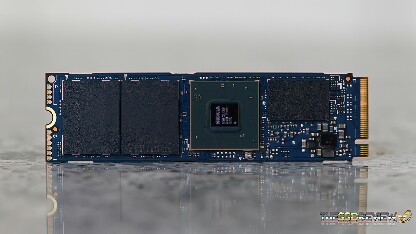
TechPowerUp's teardown of the Transcend MTE250H 1TB shows a familiar upper-mainstream Gen4 recipe: Silicon Motion's SM2264F eight-channel controller on a 12nm die, Kioxia BiCS5 112-layer TLC NAND and 1GB of Samsung DDR4-3200 as the DRAM cache, all running NVMe 1.4 over PCIe 4.0 x4. Transcend rates this capacity at 7,200 MB/s sequential reads and 6,200 MB/s writes with 530K/420K random IOPS. What makes the 250H distinctive arrives pre-installed: a finned aluminum heatsink takes the assembled drive to 9.2 mm thick and roughly 34 grams, double the height of a bare board. Launched in early 2023, it remains one of the few Gen4 drives that needs no cooler shopping.
The family ladder runs 1TB, 2TB and 4TB, and this entry capacity carries trade-offs in both directions: its 7,200 MB/s read rating actually edges the 2TB's 7,100, but writes rate 300 MB/s below the 2TB (6,500) and 500 MB/s below the 4TB (6,700), and endurance starts at 780 TBW — the smallest budget in the range. The graphene-padded MTE250S sibling shares identical speeds and endurance per capacity but cools passively with a 3.77 mm profile; that one suits slim laptops, while the 250H's taller fins and Transcend's claimed 15 percent temperature reduction belong on desktop boards with clearance to spare.
Tom's Hardware's review of the 250H reached a two-sided verdict: performance was adequate rather than class-leading, and US pricing ran high, but the warranty, thermals and the bundled SSD Scope software for monitoring and cloning earned credit. The competitive set reflects that: the DRAM-less WD Black SN770 undercuts it, Kingston's KC3000 outrates it with a similar DRAM-based design, and Samsung's 990 Pro plays in a faster league entirely. As a PS5 candidate it clears every published Sony requirement — PCIe 4.0, the 5,500 MB/s read guidance and the size limits — with the heatsink already fitted.
Storage Comparisons:
MTE250H Performance & Benchmarks
Transcend rates the 1TB MTE250H at 7,200 MB/s sequential reads, 6,200 MB/s writes and 530K/420K random read/write IOPS. TechPowerUp's entry for this exact capacity adds useful fine print: a dynamic pseudo-SLC cache of roughly 100 GB, after which writes settle near 788 MB/s. That is a healthy floor for the class, and for boot-and-games duty the cache rarely empties in daily use.
Transcend MTE250H 1 TB vs M.2 4.0 x 4 peers
Switch between sequential throughput and random IOPS to see how this drive stacks up against other M.2 4.0 x 4 SSDs in our database. The highlighted bar is the drive on this page — click any other bar to open that drive.
- Patriot Viper PV593 1 TB: 14,500 MB/s read, 14,000 MB/s write
- Patriot Viper PV593 2 TB: 14,500 MB/s read, 14,000 MB/s write
- Patriot Viper PV593 4 TB: 14,500 MB/s read, 14,000 MB/s write
- Patriot Viper PV573 2 TB: 14,000 MB/s read, 12,000 MB/s write
- Transcend MTE250H 1 TB (this drive): 7,200 MB/s read, 6,200 MB/s write
Tom's Hardware's testing emphasized how well the factory heatsink controls thermals, which matters because sustained Gen4 writes throttle more readily on bare boards. In practice, 7,200 MB/s reads put OS boots, game installs and DirectStorage asset streaming effectively on par with 7,400 MB/s flagships — the real-world gap is a fraction of a second on level loads. The 420K random-write rating is modest against DRAM-based rivals like the KC3000, but desktop, gaming and mixed creator workloads seldom probe that ceiling. Creators who move very large single files should consider the 2TB and 4TB siblings for their stronger 6,500-6,700 MB/s write ratings. Back2Gaming's review reached a friendly verdict from the value side of the divide, crediting the cooling, the five-year warranty and consistent everyday behavior.
Transcend MTE250H vs Competitors
See how the MTE250H stacks up against other M.2 4.0 x 4 drives in our database:
Compare with rival drives:
Endurance, TBW & Warranty
Transcend covers the 1TB MTE250H for five years against 780 TBW of writes, whichever comes first — 0.43 drive writes per day over the term, generous headroom for a boot drive that rarely sees even 20 GB of daily writes. At that modest pace the flash budget outlives the warranty more than a hundred times over. MTBF is listed at 3.0 million hours, a fleet-level statistic rather than a prediction for any individual unit. Two Transcend-specific details deserve attention: the five-year term where many value rivals offer three, and the aluminum heatsink is a factory-fitted part — Transcend's documentation warns that removing it can cause damage not covered under warranty, so the drive should be installed as-is. The bundled SSD Scope utility tracks health, remaining life and firmware updates.
Transcend MTE250H 1 TB Specifications
| Category | Value |
|---|---|
| Capacity [?] | 1 TB |
| Interface [?] | M.2 4.0 x 4 |
| Controller [?] | SMI SM2264 8 Channel |
| Memory type [?] | Kioxia 112-L TLC |
| DRAM [?] | Yes |
| Read speed (MB/s) [?] | 7200 |
| Write speed (MB/s) [?] | 6200 |
| Read IOPS [?] | 530000 |
| Write IOPS [?] | 420000 |
| Endurance (TBW) [?] | 780 |
| MTBF (million hours) [?] | 3000000 |
| Warranty (years) [?] | 5 |
Verdict: Is the MTE250H Worth It in 2026?
The Transcend MTE250H 1TB suits builders who want a set-and-forget Gen4 boot drive with cooling already solved — no heatsink shopping, no thermal pad guesswork. Skip it if shelf price leads the decision, because Tom's Hardware found US pricing hard to justify against faster-rated rivals, and the 780 TBW endurance budget is the family's smallest. The WD Black SN770 is the cheaper DRAM-less alternative, Kingston's KC3000 the faster DRAM-based one, and Transcend's own 2TB step-up doubles endurance while adding 300 MB/s of write headroom on the same platform. That 2TB variant also makes more sense as a PS5 library, if console storage is the real destination. For a tidy, warranty-rich 1TB upgrade, the value here is convenience.
+ Pros
- Rated 7,200/6,200 MB/s on PCIe 4.0
- Aluminum finned heatsink pre-installed
- 1GB Samsung DDR4 DRAM cache, teardown-verified
- 780 TBW endurance, five-year warranty
- About 100 GB pseudo-SLC cache before throttling
- PS5-eligible dimensions with cooler fitted
- Cons
- Tom's Hardware judged US pricing hard to justify
- 780 TBW is the family's smallest endurance budget
- Writes rate 300 MB/s under the 2TB model
- Post-cache writes settle near 788 MB/s
- 9.2 mm height fouls some laptop M.2 slots
Buy this or similar SSD Storage:



Video Review
Transcend NVMe PCIe Gen4 x4 SSD MTE250H & MTE250S