Western Digital WD SN7100 2TB Review — Cool, Quiet, Consistent (2026)
Quick answer
The Western Digital WD SN7100 2TB is the game-library configuration of the most efficient consumer SSD platform Tom's Hardware has tested: full 7,250/6,900 MB/s speed, 1,200 TBW of endurance and five years of cover in a cool-running, single-sided package.
Read: 7250 MB/s Write: 6900 MB/s Endurance: 1200 TBW Warranty: 5 years Interface: M.2 4.0 x 4
The Western Digital WD SN7100 2TB pairs full 7,250 MB/s Gen4 speed with 1,200 TBW of endurance and the power-efficiency crown Tom's Hardware awarded the platform.
Controller & Memory
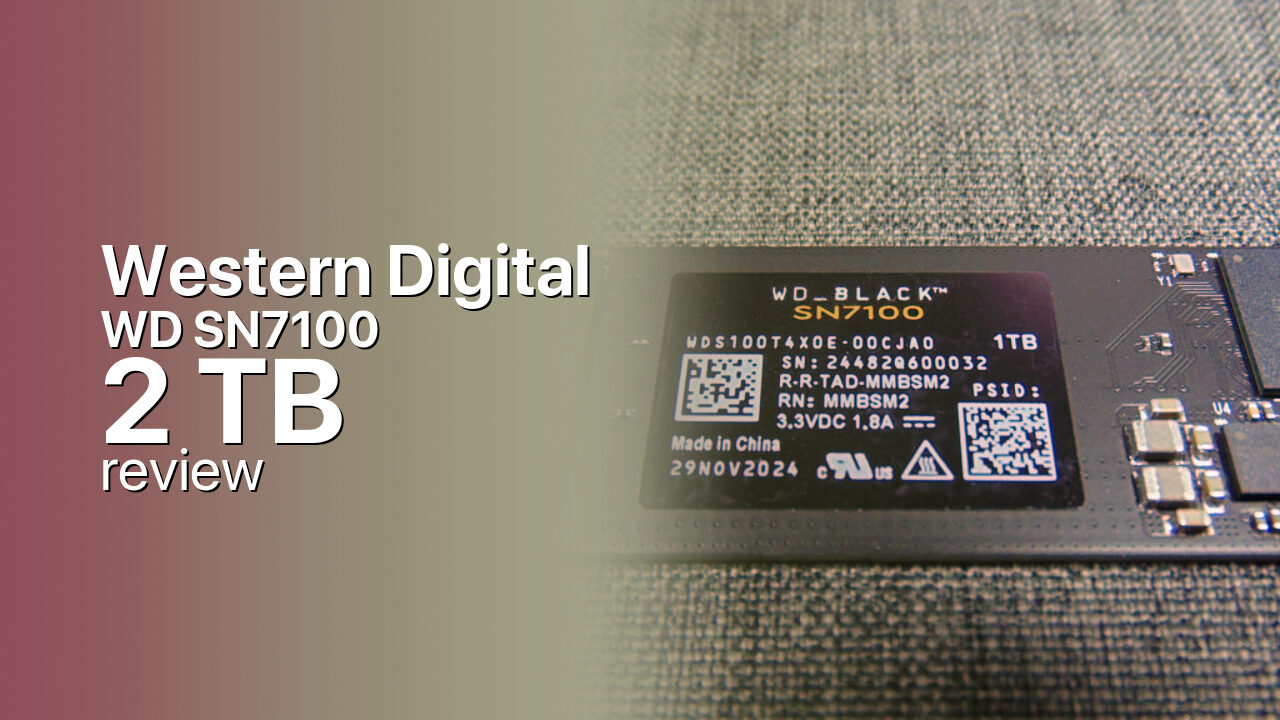
The Western Digital WD SN7100 2TB is the capacity Tom's Hardware put on its bench for the review that crowned the platform the new power-efficiency champion of consumer SSDs — a verdict the reviewer tempered by calling the drive a competent SN770 successor that is otherwise deliberately unremarkable. The hardware is a single-sided M.2 2280 board on PCIe 4.0 x4 and NVMe 1.4: SanDisk's Polaris 3 controller, sixteen 1Tb dies of 218-layer BiCS8 3D TLC NAND in the 2 TB configuration, and no DRAM chip, with the Host Memory Buffer standing in for one. After the Western Digital and SanDisk brand consolidation, the same hardware sells under either name.
Specs at this capacity match the 1 TB model exactly: 7,250 MB/s sequential reads, 6,900 MB/s writes, 1,000K random reads and 1,400K random writes rated, with endurance doubled to 1,200 TBW under the same 5-year warranty. The 500 GB entry point runs at 6,800/5,800 MB/s, and a 4 TB model added after launch rates 7,000/6,700 MB/s with 2,400 TBW. Tom's Hardware noted the 2 TB SN7100 listed above the older SN850X at review time, which frames the purchase as a vote for platform virtues — efficiency, cool running, TLC endurance — rather than headline speed.
At 2 TB the buyer profile is the gamer or creator who wants one drive for everything: operating system, a full library of 100 GB-plus games, project files and footage. The efficiency argument compounds at this size — Tom's Hardware measured the platform at the top of its charts, meaning minimal heat across long installs and transfers. Samsung's 990 EVO Plus and Lexar's NM790 are the closest external rivals in the DRAM-less Gen4 bracket, while the WD Black SN850X remains the DRAM-cached flagship for buyers who prioritize burst writes over sipping power.
Storage Comparisons:
WD SN7100 Performance & Benchmarks
Western Digital rates the 2 TB SN7100 at 7,250 MB/s sequential reads, 6,900 MB/s writes, 1,000K random reads and 1,400K random writes. Tom's Hardware's review of this exact capacity validated the platform's character without matching every headline figure, and its summary was precise: excellent random reads, mediocre overall performance, and chart-topping power efficiency — the trait no rival matched at the time. PC Gamer's results on the 1 TB sibling, landing within a percent of rated speeds in CrystalDiskMark at 7,116 MB/s reads, support the family's credibility on the numbers it does publish.
Western Digital WD SN7100 2 TB vs M.2 4.0 x 4 peers
Switch between sequential throughput and random IOPS to see how this drive stacks up against other M.2 4.0 x 4 SSDs in our database. The highlighted bar is the drive on this page — click any other bar to open that drive.
- Patriot Viper PV593 1 TB: 14,500 MB/s read, 14,000 MB/s write
- Patriot Viper PV593 2 TB: 14,500 MB/s read, 14,000 MB/s write
- Patriot Viper PV593 4 TB: 14,500 MB/s read, 14,000 MB/s write
- Patriot Viper PV573 2 TB: 14,000 MB/s read, 12,000 MB/s write
- Western Digital WD SN7100 2 TB (this drive): 7,250 MB/s read, 6,900 MB/s write
For a 2 TB game-library drive, the practical picture is what matters: installs arrive at rated speeds, load times sit within a fraction of a second of DRAM-cached flagships in reviewers' game tests, and the drive stays cool enough to run bare in most systems — a 48 degrees Celsius ceiling under a motherboard heatsink in PC Gamer's testing. The pseudo-SLC cache absorbs large burst writes, with throughput settling to native TLC rates on sustained multi-hundred-gigabyte transfers; buying 2 TB means a doubled endurance budget at 1,200 TBW, so heavy repeated writes remain comfortably inside warranty terms. Efficiency is the tiebreaker this drive wins: more performance per watt than anything Tom's Hardware had charted, which keeps noise and heat down in small builds.
Western Digital WD SN7100 vs Competitors
See how the WD SN7100 stacks up against other M.2 4.0 x 4 drives in our database:
Compare with rival drives:
Endurance, TBW & Warranty
The SN7100 2TB carries a 5-year limited warranty rated to 1,200 TBW of writes, whichever comes first — the family scales endurance at 600 TBW per terabyte, so this capacity doubles the 1 TB model's 600 TBW, while the later 4 TB variant reaches 2,400 TBW. Spread across daily use, 1,200 TBW tolerates more than 160 GB of writes every day for twenty years, a workload no consumer gaming or creator PC approaches; the calendar term is the real limit. Tom's Hardware described the coverage as competitive for the class. Underneath, 218-layer BiCS8 TLC wears far more slowly than the QLC flash used in budget-tier drives, and claims run through Western Digital's standard support channels with proof of purchase.
Western Digital WD SN7100 2 TB Specifications
| Category | Value |
|---|---|
| Capacity [?] | 2 TB |
| Interface [?] | M.2 4.0 x 4 |
| Controller [?] | SanDisk Polaris 3 |
| Memory type [?] | BiCS8 218-layer 3D TLC |
| DRAM [?] | No |
| Read speed (MB/s) [?] | 7250 |
| Write speed (MB/s) [?] | 6900 |
| Read IOPS [?] | 1000000 |
| Write IOPS [?] | 1400000 |
| Endurance (TBW) [?] | 1200 |
| MTBF (million hours) [?] | n/a |
| Warranty (years) [?] | 5 |
Verdict: Is the WD SN7100 Worth It in 2026?
The Western Digital WD SN7100 2TB is the game-library configuration of the most efficient consumer SSD platform Tom's Hardware has tested: full 7,250/6,900 MB/s speed, 1,200 TBW of endurance and five years of cover in a cool-running, single-sided package. Skip it if peak burst writes matter more than efficiency — WD's own SN850X keeps its DRAM cache and still wins that discipline — or if the library keeps growing, where the 4 TB model's 2,400 TBW and extra space make more sense. Samsung's 990 EVO Plus and Lexar's NM790 are the closest external rivals. As the one-drive answer for OS, games and projects, the 2 TB SN7100 is the family's most versatile buy.
+ Pros
- 7,250 MB/s reads and 6,900 MB/s writes rated
- 1,200 TBW endurance with 5-year warranty
- Top of Tom's Hardware power-efficiency charts
- Sixteen-die single-sided layout, cool running
- 1,000K random reads, 1,400K random writes rated
- 218-layer BiCS8 TLC, not QLC
- Cons
- No DRAM cache on the PCB
- Ships without a heatsink
- Listed above the older SN850X at launch
- Sustained writes settle to TLC rates past the pSLC cache
- No 4 TB option at launch
Buy this or similar SSD Storage:



Video Review
WD Black SN7100 2 TB Performance Review - The Best Gen 4 SSD?