ADATA XPG S70 2TB Review — Flagship PCIe 4.0 NVMe SSD (2026)
Quick answer
The ADATA XPG Gammix S70 2 TB is the capacity to buy if you want the full speed of ADATA's IG5236 platform in a drive that comes thermally ready out of the box.
Read: 7400 MB/s Write: 6400 MB/s Endurance: 1480 TBW Warranty: 5 years Interface: M.2 4.0 x 4
The ADATA XPG Gammix S70 2 TB is the flagship capacity of ADATA's IG5236-powered lineup, pairing 6,400 MB/s writes with 1,480 TBW of endurance behind a factory heatsink that actually earns its place on the PCB.
Controller & Memory
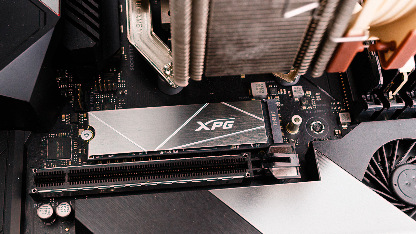
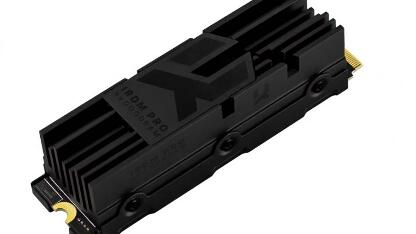
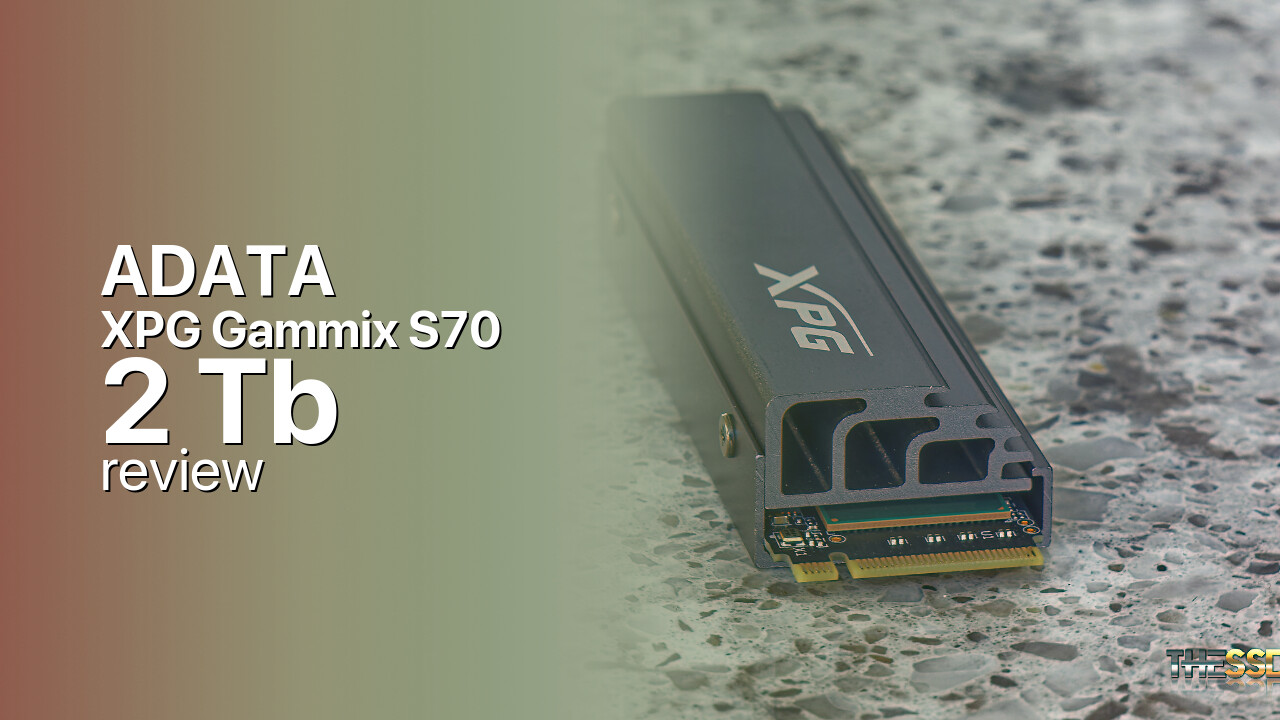
The 2 TB XPG Gammix S70 is the fully populated variant of ADATA's InnoGrit IG5236 platform. It pairs the same 8-channel controller and Micron 3D TLC NAND as the 1 TB version but doubles the DRAM to 2 GB of DDR4 and populates all available NAND channels, which raises the sequential write ceiling to 6,400 MB/s. The drive uses the PCIe 4.0 x4 interface on a standard M.2 2280 form factor with a large aluminium heatsink permanently attached — a design choice that improves sustained thermals at the cost of physical compatibility.
ADATA also sells the S70 in a 1 TB capacity, which drops to 5,500 MB/s writes, 740 TBW endurance, and 1 GB of DRAM. The 2 TB variant reviewed here is the one to pick if your use case involves sustained large-file transfers, 4K or 8K video editing, or simply housing a deep game library alongside an OS without juggling multiple drives. The 2 GB DRAM buffer gives it more headroom for mapping the larger NAND array, which matters under heavy mixed read/write workloads where DRAM-less drives begin to stumble.
The S70's competition has not changed: the Samsung 980 Pro 2 TB, WD Black SN850 2 TB, and Sabrent Rocket 4 Plus 2 TB all sit in the same enthusiast PCIe 4.0 bracket. The S70's factory heatsink remains its strongest differentiator — the 980 Pro and SN850 both require a separate heatsink purchase if you plan to push sustained writes. That said, the permanently attached heatsink rules out laptop and console use entirely, and the roughly 11 mm total z-height means ITX and micro-ATX builders should measure their M.2 slot clearance before buying.
Storage Comparisons:
XPG Gammix S70 Performance & Benchmarks
The 2 TB XPG Gammix S70 is rated for up to 7,400 MB/s sequential reads and 6,400 MB/s sequential writes — the fastest write speed in the S70 family, made possible by the fully populated NAND channels. Random performance is rated at up to 720,000 write IOPS, putting it near the top of the IG5236 controller class. In real-world terms, the 2 TB variant loads games and boots Windows indistinguishably from any other high-end PCIe 4.0 drive; where it pulls ahead of the 1 TB is in sustained throughput — large file copies, video ingest, and export workflows that exceed the 1 TB variant's pSLC cache depth.
ADATA XPG Gammix S70 2 TB vs M.2 4.0 x 4 peers
Switch between sequential throughput and random IOPS to see how this drive stacks up against other M.2 4.0 x 4 SSDs in our database. The highlighted bar is the drive on this page — click any other bar to open that drive.
- Patriot Viper PV593 1 TB: 14,500 MB/s read, 14,000 MB/s write
- Patriot Viper PV593 2 TB: 14,500 MB/s read, 14,000 MB/s write
- Patriot Viper PV593 4 TB: 14,500 MB/s read, 14,000 MB/s write
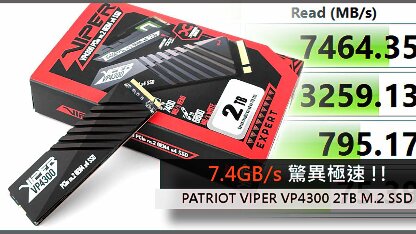
- Patriot Viper PV573 2 TB: 14,000 MB/s read, 12,000 MB/s write
- ADATA XPG Gammix S70 2 TB (this drive): 7,400 MB/s read, 6,400 MB/s write
Independent testing of the IG5236 platform shows a roughly 250 GB pSLC write cache on the 2 TB model, after which direct-to-TLC writes settle to approximately 1,600—1,900 MB/s — faster than the 1 TB's post-cache floor thanks to the extra NAND parallelism. The factory heatsink effectively absorbs thermal spikes: sustained sequential writes on an open bench hold above 4,000 MB/s even after the SLC cache exhausts, where a bare-drive IG5236 implementation would throttle into the hundreds of MB/s. In a case with constrained airflow the controller will eventually hit its thermal ceiling on a long enough write pass, but for any consumer-length transfer the heatsink keeps performance in PCIe 4.0 territory. Power consumption at idle is higher than competing PCIe 4.0 controllers — something to note for always-on home servers or NAS builds.
ADATA XPG Gammix S70 vs Competitors
See how the XPG Gammix S70 stacks up against other M.2 4.0 x 4 drives in our database:
Compare with rival drives:
Endurance, TBW & Warranty
The 2 TB XPG Gammix S70 carries a 1,480 TBW endurance rating and a 5-year limited warranty, whichever limit is reached first. At a typical desktop workload of 20—50 GB of writes per day, this works out to roughly 80 to 200 years of usable life — the warranty will expire long before the NAND wears under normal use. The MTBF is rated at 2 million hours, a population-level statistic describing expected failure rates across a large sample, not an individual drive's lifespan. ADATA handles warranty claims through its standard RMA process. For comparison, the Samsung 980 Pro 2 TB and WD Black SN850 2 TB are each rated at 1,200 TBW — 280 TBW lower than the S70 — which makes the S70 one of the most endurance-heavy consumer PCIe 4.0 drives in the 2 TB class.
ADATA XPG Gammix S70 2 TB Specifications
| Category | Value |
|---|---|
| Capacity [?] | 2 TB |
| Interface [?] | M.2 4.0 x 4 |
| Controller [?] | Innogrit Rainer IG5236 |
| Memory type [?] | Micron 3D TLC |
| DRAM [?] | SLC Caching and DRAM cache buffer |
| Read speed (MB/s) [?] | 7400 |
| Write speed (MB/s) [?] | 6400 |
| Read IOPS [?] | 320000 |
| Write IOPS [?] | 720000 |
| Endurance (TBW) [?] | 1480 |
| MTBF (million hours) [?] | 2 |
| Warranty (years) [?] | 5 |
Verdict: Is the XPG Gammix S70 Worth It in 2026?
The ADATA XPG Gammix S70 2 TB is the capacity to buy if you want the full speed of ADATA's IG5236 platform in a drive that comes thermally ready out of the box. It delivers 6,400 MB/s writes, a generous 1,480 TBW endurance rating, and a factory heatsink that keeps it from throttling — all in a package that undercut the Samsung and WD flagships at launch. Skip the S70 if you are building in a laptop, a PS5, or a small form factor case with tight M.2 clearance — the fixed heatsink is a genuine physical barrier in those scenarios. For those builds, consider the XPG Gammix S70 Blade 2 TB, which drops the factory heatsink, fits standard M.2 slots, and performs identically in burst workloads. The original S70 remains a strong pick for a full-size desktop build where thermals matter and clearance is not an issue.
+ Pros
- 7,400 MB/s reads and 6,400 MB/s writes on the 2 TB capacity
- 2 GB DDR4 DRAM cache for consistent heavy-workload latency
- 1,480 TBW endurance — among the highest in the 2 TB PCIe 4.0 class
- Factory aluminium heatsink prevents throttling under sustained writes
- 5-year warranty matches or exceeds flagship competitors
- Innogrit IG5236 controller delivers full PCIe 4.0 bandwidth
- Cons
- Permanently attached heatsink blocks laptop and PS5 installation
- Higher idle power consumption than competing PCIe 4.0 controllers
- Heatsink clearance issues on ITX and micro-ATX motherboards
- No user-replaceable heatsink option for alternative cooling setups
Buy this or similar SSD Storage:



Video Review
XPG Gammix S70 VS S50 Lite VS SX8200 Pro Review - Real World File Transfer Tests!