ADATA XPG Legend 970 Pro 2 TB Review: Fan-Cooled PCIe 5.0 NVMe (2026)
Quick answer
The ADATA XPG Legend 970 Pro 2 TB makes sense for desktop builders who want PCIe 5.0 sequential speed without cable clutter: its self-powered fan heatsink keeps the drive from throttling, and 1,480 TBW with five years of coverage is solid insurance.
Read: 14000 MB/s Write: 10000 MB/s Endurance: 1480 TBW Warranty: 5 years Interface: M.2 5.0
The ADATA XPG Legend 970 Pro 2 TB pushes 14,000 MB/s over PCIe 5.0 and cools itself with a built-in fan that finally needs no awkward power cable.
Controller & Memory
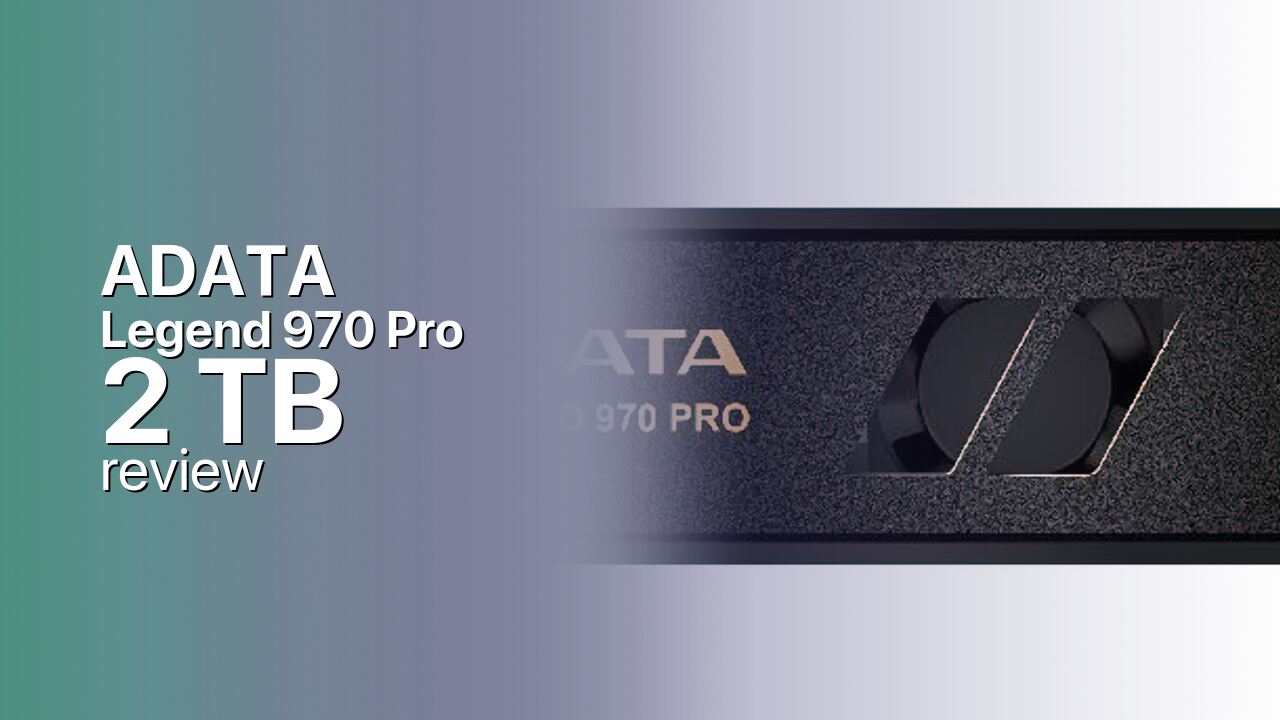
Inside, the ADATA XPG Legend 970 Pro 2 TB pairs InnoGrit's 12 nm IG5666 controller with Micron 232-layer 3D TLC NAND and a 2 GB DDR4 DRAM cache, making it one of the first mainstream PCIe 5.0 drives to skip Phison's near-ubiquitous E26 platform. The stick underneath is a standard double-sided M.2 2280, but you will rarely see it bare: ADATA pre-installs a double-layer extruded aluminum heatsink with a micro-fan that draws power directly from the drive's own circuit board. That detail matters more than it sounds, because earlier fan-cooled Gen5 drives, including ADATA's own Legend 970, needed a separate SATA power cable snaked across the motherboard.
The series ships in 1 TB, 2 TB and 4 TB capacities, and the differences between them are real. This 2 TB model delivers the full 14,000 MB/s read rating but tops out at 10,000 MB/s writes, where the 4 TB version reaches 11,000 MB/s; the 1 TB drops to 13,000 MB/s reads and 9,500 MB/s writes. That makes 2 TB the sensible middle of the range for enthusiasts and content creators who want a fast Gen5 game library or scratch disk without paying 4 TB money.
The integrated cooler also makes this a desktop-only proposition: at 17.9 mm tall it will not fit a laptop, and it is far over Sony's height limit for the PS5 expansion bay. It can collide with motherboards that expect to clamp their own M.2 shield over the slot, so check clearance around your primary Gen5 socket before buying. Its direct rivals are the Crucial T705 and Corsair MP700 Pro on Phison's E26 controller, both built on the same Micron flash; the T705 is the benchmark this drive gets measured against, and reviewers generally hand Phison the win on raw responsiveness while crediting ADATA with the cleaner cooling solution.
Storage Comparisons:
Legend 970 Pro Performance & Benchmarks
ADATA rates the 2 TB Legend 970 Pro at 14,000 MB/s sequential reads and 10,000 MB/s sequential writes, with random performance of up to 1,800,000 IOPS on reads and 1,300,000 IOPS on writes; those are best-case figures, but independent testing largely confirms the sequential numbers.
ADATA Legend 970 Pro 2 TB vs M.2 5.0 peers
Switch between sequential throughput and random IOPS to see how this drive stacks up against other M.2 5.0 SSDs in our database. The highlighted bar is the drive on this page — click any other bar to open that drive.
- Corsair MP700 Pro XT 1 TB: 14,900 MB/s read, 14,200 MB/s write
- Corsair MP700 Pro XT 2 TB: 14,900 MB/s read, 14,500 MB/s write
- Corsair MP700 Pro XT 4 TB: 14,900 MB/s read, 14,400 MB/s write
- Crucial T710 1 TB: 14,900 MB/s read, 13,800 MB/s write
- ADATA Legend 970 Pro 2 TB (this drive): 14,000 MB/s read, 10,000 MB/s write
Reviews paint a consistent picture. The drive reaches its rated throughput, and TechPowerUp's thermal testing found it never throttles, a genuine rarity among PCIe 5.0 drives. The catch shows up in everyday workloads: Tom's Hardware measured weaker latency and notably poor power efficiency compared with Phison E26 drives such as the Crucial T705, concluding that InnoGrit's controller trails in real-world responsiveness even with identical Micron flash on board. In practice that means game loading and OS work feel close to a good PCIe 4.0 drive, while the interface earns its keep in large sequential transfers: video footage, disk images and game library migrations. As with every Gen5 drive, the headline write speed is an SLC-cached burst figure, and sustained transfers that outrun the cache will settle lower, so plan around that if you regularly move multi-terabyte datasets.
ADATA Legend 970 Pro vs Competitors
See how the Legend 970 Pro stacks up against other M.2 5.0 drives in our database:
Compare with rival drives:
Endurance, TBW & Warranty
The 2 TB Legend 970 Pro carries a 1,480 TBW endurance rating under a 5-year limited warranty, and coverage ends at whichever limit arrives first. That allowance is generous for the class: at a heavy 50 GB of writes per day, 1,480 TBW works out to roughly 80 years of use, so even a creator hammering it as a scratch disk will reach the calendar limit long before the flash wears out. ADATA quotes a 1.6 million-hour MTBF, which is a population-level reliability statistic rather than a promise about any individual unit's lifespan. The bundled SSD Toolbox software covers firmware updates, diagnostics and drive health monitoring, which is worth installing to keep tabs on wear. Note that the endurance rating scales with capacity, so the smaller 1 TB version carries a proportionally lower allowance.
ADATA Legend 970 Pro 2 TB Specifications
| Category | Value |
|---|---|
| Capacity [?] | 2 TB |
| Interface [?] | M.2 5.0 |
| Controller [?] | InnoGrit IG5666 |
| Memory type [?] | Micron 232-L TLC |
| DRAM [?] | Yes |
| Read speed (MB/s) [?] | 14000 |
| Write speed (MB/s) [?] | 10000 |
| Read IOPS [?] | 1800000 |
| Write IOPS [?] | 1300000 |
| Endurance (TBW) [?] | 1480 |
| MTBF (million hours) [?] | 1600000 |
| Warranty (years) [?] | 5 |
Verdict: Is the Legend 970 Pro Worth It in 2026?
The ADATA XPG Legend 970 Pro 2 TB makes sense for desktop builders who want PCIe 5.0 sequential speed without cable clutter: its self-powered fan heatsink keeps the drive from throttling, and 1,480 TBW with five years of coverage is solid insurance. Skip it if you care about efficiency or peak responsiveness, since Tom's Hardware found its power draw and everyday latency clearly behind Phison E26 rivals, and skip it entirely for laptops or the PS5, where the 17.9 mm cooler simply does not fit. The Crucial T705 2 TB is the alternative to cross-shop: same Micron flash, faster in real-world testing, though you will need your own cooling plan. We would frame the ADATA's case simply: it is the tidiest thermal package in the Gen5 field, and the right pick whenever it undercuts the T705 rather than matching it.
+ Pros
- 14,000 MB/s sequential reads on PCIe 5.0
- Self-powered fan heatsink, no SATA cable
- No thermal throttling in independent testing
- 2 GB DDR4 DRAM cache
- 1,480 TBW endurance with 5-year warranty
- Up to 1,800K random read IOPS
- Cons
- Poor power efficiency versus Phison E26 rivals
- 17.9 mm cooler blocks PS5 and laptop use
- Everyday latency trails the Crucial T705
- Slower 10,000 MB/s writes than the 4 TB model
Buy this or similar SSD Storage:
Video Review
ADATA Legend 970 SSD Review - Good Enough?