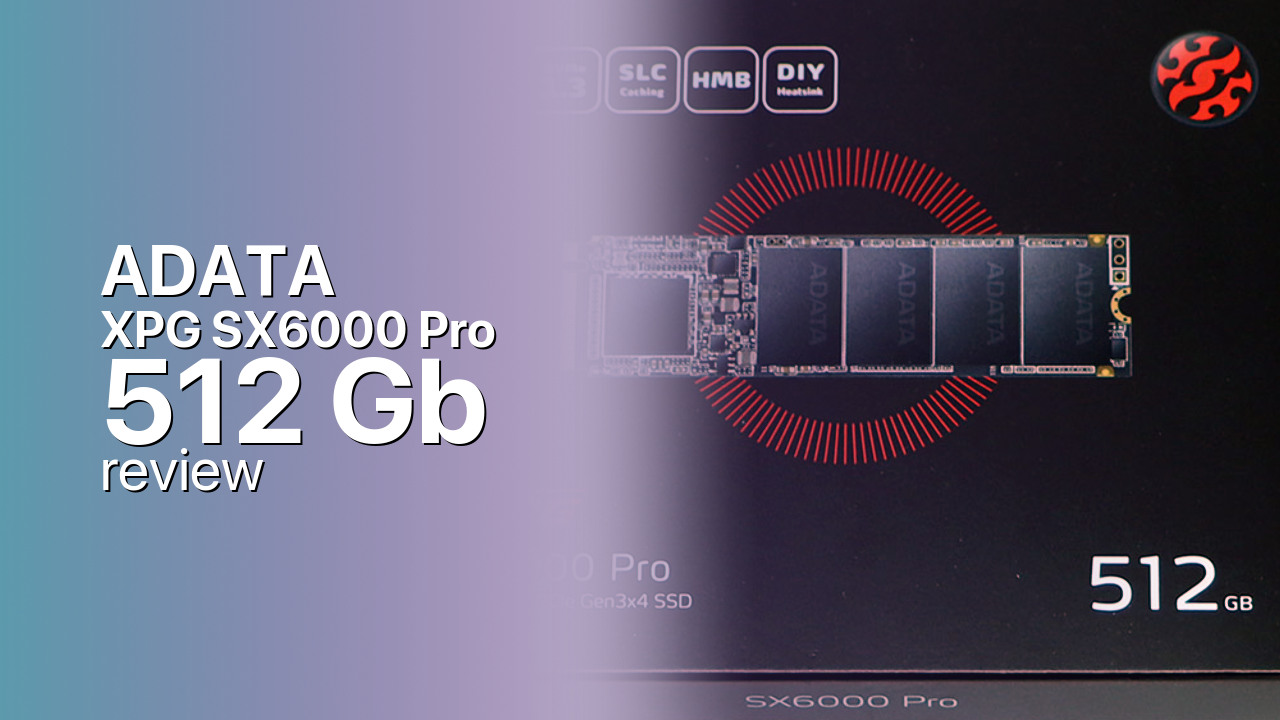
ADATA XPG SX6000 Pro 512GB Review — Budget DRAM-Less PCIe 3.0 NVMe (2026)
Quick answer
The ADATA XPG SX6000 Pro 512GB is a budget PCIe 3.0 NVMe SSD that delivers adequate performance for light to moderate desktop use at a competitive price.
Read: 2100 MB/s Write: 1500 MB/s Endurance: 240 TBW Warranty: 5 years Interface: M.2 3.0 x 4
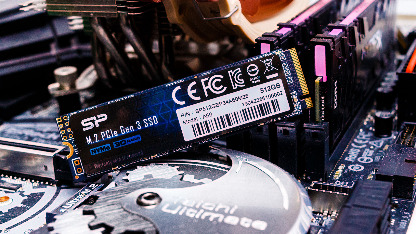
The ADATA XPG SX6000 Pro 512GB is a budget PCIe 3.0 NVMe SSD that uses a DRAM-less HMB design for everyday computing at a competitive price.
Controller & Memory
The 512 GB SX6000 Pro pairs Realtek's RTS5763DL controller — a budget-oriented PCIe 3.0 x4 design — with Micron TLC NAND in a DRAM-less configuration that relies on Host Memory Buffer to borrow a small slice of system RAM for the flash translation table. This cost-saving approach keeps the price down but impacts random I/O consistency under sustained workloads, especially as the drive fills up.
ADATA rates the SX6000 Pro at 2,100 MB/s sequential reads and 1,500 MB/s sequential writes across all capacities. These numbers place the drive in the mid-range of the PCIe 3.0 spectrum — roughly four times faster than a SATA SSD but well behind flagship NVMe drives that saturate the full PCIe 3.0 x4 bandwidth at 3,500 MB/s. The 512 GB capacity offers a larger dynamic SLC cache than the 256 GB variant, meaning it can absorb more burst writes before the cache exhausts and write speeds drop.
The SX6000 Pro occupies an awkward position in ADATA's lineup. It sits below the SX8200 Pro, which uses a Silicon Motion controller with DRAM and delivers roughly 70 percent higher throughput. The SX6000 Pro's selling point is price, but at the time of its release, competitors like the WD Blue SN570 and Kingston A2000 offered better performance at similar prices. The drive comes in a single-sided M.2 2280 form factor, making it compatible with laptops and thin systems.
The DRAM-less design means the SX6000 Pro is best suited for light to moderate desktop use — web browsing, office applications, photo storage, and casual gaming. The 512 GB capacity is more practical than the 256 GB variant for modern use, offering enough space for the operating system, applications, and a decent media library. Heavy workloads like video editing, large file transfers, or database operations will expose the controller's limitations as the SLC cache exhausts and the drive falls back to slow direct-to-TLC writes.
Direct competitors include the WD Blue SN570 500GB (faster, same DRAM-less design), the Crucial P3 500GB (QLC NAND but higher capacities available), and the Kingston A2000 500GB (DRAM-less but with better sustained performance).
Storage Comparisons:
XPG SX6000 Pro Performance & Benchmarks
The ADATA XPG SX6000 Pro 512GB is rated at 2,100 MB/s sequential reads and 1,500 MB/s sequential writes — numbers that put it squarely in the mid-range of the PCIe 3.0 NVMe spectrum. These figures are roughly four times faster than a SATA SSD but only about 60 percent of what flagship PCIe 3.0 drives achieve. The Realtek RTS5763DL controller is a budget design that prioritizes cost over performance, and it shows in both synthetic benchmarks and real-world workloads.
ADATA XPG SX6000 Pro 512 GB vs M.2 3.0 x 4 peers
Switch between sequential throughput and random IOPS to see how this drive stacks up against other M.2 3.0 x 4 SSDs in our database. The highlighted bar is the drive on this page — click any other bar to open that drive.
- ADATA SX 8800 Pro 512 GB: 3,500 MB/s read, 2,700 MB/s write
- ADATA SX 8800 Pro 1 TB: 3,500 MB/s read, 2,700 MB/s write
- ADATA XPG Spectrix S40G RGB 256 GB: 3,500 MB/s read, 3,000 MB/s write
- ADATA XPG Spectrix S40G RGB 512 GB: 3,500 MB/s read, 3,000 MB/s write
- ADATA XPG SX6000 Pro 512 GB (this drive): 2,100 MB/s read, 1,500 MB/s write
The drive uses a dynamic SLC cache to accelerate burst writes. On the 512 GB capacity, this cache is larger than on the 256 GB variant, giving it more headroom for sustained burst writes. Typical desktop workloads — copying files, installing games, running applications — will feel snappy thanks to the 2,100 MB/s read speed. However, Tom's Hardware's review identified poor direct-to-TLC write speeds as the drive's primary weakness: once the SLC cache exhausts during sustained writes, throughput drops dramatically. This matters for large file transfers, video editing scratch disks, or any workload that writes tens of gigabytes continuously.
Random 4K performance is rated at 250,000 IOPS reads and 240,000 IOPS writes. These are respectable on paper for a DRAM-less drive, but the HMB (Host Memory Buffer) design means real-world random performance depends on system RAM availability and motherboard support. Under heavy mixed I/O, the RTS5763DL controller shows inconsistency — a trade-off inherent to DRAM-less architectures. For light to moderate desktop use and gaming, the SX6000 Pro is responsive. For sustained workloads, expect the performance to drop after the SLC cache fills.
Application performance was rated below average in Tom's Hardware's testing, with PCMark 10 storage benchmarks placing the SX6000 Pro behind the WD Blue SN570 and Kingston A2000. The drive's strongest suit is sequential throughput for everyday tasks like boot times and application launches, where the 2,100 MB/s read speed makes a noticeable difference over SATA drives.
ADATA XPG SX6000 Pro vs Competitors
See how the XPG SX6000 Pro stacks up against other M.2 3.0 x 4 drives in our database:
Compare with rival drives:
Endurance, TBW & Warranty
ADATA covers the SX6000 Pro 512GB with a five-year limited warranty, whichever comes first based on TBW (terabytes written) or warranty period. ADATA does not publish a specific TBW rating for the SX6000 Pro on its product page, which is unusual for a consumer SSD. Based on comparable 512 GB TLC drives from the same era, estimated TBW would be in the range of 240-320 TBW, though this is an estimate since ADATA has not published an official figure. At a sustained workload of 30 GB per day, a 240 TBW drive would take roughly 22 years to exhaust — well beyond the five-year warranty period. The drive does not carry a published MTBF rating.
ADATA XPG SX6000 Pro 512 GB Specifications
| Category | Value |
|---|---|
| Capacity [?] | 512 GB |
| Interface [?] | M.2 3.0 x 4 |
| Controller [?] | Realtek RTS5763DL |
| Memory type [?] | Micron TLC |
| DRAM [?] | HMB |
| Read speed (MB/s) [?] | 2100 |
| Write speed (MB/s) [?] | 1500 |
| Read IOPS [?] | 250000 |
| Write IOPS [?] | 240000 |
| Endurance (TBW) [?] | 240 |
| MTBF (million hours) [?] | 2 |
| Warranty (years) [?] | 5 |
Verdict: Is the XPG SX6000 Pro Worth It in 2026?
The ADATA XPG SX6000 Pro 512GB is a budget PCIe 3.0 NVMe SSD that delivers adequate performance for light to moderate desktop use at a competitive price. Its DRAM-less HMB design keeps costs down but limits sustained write performance and random I/O consistency. The 512 GB capacity is the sweet spot for this drive, offering enough space for OS, applications, and media without the endurance concerns of smaller variants. The WD Blue SN570 500GB is a better choice at a similar price, offering faster speeds and more consistent performance. The Kingston A2000 500GB also outperforms the SX6000 Pro in sustained workloads. The SX6000 Pro makes sense only if found at a significant discount compared to these alternatives.
+ Pros
- 2,100/1,500 MB/s faster than SATA SSDs
- 512 GB capacity practical for modern use
- Single-sided M.2 2280 fits laptops
- Five-year limited warranty
- Larger SLC cache than 256 GB variant
- Cons
- DRAM-less HMB design limits consistency
- Poor direct-to-TLC write speed after cache exhausts
- Below-average application performance
- No published TBW endurance rating
- Outperformed by WD Blue SN570 at similar price
Buy this or similar SSD Storage:
Video Review
ADATA XPG SX6000 Pro 512GB M.2 2280 PCIe SSD