BIWIN NX500 512GB Review — A Bare-Bones Gen3 Boot Drive (2026)
Quick answer
Buy the BIWIN NX500 512GB when an old PC needs a no-drama second life with room to actually use it: an operating system, applications, and a game or two fit without the churn a 256 GB drive forces.
Read: 2100 MB/s Write: 1600 MB/s Interface: M.2 3.0 x 4
The BIWIN NX500 512GB is a no-frills Gen3 upgrade for aging PCs — 2,100 MB/s reads, 3D TLC NAND and room for an OS plus games.
Controller & Memory
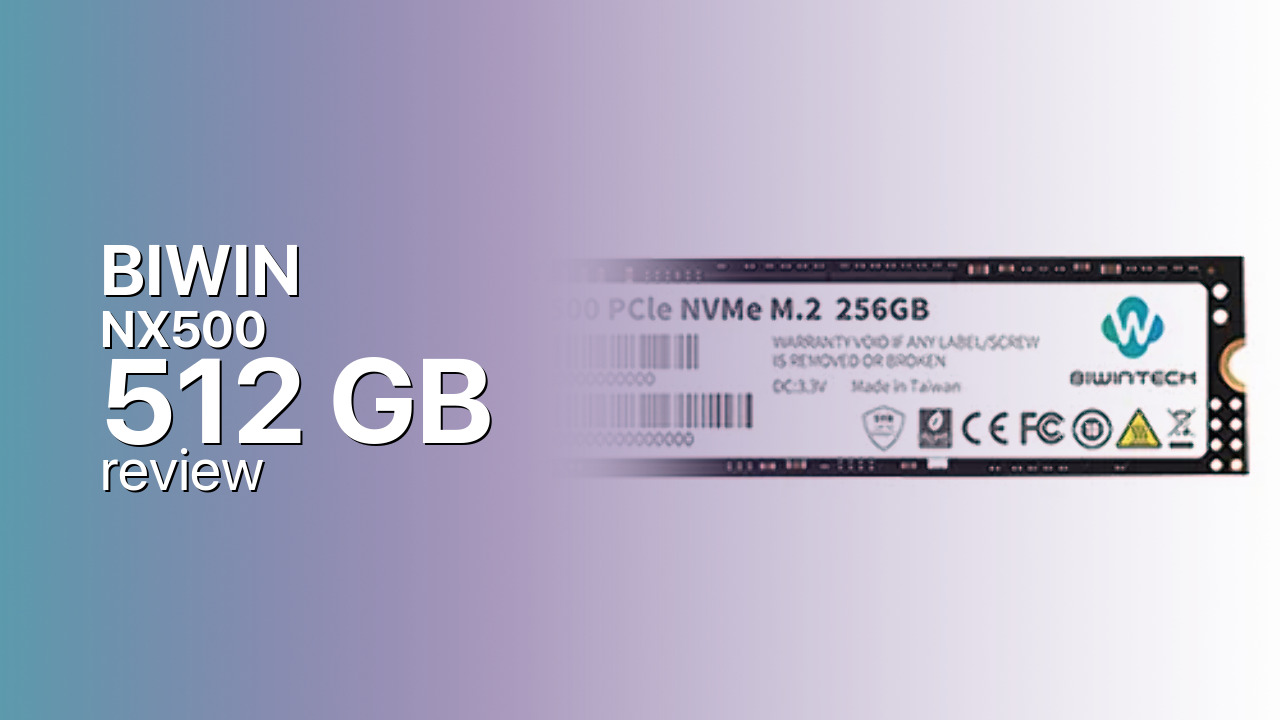
The BIWIN NX500 512GB is about as entry-level as NVMe gets: a DRAM-less Silicon Motion SM2263XT running four channels over PCIe 3.0 x4, 3D TLC NAND, and an NVMe 1.3 stack that uses the Host Memory Buffer instead of onboard DRAM. The rated ceiling is 2,100 MB/s reads and 1,600 MB/s writes — roughly four times a SATA SSD's limit — with LDPC error correction handling the flash's error rates over the drive's life. It all sits on a slim M.2 2280 module listed at 2.8 mm thick, with no heatsink included and none needed at this power level.
BIWIN is a Chinese flash-storage manufacturer and BiwinTech is its consumer label; the NX500 sells mainly through regional retailers in South Asia and similar markets. The 512 GB trim is the best-documented of the family: retailer listings consistently quote 2,100 MB/s reads and 1,600 MB/s writes, matching the family rating, while the smaller 256 GB variant shows a lower and less consistent write ceiling across spec sheets. As with the rest of the line, no professional review exists and BIWIN publishes no endurance rating or warranty term — which shapes every recommendation below.
At 512 GB this drive stops being a bare boot drive: an operating system, applications, and a game or two fit without constant install-and-delete churn. The honest comparison set is the Kingston NV1, the WD Blue SN550, and the Crucial P3 — all entry-class Gen3 drives at this capacity — and each carries a review record and published warranty terms the NX500 lacks. Those matter more on an undocumented drive than a small edge on a spec sheet.
Storage Comparisons:
NX500 Performance & Benchmarks
BIWIN rates the NX500 512GB at 2,100 MB/s sequential reads and 1,600 MB/s writes over PCIe 3.0 x4 — figures the 512 GB trim carries consistently across retailer listings. Read speed is the headline: boot times and application launches improve immediately over any SATA drive, and that jump is the entire reason this class exists. Write behavior follows the usual DRAM-less pattern — a pseudo-SLC cache absorbs everyday bursts, but sustained transfers will settle to native TLC rates below the 1,600 MB/s peak. With no professional reviews and no published IOPS ratings, there are no verified random-performance figures to quote; plan on typical entry-tier responsiveness rather than flagship 4K numbers.
BIWIN NX500 512 GB vs M.2 3.0 x 4 peers
Switch between sequential throughput and random IOPS to see how this drive stacks up against other M.2 3.0 x 4 SSDs in our database. The highlighted bar is the drive on this page — click any other bar to open that drive.
- ADATA SX 8800 Pro 512 GB: 3,500 MB/s read, 2,700 MB/s write
- ADATA SX 8800 Pro 1 TB: 3,500 MB/s read, 2,700 MB/s write
- ADATA XPG Spectrix S40G RGB 256 GB: 3,500 MB/s read, 3,000 MB/s write
- ADATA XPG Spectrix S40G RGB 512 GB: 3,500 MB/s read, 3,000 MB/s write
- BIWIN NX500 512 GB (this drive): 2,100 MB/s read, 1,600 MB/s write
The larger NAND complement helps at this capacity: a bigger pseudo-SLC cache and more parallel dies mean the 512 GB model sustains bursts longer than the 256 GB before settling toward TLC rates. The 2,100 MB/s read ceiling still sets honest expectations — no Gen4 territory, no saturating even the Gen3 interface it uses. For its role as an OS-plus-games drive in an older PC, the read rating, the TLC NAND, and the slim 2.8 mm profile are the specs that matter, and the NX500 delivers what its listing promises.
BIWIN NX500 vs Competitors
See how the NX500 stacks up against other M.2 3.0 x 4 drives in our database:
Compare with rival drives:
Endurance, TBW & Warranty
BIWIN publishes no TBW endurance rating and no official warranty term for the NX500, and that absence is itself useful information: at this tier, established brands typically quote endurance figures and cover one to three years, while here support depends on the seller rather than a datasheet. One retailer has advertised a five-year manufacturing warranty on the smaller 256 GB variant of this line, but the manufacturer's own materials do not confirm a term for any capacity, so treat coverage as seller-dependent and verify the listing before purchase. Without a published TBW figure there is no endurance math to quote — plan for the light write workload a boot-plus-games drive sees, keep backups current, and treat the failure timeline as unknown rather than guaranteed.
BIWIN NX500 512 GB Specifications
| Category | Value |
|---|---|
| Capacity [?] | 512 GB |
| Interface [?] | M.2 3.0 x 4 |
| Controller [?] | Silicon Motion SM2263XT |
| Memory type [?] | 3D TLC |
| DRAM [?] | No |
| Read speed (MB/s) [?] | 2100 |
| Write speed (MB/s) [?] | 1600 |
| Read IOPS [?] | n/a |
| Write IOPS [?] | n/a |
| Endurance (TBW) [?] | n/a |
| MTBF (million hours) [?] | n/a |
| Warranty (years) [?] | n/a |
Verdict: Is the NX500 Worth It in 2026?
Buy the BIWIN NX500 512GB when an old PC needs a no-drama second life with room to actually use it: an operating system, applications, and a game or two fit without the churn a 256 GB drive forces. Skip it when published endurance numbers, a confirmed warranty term, or benchmark history are requirements — the Kingston NV1 and Crucial P3 provide all three at similar speed, and the WD Blue SN550 adds WD's documented warranty record when availability allows. As an undocumented product from a real NAND-industry manufacturer, the NX500 at 512 GB is plausible rather than proven, and the price should reflect that. At the right price, that trade can still make sense.
+ Pros
- 2,100/1,600 MB/s rated transfers
- 3D TLC NAND with LDPC correction
- Slim 2.8 mm M.2 2280 module
- 512 GB fits an OS plus games
- Roughly four times SATA read speed
- Cons
- No DRAM cache on board
- No published TBW endurance rating
- No official warranty term from BIWIN
- No professional benchmarks exist
- 1,600 MB/s write peak trails better-documented rivals
Buy this or similar SSD Storage:



Video Review
The Drift King - Honda NX500 Review