PCIe 5.0 at 1TB: The Entry Point That Still Outpaces Every PCIe 4.0 Drive (2026)
Quick answer
The Crucial T705 1TB is the right choice for buyers who want PCIe 5.0 performance at the lowest available capacity without compromise on the core platform.
Read: 13600 MB/s Write: 10200 MB/s Endurance: 600 TBW Warranty: 5 years Interface: M.2 5.0
The Crucial T705 1TB brings the Phison PS5026-E26 platform and Micron 232-layer TLC NAND to the smallest capacity in the lineup, delivering 13,600 MB/s sequential reads at a price point that makes PCIe 5.0 accessible to a wider range of buyers.
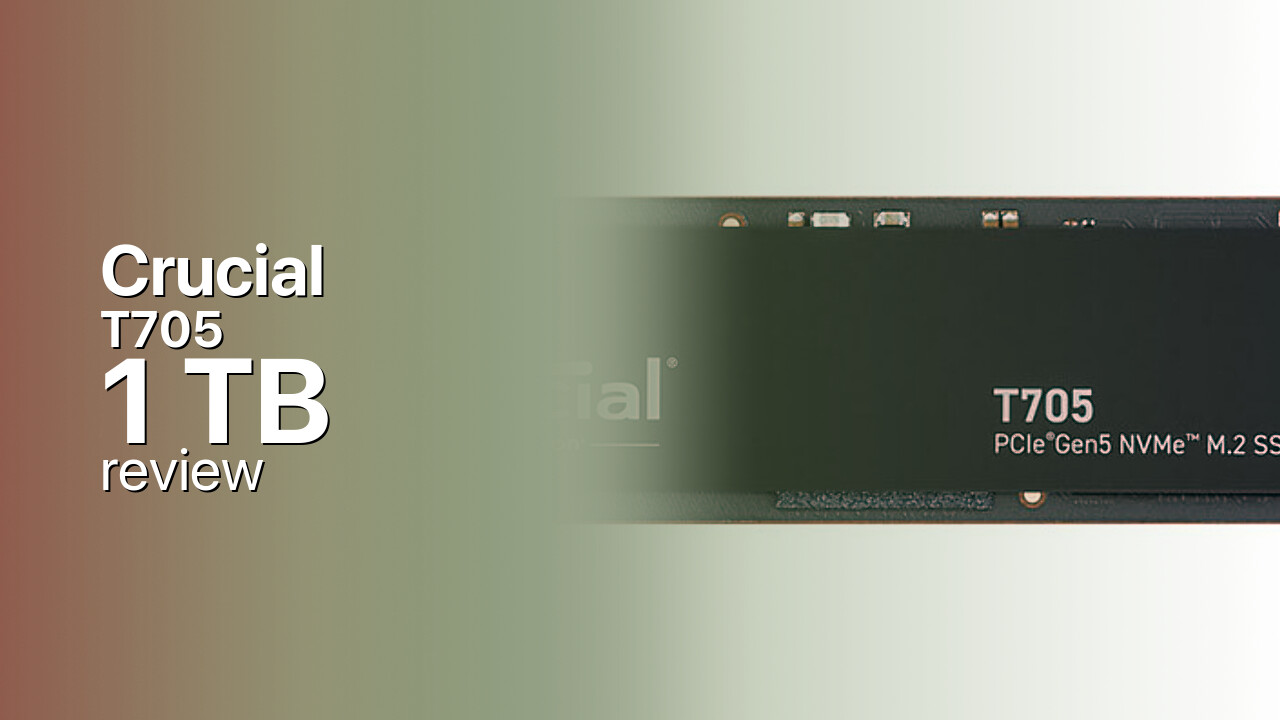
Controller & Memory
The T705 1TB sits at the entry of Crucial's PCIe 5.0 lineup, and the distinction from its larger siblings matters more than the marketing makes clear. Where the 2TB and 4TB models reach 14,500 MB/s and 14,100 MB/s sequential reads respectively, the 1TB is rated at 13,600 MB/s reads and 10,200 MB/s writes. That is not a complaint — 13,600 MB/s is still roughly double the fastest PCIe 4.0 drives available — but buyers upgrading from a high-end PCIe 4.0 SSD should know the jump is larger at 2TB than at 1TB.
The platform underneath is identical across all three capacities. The Phison PS5026-E26 is an 8-channel PCIe 5.0 NVMe 2.0 controller that Crucial pairs with Micron's 232-layer B58R 3D TLC NAND — a well-characterised die that delivers predictable performance and strong endurance. Dedicated DRAM keeps the drive off the Host Memory Buffer path, which matters for consistent random I/O and sustained sequential performance. The 1TB NAND pool is smaller than the 2TB or 4TB, which means fewer dies operating in parallel and a proportionally smaller SLC write cache, but the architecture is otherwise the same.
Crucial sells the 1TB T705 in two configurations: the bare drive (CT1000T705SSD3) and a heatsink SKU (CT1000T705SSD5) with a low-profile aluminum spreader. PCIe 5.0 SSDs run warmer than PCIe 4.0 equivalents under sustained load; if your motherboard lacks a built-in M.2 heatsink, the heatsink SKU is the practical choice. Both fit the standard M.2 2280 footprint.
At 1TB, the T705 competes squarely against the Corsair MP700 PRO 1TB and Seagate FireCuda 540 1TB within the PCIe 5.0 tier, and prices itself well above the Samsung 990 Pro and WD Black SN850X at the same capacity. Whether the PCIe 5.0 premium over a top-tier PCIe 4.0 drive translates into perceptible real-world benefit depends heavily on the workload — a point worth weighing for buyers whose primary use is gaming rather than large file transfers or content creation.
Storage Comparisons:
T705 Performance & Benchmarks
Crucial rates the T705 1TB at 13,600 MB/s sequential reads and 10,200 MB/s sequential writes — the lowest figures in the T705 family, but still the fastest tier in consumer storage. Random performance is specified at 1,400,000 read IOPS and 1,750,000 write IOPS at queue depth 32.
Crucial T705 1 TB vs M.2 5.0 peers
Switch between sequential throughput and random IOPS to see how this drive stacks up against other M.2 5.0 SSDs in our database. The highlighted bar is the drive on this page — click any other bar to open that drive.
- Corsair MP700 Pro XT 1 TB: 14,900 MB/s read, 14,200 MB/s write
- Corsair MP700 Pro XT 2 TB: 14,900 MB/s read, 14,500 MB/s write
- Corsair MP700 Pro XT 4 TB: 14,900 MB/s read, 14,400 MB/s write
- Crucial T710 1 TB: 14,900 MB/s read, 13,800 MB/s write
- Crucial T705 1 TB (this drive): 13,600 MB/s read, 10,200 MB/s write
The write speed gap between the 1TB (10,200 MB/s) and 2TB (12,700 MB/s) is the most practical difference between these capacities. Sequential write-heavy workflows — large video project copies, OS reinstalls, backup transfers — will complete noticeably faster on the 2TB. Sequential read speeds are closer (13,600 vs 14,500 MB/s), and in real-world game loading and application launches the gap is rarely perceptible.
Random IOPS at low queue depths, which govern OS responsiveness and application launch times, are strong. The dedicated DRAM cache ensures the controller does not fall back to HMB, keeping 4K random read latency tight. Under sustained sequential writes that exceed the SLC write cache, the drive transitions to direct TLC writes at a lower rate — normal behavior for all TLC-based SSDs. The 1TB model's cache is proportionally smaller than the 2TB or 4TB, so sustained write sessions will exhaust it sooner.
PCIe 5.0 x4 bandwidth is required for full performance. In a PCIe 4.0 slot, the T705 will operate at PCIe 4.0 speeds and is still functional, but the primary reason to buy it over a PCIe 4.0 drive would be eliminated.
Crucial T705 vs Competitors
See how the T705 stacks up against other M.2 5.0 drives in our database:
Compare with rival drives:
Endurance, TBW & Warranty
The Crucial T705 1TB is covered by a five-year limited warranty from the date of original purchase, with an endurance rating of 600 TBW. The warranty is valid for whichever limit — five years or 600 TBW — is reached first. At 600 TBW, the drive accommodates up to 120 TB written per year across the warranty period. A user writing 50 GB per day — a heavy desktop workload covering large game installs, video editing scratch, and regular backups — accumulates roughly 18 TB per year, reaching the TBW threshold in approximately 33 years. Even at 200 GB per day, the endurance budget lasts over eight years. For the overwhelming majority of buyers, the five-year warranty expiration is the operative limit, not the TBW figure. MTBF is rated at 1.5 million hours.
Crucial T705 1 TB Specifications
| Category | Value |
|---|---|
| Capacity [?] | 1 TB |
| Interface [?] | M.2 5.0 |
| Controller [?] | Phison PS5026-E26 8 channel |
| Memory type [?] | Micron 232-L B58R 3D TLC |
| DRAM [?] | Yes |
| Read speed (MB/s) [?] | 13600 |
| Write speed (MB/s) [?] | 10200 |
| Read IOPS [?] | 1400000 |
| Write IOPS [?] | 1750000 |
| Endurance (TBW) [?] | 600 |
| MTBF (million hours) [?] | 2000000 |
| Warranty (years) [?] | 5 |
Verdict: Is the T705 Worth It in 2026?
The Crucial T705 1TB is the right choice for buyers who want PCIe 5.0 performance at the lowest available capacity without compromise on the core platform. The Phison E26 controller, Micron 232-layer TLC NAND, and dedicated DRAM are all present — nothing is removed to hit the 1TB price point. The sequential write rating of 10,200 MB/s is lower than the 2TB model's 12,700 MB/s, which is worth knowing if large file transfers are a priority.
Buyers who move mostly large files — video production, data migration, large archive transfers — will find more value stepping up to the 2TB model. Those who need a fast system drive for gaming, development, or general desktop use will see the full benefit of the PCIe 5.0 platform at 1TB. The five-year warranty and 600 TBW endurance rating are appropriate for the capacity.
+ Pros
- 13,600 MB/s sequential reads — faster than any PCIe 4.0 drive at this capacity
- Phison PS5026-E26 8-channel controller with dedicated DRAM on all SKUs
- Micron 232-layer B58R TLC NAND with well-documented reliability characteristics
- Five-year warranty with 600 TBW endurance
- Available with a low-profile heatsink SKU for motherboards lacking M.2 thermal coverage
- Standard M.2 2280 form factor fits desktops and compatible laptops
- Cons
- Sequential write speed (10,200 MB/s) is 20 percent lower than the 2TB model — a real gap for large-file workloads
- Requires a PCIe 5.0 x4 M.2 slot to reach rated speeds; PCIe 4.0 hosts cap performance well below spec
- Smaller NAND pool means a proportionally smaller SLC write cache than the 2TB or 4TB
- Price premium over PCIe 4.0 drives at 1TB is harder to justify for purely gaming or light desktop use
- PCIe 5.0 thermal output is higher than PCIe 4.0 equivalents; a heatsink is recommended
Buy this or similar SSD Storage:



Video Review
Faster than a 9100 PRO? - Crucial T705 Gen5 NVMe SSD Review