MSI M580 1 TB: A Gen5 SSD With Its Own Heatsink (2026)
Quick answer
The MSI M580 1 TB is the drive to buy if you want PCIe 5.0 performance and do not want to shop for a separate M.2 heatsink.
Read: 13700 MB/s Write: 10300 MB/s Endurance: 700 TBW Warranty: 5 years Interface: M.2 5.0
The MSI M580 1 TB is the value entry of MSI's Spatium M580 FROZR PCIe 5.0 line, shipping with its own tower heatsink for up to 13,700 MB/s reads.
Controller & Memory
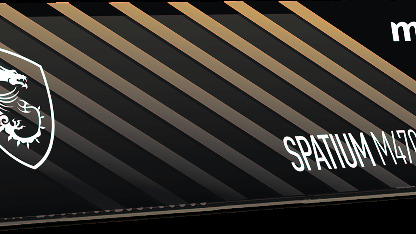
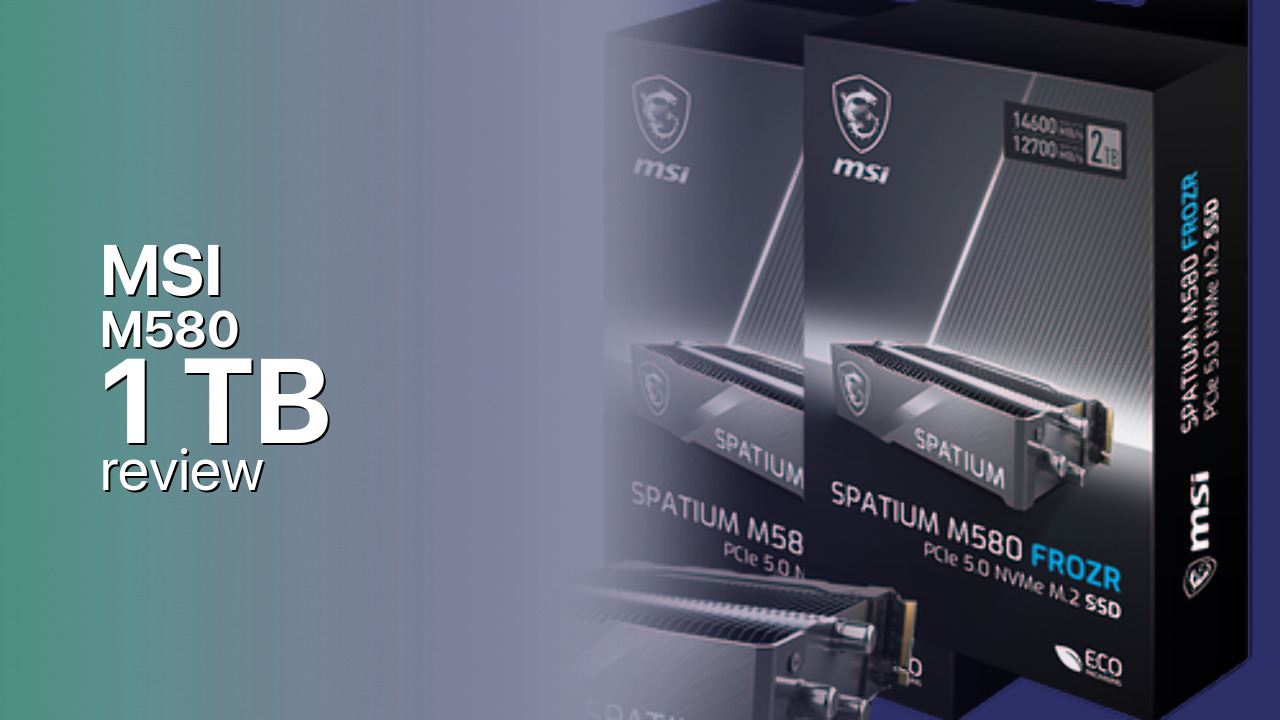
The MSI M580 1 TB is the entry capacity of MSI's Spatium M580 FROZR, a PCIe 5.0 NVMe drive sold in 1 TB, 2 TB and 4 TB sizes, and its single most distinguishing feature is in the box: the drive ships with MSI's FROZR cooler pre-installed. That cooler is a passive tower heatsink built around three CORE heatpipes and a stack of aluminum fins, with no fan, and it makes the M580 FROZR unusual among Gen5 drives, which normally leave M.2 cooling to the buyer. The cooler exists because the hardware runs hot: the Phison E26 controller and Micron NAND platform can draw more than 11 watts under load, so MSI solves the thermal problem at the factory rather than expecting the user to.
Inside the metal is a conventional M.2 2280 gumstick built on the Phison PS5026-E26 controller paired with Micron 232-layer 3D TLC NAND (B58R) and an LPDDR4 DRAM cache, the same platform shared with the Crucial T700 and T705. As the value capacity, the 1 TB carries lower headline numbers than the larger models: it is rated at 13,700 MB/s sequential read and 10,300 MB/s write, against 14,600 and 12,700 MB/s on the 2 TB, and its endurance is 700 TBW against 1,400 TBW on the 2 TB and 3,000 TBW on the 4 TB. The 1 TB still shares the product's 5-year warranty and its rated 1.5 million random IOPS ceiling. For a buyer who wants Gen5 speed without sourcing a separate heatsink, the 1 TB is the cheapest way into the FROZR line.
The trade-off is physical size. The FROZR tower cooler is tall and blocks adjacent M.2 slots on some motherboards, so the M580 FROZR suits a desktop build with a free, well-spaced PCIe 5.0 M.2 slot rather than a laptop or a compact ITX rig. It is backward compatible with PCIe 4.0 boards, where it runs at roughly half its rated bandwidth. Direct rivals are the Crucial T705 and Corsair MP700 Pro on the same Phison E26 platform and Samsung's 9100 Pro; the M580 FROZR's case against them is the included cooler and a 5-year warranty, weighed against the competitor's typically lower profile and, in the T705's case, slightly higher peak benchmark speeds.
Storage Comparisons:
M580 Performance & Benchmarks
The 1 TB MSI Spatium M580 FROZR is rated at 13,700 MB/s sequential read and 10,300 MB/s sequential write over its PCIe 5.0 x4 interface, with up to 1.5 million random read and write IOPS. Those are capacity-specific figures: the 2 TB model in the same line reaches 14,600 MB/s read and 12,700 MB/s write, and HotHardware explicitly notes the 1 TB does not quite match the peak sequential capabilities of the larger capacities. For a value Gen5 entry, 13,700 MB/s is still comfortably into PCIe 5.0 territory and well beyond any PCIe 4.0 drive.
MSI M580 1 TB vs M.2 5.0 peers
Switch between sequential throughput and random IOPS to see how this drive stacks up against other M.2 5.0 SSDs in our database. The highlighted bar is the drive on this page — click any other bar to open that drive.
- Corsair MP700 Pro XT 1 TB: 14,900 MB/s read, 14,200 MB/s write
- Corsair MP700 Pro XT 2 TB: 14,900 MB/s read, 14,500 MB/s write
- Corsair MP700 Pro XT 4 TB: 14,900 MB/s read, 14,400 MB/s write
- Crucial T710 1 TB: 14,900 MB/s read, 13,800 MB/s write
- MSI M580 1 TB (this drive): 13,700 MB/s read, 10,300 MB/s write
For real-world use, that bandwidth shows up most in the workflows that actually saturate a Gen5 link: fast in-game asset streaming and DirectStorage titles, large file transfers, and OS responsiveness where random IOPS matter more than peak sequential. Reviewers who tested the larger M580 FROZR capacities frame it as a fast, hot-running Phison E26 design that reaches flagship-class numbers but needs the bundled FROZR cooler to sustain them, since the E26 platform draws more than 11 watts and will throttle without adequate thermal management.
The honest caveat for the 1 TB capacity is sustained writes. Like all TLC NVMe drives, the M580 writes into a fast SLC cache first, then drops to a lower direct-TLC rate once the cache fills. The 1 TB carries the smallest cache in the lineup, so under a long contiguous write such as a video render the slowdown to direct-TLC speed arrives sooner than on the 2 TB or 4 TB. For boot, applications and typical game libraries the cache is effectively never exhausted, so everyday performance is close to the larger capacities while the 1 TB costs substantially less.
MSI M580 vs Competitors
See how the M580 stacks up against other M.2 5.0 drives in our database:
Compare with rival drives:
Endurance, TBW & Warranty
The 1 TB MSI Spatium M580 FROZR carries a rated endurance of 700 TBW (terabytes written), the lowest in a lineup that scales to 1,400 TBW on the 2 TB and 3,000 TBW on the 4 TB. MSI covers the drive for 5 years, with coverage ending at whichever threshold comes first, the 5-year term or 700 TBW of cumulative writes. The 5-year term is the standard retail coverage for this tier and is longer than the 3-year OEM warranties on some competing Gen5 drives.
For almost all buyers the time limit, not the endurance limit, is what binds. At a typical 20 GB of writes per day, exhausting 700 TBW would take around 96 years; at a heavy 100 GB per day it is still roughly 19 years. Only users writing several hundred gigabytes every single day would approach the TBW ceiling inside the 5-year warranty window, and a 1 TB client drive is rarely asked to do that. The drive is rated at 1,600,000 hours MTBF, a population-reliability statistic rather than a per-unit life expectancy.
MSI M580 1 TB Specifications
| Category | Value |
|---|---|
| Capacity [?] | 1 TB |
| Interface [?] | M.2 5.0 |
| Controller [?] | Phison PS5026-E26 8 Channels |
| Memory type [?] | Micron 232-L TLC |
| DRAM [?] | Yes |
| Read speed (MB/s) [?] | 13700 |
| Write speed (MB/s) [?] | 10300 |
| Read IOPS [?] | 1500000 |
| Write IOPS [?] | 1500000 |
| Endurance (TBW) [?] | 700 |
| MTBF (million hours) [?] | 1600000 |
| Warranty (years) [?] | 5 |
Verdict: Is the M580 Worth It in 2026?
The MSI M580 1 TB is the drive to buy if you want PCIe 5.0 performance and do not want to shop for a separate M.2 heatsink. The bundled FROZR tower cooler, the 5-year warranty and the proven Phison E26 plus Micron 232-layer TLC platform make it one of the more self-contained Gen5 entries, and the 1 TB is the cheapest way into that package, rated at 13,700 MB/s reads and 700 TBW.
Step up to the 2 TB if you want the lineup's peak 14,600/12,700 MB/s sequential and double the endurance at 1,400 TBW; the larger cache also holds sustained writes at full speed longer. Skip the M580 FROZR if your build cannot fit the tall tower cooler, since it blocks adjacent slots on some boards, or if you want the single fastest peak benchmarks, where the Crucial T705 edges it. For a desktop with a free PCIe 5.0 slot and a preference for an all-in-one cooled drive, the M580 FROZR 1 TB is a sensible, well-warranted choice.
+ Pros
- Bundled FROZR passive tower heatsink included
- PCIe 5.0 with 13,700 MB/s sequential reads
- Phison E26 with Micron 232-layer TLC and DRAM cache
- 5-year warranty, longer than some Gen5 OEM rivals
- Rated up to 1.5M random read/write IOPS
- Self-contained cooling out of the box
- Cons
- Tall FROZR cooler blocks adjacent M.2 slots on some boards
- 1 TB is slower than the 2 TB flagship (10,300 MB/s write)
- 700 TBW is the lowest endurance in the M580 line
- Hot-running Phison E26 platform draws over 11 watts
- No laptop or compact ITX fit due to the cooler
Buy this or similar SSD Storage:



Video Review
MSI Spatium M580 FROZR Review: The BEST PCIe 5 SSD so far