Digma Meta P7 2TB: large budget PCIe 4.0 storage (2026)
Quick answer
Buy the Digma Meta P7 2 TB for a budget build that wants a large game library or archive on a single PCIe 4.0 drive, with 1,200 TBW of endurance and a five-year warranty for well under flagship money.
Read: 7300 MB/s Write: 6400 MB/s Endurance: 1200 TBW Warranty: 5 years Interface: M.2 4.0 x 4
The Digma Meta P7 2 TB is the top capacity of Digma's budget DRAM-less PCIe 4.0 line, rated at up to 7,300 MB/s reads with Kioxia 3D TLC and 1,200 TBW endurance.
Controller & Memory
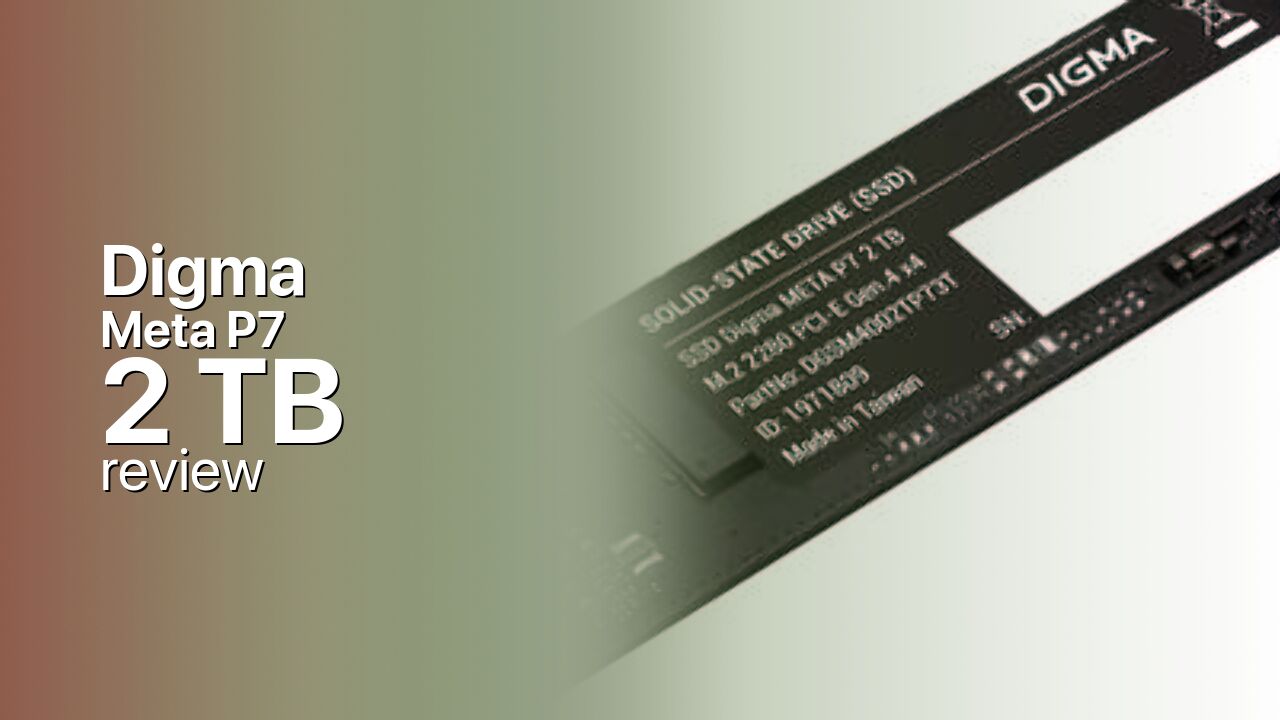
The Digma Meta P7 2 TB is the largest module in the Meta P7 family, a budget DRAM-less PCIe 4.0 SSD from the Russian retail brand Digma. Inside the M.2 2280 card sit Phison's PS5027-E27T controller and Kioxia 3D TLC NAND, with no DRAM, so the drive uses the Host Memory Buffer to hold the flash translation layer in system RAM. It is rated at 7,300 MB/s sequential reads and 6,400 MB/s writes over PCIe 4.0 x4.
The Meta P7 ships in 512 GB, 1 TB, and 2 TB. The 2 TB is the biggest and carries the line's top endurance of 1,200 TBW, double the 1 TB's 600 TBW, all under a five-year warranty. It is a single-sided M.2 2280 card, so it fits laptops and desktops with a PCIe 4.0 slot without clearance issues, and it ships without a heatsink.
As a DRAM-less design, the Meta P7 leans on its SLC cache to reach its rated write speed, and like most budget drives the sustained figures trail the peak rating. For a 2 TB drive the large SLC cache absorbs long transfers at full speed before writes settle to the native TLC rate, which suits a big game library or an archive. For booting, gaming, and everyday file work the drive is more than adequate, and the 2 TB capacity is its main draw: a lot of fast storage for a budget price.
Storage Comparisons:
Meta P7 Performance & Benchmarks
The Meta P7 2 TB is rated at 7,300 MB/s sequential reads and 6,400 MB/s writes over PCIe 4.0, figures shared with the 1 TB model. No reliable random-IOPS figure is published for the drive, and the manufacturer rates the same peak throughput across the line.
Digma Meta P7 2 TB vs M.2 4.0 x 4 peers
Switch between sequential throughput and random IOPS to see how this drive stacks up against other M.2 4.0 x 4 SSDs in our database. The highlighted bar is the drive on this page — click any other bar to open that drive.
- Patriot Viper PV593 1 TB: 14,500 MB/s read, 14,000 MB/s write
- Patriot Viper PV593 2 TB: 14,500 MB/s read, 14,000 MB/s write
- Patriot Viper PV593 4 TB: 14,500 MB/s read, 14,000 MB/s write
- Patriot Viper PV573 2 TB: 14,000 MB/s read, 12,000 MB/s write
- Digma Meta P7 2 TB (this drive): 7,300 MB/s read, 6,400 MB/s write
Real-world results trail the rating, as is typical for budget DRAM-less drives. PassMark's sample of the 1 TB recorded roughly 6,190 MB/s sequential read and 5,449 MB/s write, and the 2 TB behaves similarly while offering a larger SLC cache that holds sustained writes longer. The gap to the headline numbers comes from the SLC cache: writes run at full speed until it fills, then settle to the native TLC rate.
For gaming and everyday use the difference is hard to notice. Game load times are bounded by the CPU and asset decompression once a drive clears about 3,000 MB/s, so the Meta P7 feels as quick as a faster-rated drive in practice. The 2 TB's advantage is capacity, holding a full modern game library on one drive. Large sustained transfers and heavy write workloads are where the budget DRAM-less design shows; for a game library that rarely matters. It runs cool enough under light use, though sustained writes benefit from a motherboard heatsink.
Digma Meta P7 vs Competitors
See how the Meta P7 stacks up against other M.2 4.0 x 4 drives in our database:
Compare with rival drives:
Endurance, TBW & Warranty
Digma covers the Meta P7 2 TB with a five-year limited warranty, a strong term for a budget drive. Endurance is rated at 1,200 TBW on this model, the highest in the line, scaling from 600 TBW on the 1 TB and 300 TBW on the 512 GB. At a typical 20 GB per day of writes, 1,200 TBW equates to roughly 164 years, so the flash will outlast the warranty in any realistic workload. Digma rates the drive at around 1.8 million hours MTBF, a population statistic describing expected failures across a fleet rather than a guarantee for any single unit. Returns are handled through the retailer or Digma depending on region, and the drive ships without a heatsink, so motherboard M.2 cooling is recommended.
Digma Meta P7 2 TB Specifications
| Category | Value |
|---|---|
| Capacity [?] | 2 TB |
| Interface [?] | M.2 4.0 x 4 |
| Controller [?] | Phison PS5027-E27T |
| Memory type [?] | Kioxia 3D TLC |
| DRAM [?] | No |
| Read speed (MB/s) [?] | 7300 |
| Write speed (MB/s) [?] | 6400 |
| Read IOPS [?] | n/a |
| Write IOPS [?] | n/a |
| Endurance (TBW) [?] | 1200 |
| MTBF (million hours) [?] | 1800000 |
| Warranty (years) [?] | 5 |
Verdict: Is the Meta P7 Worth It in 2026?
Buy the Digma Meta P7 2 TB for a budget build that wants a large game library or archive on a single PCIe 4.0 drive, with 1,200 TBW of endurance and a five-year warranty for well under flagship money. Skip it when very large files are moved constantly, since the DRAM-less design settles to the native TLC rate once the SLC cache fills, or when brand familiarity and review coverage matter, where the Crucial P310 2 TB is the safer pick. The natural rivals are the Crucial P310 2 TB and Kingston NV2 2 TB, both budget Gen4 options. We rate the 2 TB Meta P7 a reasonable large-capacity value drive, best suited to everyday, gaming, and archive use on a budget.
+ Pros
- 2 TB capacity on a budget Gen4 drive
- Up to 7,300 MB/s rated reads
- Kioxia 3D TLC NAND
- 1,200 TBW endurance rating
- Five-year limited warranty term
- Single-sided M.2 2280, fits laptops
- Cons
- DRAM-less; real-world writes trail the rating
- No published random-IOPS figure
- Budget brand, limited review coverage
- Sustained writes settle to the TLC rate
Buy this or similar SSD Storage:



Video Review
Тестирование недорогих SSD Digma Mega M2, Meta M6 и Meta P7 емкостью 1 ТБ