Integral Ultima Pro X 256GB Review — a Boot Drive With Caveats (2026)
Quick answer
The Integral Ultima Pro X 256GB makes sense as a boot drive for a Gen3-era laptop, NUC, or desktop that needs a small OS module with hardware encryption — TCG Opal 2.0 support is its genuine differentiator.
Read: 3100 MB/s Write: 1100 MB/s Endurance: 170 TBW Warranty: 3 years Interface: M.2 3.0 x 4
The Integral Ultima Pro X 256GB posts a strong 3,100 MB/s read, but a 1,100 MB/s write cap and 170 TBW rating narrow it to light boot duty.
Controller & Memory
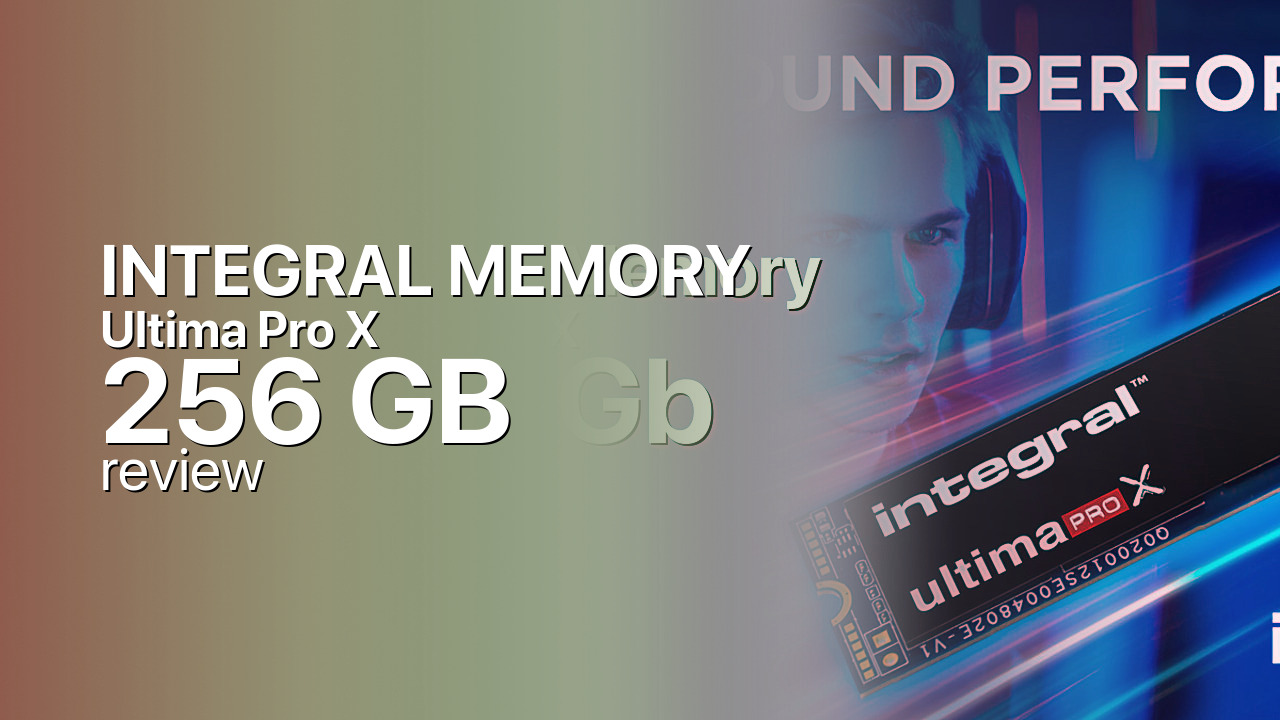
The Integral Ultima Pro X 256GB — part code INSSD256GM280NUPX2, Version 2 of the family — is the entry ticket to Integral's Gen3 NVMe line, and it behaves exactly like an entry ticket should. The Phison E12 controller with DRAM and 3D TLC NAND is shared with every capacity from 240 GB to 4 TB, but Integral's datasheet rates this variant at 3,100 MB/s reads and just 1,100 MB/s writes, with 138K random reads and 280K random writes. The one feature that lifts it above most same-tier drives is 256-bit AES hardware encryption with TCG Opal 2.0 support — rare company for a small Gen3 module — alongside the family's published per-capacity endurance figures.
That datasheet also contains the capacity's biggest oddity: the 256GB is rated at 170 TBW, less than half the 380 TBW of the smaller-numbered 240 GB sibling. Buyers choosing between the two small capacities should read that carefully — the 240 GB is the more durable drive. Endurance aside, the 256GB's profile is classic boot-drive material: an operating system, office work, and light multitasking, where the strong 3,100 MB/s read rating matters more than the modest write ceiling. It is a double-sided M.2 2280 module at 3.8 mm, and it draws up to 4.6 W reading with a 190 mW idle rating — the latter is high for a laptop drive.
The rival set at 250-256 GB is well stocked: Samsung's 970 EVO Plus 250GB writes at a rated 2,300 MB/s with a 5-year warranty, Kingston's DRAM-less A2000 trades speed for a lower shelf price, and WD's Blue SN550 offers 2,400/1,750 MB/s without DRAM. The Integral's case rests on TCG Opal 2.0 encryption and datasheet transparency rather than raw speed — and on being a legacy part whose remaining stock sits with discount retailers.
Storage Comparisons:
Ultima Pro X Performance & Benchmarks
Integral rates the 256GB at 3,100 MB/s sequential reads and 1,100 MB/s writes, with 138K random-read and 280K random-write IOPS. The read figure is genuinely quick — within 10 percent of the family's 3,400 MB/s ceiling — so Windows, applications, and games open with the responsiveness expected of a DRAM-backed Gen3 drive. The write ceiling is the compromise: at 1,100 MB/s, large installs and file copies run at roughly a third of the speed of the 960 GB and 1 TB variants, and only the 240 GB model rates lower in the family.
INTEGRAL MEMORY Ultima Pro X 256 GB vs M.2 3.0 x 4 peers
Switch between sequential throughput and random IOPS to see how this drive stacks up against other M.2 3.0 x 4 SSDs in our database. The highlighted bar is the drive on this page — click any other bar to open that drive.
- ADATA SX 8800 Pro 512 GB: 3,500 MB/s read, 2,700 MB/s write
- ADATA SX 8800 Pro 1 TB: 3,500 MB/s read, 2,700 MB/s write
- ADATA XPG Spectrix S40G RGB 256 GB: 3,500 MB/s read, 3,000 MB/s write
- ADATA XPG Spectrix S40G RGB 512 GB: 3,500 MB/s read, 3,000 MB/s write
- INTEGRAL MEMORY Ultima Pro X 256 GB (this drive): 3,100 MB/s read, 1,100 MB/s write
Burst versus sustained matters more here than in bigger capacities. The pseudo-SLC cache on a 256 GB module is small, so sustained writes beyond a modest burst settle to native TLC rates well below the headline figure — fine for boot-and-office duty, noticeable when moving large photo or video batches. The 138K random-read rating is the family's lowest, though it remains far above what any SATA drive manages. As with the rest of the range, independent benchmarks are scarce — Cowcotland's early-2020 reviews covered the 960 GB variants — so these are manufacturer ratings, not measured results.
INTEGRAL MEMORY Ultima Pro X vs Competitors
See how the Ultima Pro X stacks up against other M.2 3.0 x 4 drives in our database:
Compare with rival drives:
Endurance, TBW & Warranty
Integral's warranty for the UltimaPro X Version 2 family runs 3 years or the TBW rating, whichever comes first, and the 256GB's budget is the one to scrutinise: 170 TBW, less than half the 380 TBW assigned to the 240 GB variant in Integral's own datasheet. At 20 GB of writes per day — typical for a boot drive — 170 TBW covers about 23 years, so the 3-year term remains the practical limit for ordinary use. MTBF is rated at 1.8 million hours, a population statistic rather than an individual lifespan promise. The published per-capacity endurance table is genuinely useful, and buyers comparing the 256 GB and 240 GB parts should weigh that difference before choosing. Claims are handled through Integral's UK support with proof of purchase.
INTEGRAL MEMORY Ultima Pro X 256 GB Specifications
| Category | Value |
|---|---|
| Capacity [?] | 256 GB |
| Interface [?] | M.2 3.0 x 4 |
| Controller [?] | Phison PS5012-E12 8 Channel |
| Memory type [?] | 3D TLC |
| DRAM [?] | Yes |
| Read speed (MB/s) [?] | 3100 |
| Write speed (MB/s) [?] | 1100 |
| Read IOPS [?] | 138000 |
| Write IOPS [?] | 280000 |
| Endurance (TBW) [?] | 170 |
| MTBF (million hours) [?] | 1800000 |
| Warranty (years) [?] | 3 |
Verdict: Is the Ultima Pro X Worth It in 2026?
The Integral Ultima Pro X 256GB makes sense as a boot drive for a Gen3-era laptop, NUC, or desktop that needs a small OS module with hardware encryption — TCG Opal 2.0 support is its genuine differentiator. Skip it for anything write-heavy: 1,100 MB/s writes, the family's lowest 138K random-read rating, and a 170 TBW budget undercut it for media work, and the 240 GB sibling is the more durable small capacity. A Samsung 970 EVO Plus 250GB writes nearly twice as fast with a 5-year warranty, and WD's DRAM-less Blue SN550 idles far lower for laptop duty. As a legacy part with thinning stock, it earns a place only where encryption support or price makes the case.
+ Pros
- 3,100 MB/s sequential read rating
- TCG Opal 2.0 AES-256 hardware encryption
- DRAM-backed Phison E12 platform
- 280K random-write IOPS rating
- Per-capacity endurance published by Integral
- Cons
- Writes capped at 1,100 MB/s
- 170 TBW is less than half the 240 GB rating
- 138K random reads, the family's lowest
- 190 mW idle draw is high for laptops
- Legacy product with limited retail stock
Buy this or similar SSD Storage:



Video Review
M.2 2230 NVME SSD GEN4 | Integral Memory