Why the KLEVV CRAS C910G 2TB makes value sense (2026)
Quick answer
Two terabytes is where the C910G argument becomes compelling: line-peak 5,200 MB/s reads, full-family write speed, doubled endurance, and a fitted heatsink at pricing that undercuts most name-brand TLC alternatives.
Read: 5200 MB/s Write: 4800 MB/s Endurance: 1400 TBW Warranty: 5 years Interface: M.2 4.0 x 4
The KLEVV CRAS C910G 2TB lifts sequential reads to 5,200 MB/s while quadrupling endurance to 1,400 TBW, all beneath a factory-fitted graphene cooler.
Controller & Memory
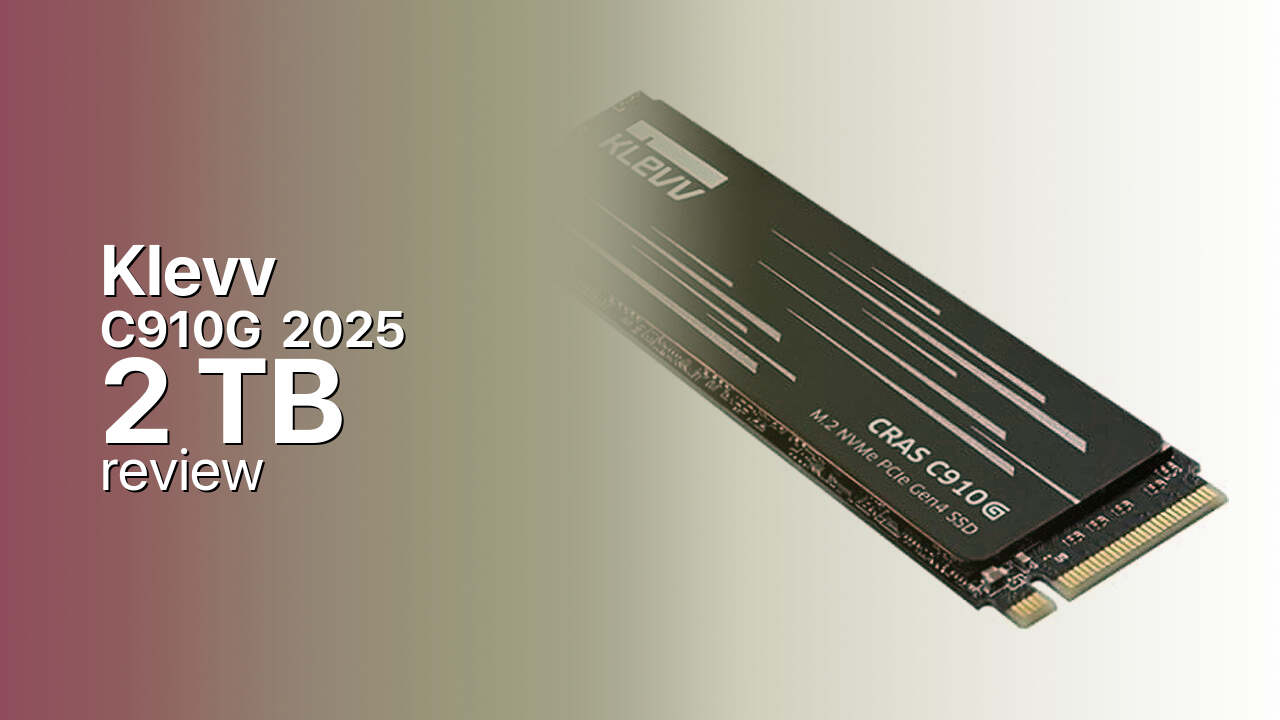
Architecture stays consistent across KLEVV's refreshed CRAS range: Realtek's RTS5772DL eight-channel controller runs DRAM-less over PCIe 4.0 x4 with NVMe 1.4, holding mapping tables in system memory through Host Memory Buffer while SLC caching smooths write traffic. SK Hynix-manufactured TLC flash carries the data, protected by third-generation LDPC correction and end-to-end CRC checks. The signature G-upgrade is thermal - an ultra-thin copper-graphene composite heatsink bonded at the factory, claimed to shed around 15 percent more heat than standard designs, keeping the whole assembly slim enough for laptops and console bays.
This 2 TB version shares the family peak for sequential reads at up to 5,200 MB/s alongside full-line write ratings of 4,800 MB/s, with random activity rated at 560K reads and 615K writes IOPS. Endurance doubles again from the 1 TB tier to 1,400 TBW, and the enlarged pseudo-SLC cache stretches how long heavy copy sessions hold near-peak pace before settling toward native flash speeds. Funky Kit's review of exactly this model delivered a positive verdict, praising the balance of modern features and accessible pricing.
Against rivals, the comparison set includes the Crucial P3 Plus - which undercuts on cost but runs slower-wearing QLC - and WD's SN770, whose similar DRAM-less TLC formula trades blows on brand recognition rather than substance.
Storage Comparisons:
C910G 2025 Performance & Benchmarks
Official ratings reach 5,200 MB/s sequential reads and 4,800 MB/s sequential writes over PCIe 4.0 x4, plus 560,000 random-read and 615,000 random-write IOPS. Platform measurements lend credibility: UNIKO's Hardware recorded the 1 TB sibling slightly exceeding its own rated figures in CrystalDiskMark, suggesting conservative quoting across this controller family, while Funky Kit's 2 TB testing described consistently fast everyday behavior. Two terabytes of NAND give the pseudo-SLC cache substantial room, so ordinary desktop workloads never brush its limits and even large game installs complete without dramatic slowdown.
Klevv C910G 2025 2 TB vs M.2 4.0 x 4 peers
Switch between sequential throughput and random IOPS to see how this drive stacks up against other M.2 4.0 x 4 SSDs in our database. The highlighted bar is the drive on this page — click any other bar to open that drive.
- Patriot Viper PV593 1 TB: 14,500 MB/s read, 14,000 MB/s write
- Patriot Viper PV593 2 TB: 14,500 MB/s read, 14,000 MB/s write
- Patriot Viper PV593 4 TB: 14,500 MB/s read, 14,000 MB/s write
- Patriot Viper PV573 2 TB: 14,000 MB/s read, 12,000 MB/s write
- Klevv C910G 2025 2 TB (this drive): 5,200 MB/s read, 4,800 MB/s write
Expect boots in seconds, quick level streaming, and interface-class file copies until sustained writing eventually exhausts the cache and throughput eases toward native TLC rates. The one honest caveat: out-of-cache consistency is modest on this Realtek platform compared with DRAM-equipped competitors, so endless multi-hundred-gigabyte transfers or professional ingest workloads will notice. Gaming, general productivity, and content consumption sit nowhere near that ceiling in ordinary use.
Klevv C910G 2025 vs Competitors
See how the C910G 2025 stacks up against other M.2 4.0 x 4 drives in our database:
Compare with rival drives:
Endurance, TBW & Warranty
KLEVV protects the drive with a five-year limited warranty and rates endurance at 1,400 TBW of host writes - double the allowance one capacity down. At a typical 20-50 GB written daily, exhaustion lies decades away for any consumer workload; coverage simply ends at whichever limit arrives first, terabytes or years. The protection stack beneath includes hardware LDPC error correction, end-to-end CRC parity, SRAM error handling, global wear leveling, thermal throttling safeguards and continuous S.M.A.R.T. reporting, with AES-256 hardware encryption support built into the controller. Every unit bundles an Acronis True Image activation key adding backup tooling and active ransomware protection. No official MTBF statistic exists for this platform.
Klevv C910G 2025 2 TB Specifications
| Category | Value |
|---|---|
| Capacity [?] | 2 TB |
| Interface [?] | M.2 4.0 x 4 |
| Controller [?] | Realtek RTS5772DL |
| Memory type [?] | 3D TLC |
| DRAM [?] | No |
| Read speed (MB/s) [?] | 5200 |
| Write speed (MB/s) [?] | 4800 |
| Read IOPS [?] | 560000 |
| Write IOPS [?] | 615000 |
| Endurance (TBW) [?] | 1400 |
| MTBF (million hours) [?] | 1800000 |
| Warranty (years) [?] | 5 |
Verdict: Is the C910G 2025 Worth It in 2026?
Two terabytes is where the C910G argument becomes compelling: line-peak 5,200 MB/s reads, full-family write speed, doubled endurance, and a fitted heatsink at pricing that undercuts most name-brand TLC alternatives. Buyers running continuous multi-hundred-gigabyte transfers professionally should still prefer DRAM-equipped hardware, since out-of-cache steadiness is this platform's known compromise. The Crucial P3 Plus remains cheaper if budget rules everything, though its QLC endurance tells against it over years of use. For game vaults, general upgrades, and secondary storage in creative machines, this KLEVV delivers about as much specification per unit of spending as the Gen4 market currently offers.
+ Pros
- Reads hit the 5,200 MB/s family peak
- 1,400 TBW endurance doubles the 1TB tier
- Five-year limited warranty across capacities
- Graphene-copper heatsink comes pre-fitted
- Strong capacity-per-dollar for game libraries
- Cons
- Random ratings dip slightly versus the 1TB model
- DRAM-less design borrows system memory via HMB
- Out-of-cache sustained throughput is modest
- Availability outside Asia can be inconsistent
Buy this or similar SSD Storage:



Video Review
Don’t Buy This SSD Until See This Video! KLEVV CRAS C910 Honest Review