Bulk storage speed: inside the KLEVV CRAS C910G 4TB (2026)
Quick answer
Four terabytes transforms the C910G from budget boot drive into genuine bulk-storage contender: family-peak speeds, the range's largest cache and a 2,800 TBW endurance budget that removes longevity anxiety almost entirely, all under a five-year warranty.
Read: 5200 MB/s Write: 4800 MB/s Endurance: 2800 TBW Warranty: 5 years Interface: M.2 4.0 x 4
The KLEVV CRAS C910G 4TB tops KLEVV's value range with family-peak 5,200/4,800 MB/s speeds and an enormous 2,800 TBW endurance rating.
Controller & Memory
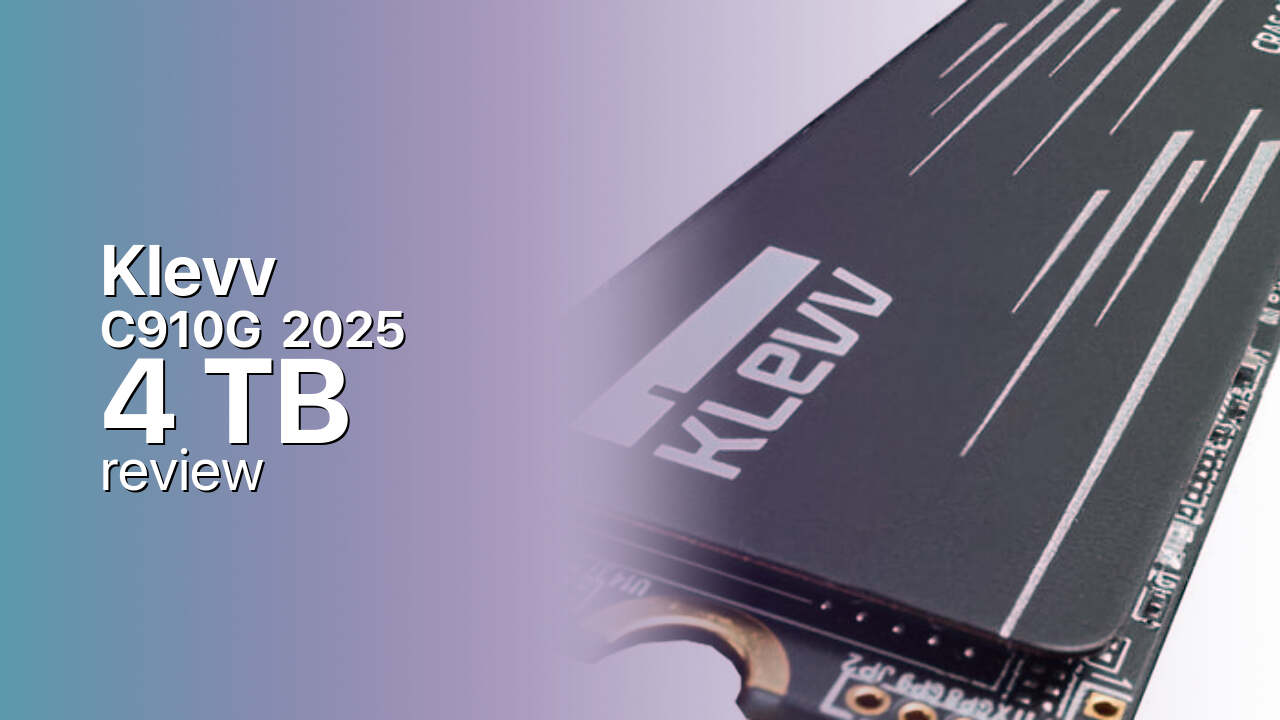
As the flagship of the refreshed CRAS line, this drive packs four terabytes onto a single-sided M.2 2280 board thanks to high-density NAND packaging, all managed by Realtek's RTS5772DL eight-channel controller running DRAM-less over PCIe 4.0 x4 with NVMe 1.4. SK Hynix-manufactured TLC flash stores the data under Essencore's own branding, with Host Memory Buffer standing in for absent DRAM and third-generation LDPC correction guarding integrity. The factory-bonded copper-graphene heatsink - the defining G-generation upgrade - adds fractions of a millimeter while improving cooling around 15 percent by KLEVV's measurement.
Specifications sit at the family peak alongside the 2 TB model: up to 5,200 MB/s sequential reads and 4,800 MB/s sequential writes, with random activity rated at 540K reads and 600K writes IOPS. The headline number is endurance - 2,800 TBW doubles the 2 TB allowance again, giving this drive one of the more generous write budgets in the budget-oriented Gen4 market. The pseudo-SLC cache likewise grows largest here, sustaining heavy transfers longer than any smaller sibling before easing toward native flash pace.
Positioning matters: this is bulk storage first, speed demon second. Against QLC-based bulk rivals like the Crucial P3 Plus 4TB it argues through TLC durability and higher sustained ceilings, while DRAM-equipped workstation drives remain the choice for constant professional writing.
Storage Comparisons:
C910G 2025 Performance & Benchmarks
Official ratings reach 5,200 MB/s sequential reads and 4,800 MB/s sequential writes over PCIe 4.0 x4, plus 540,000 random-read and 600,000 random-write IOPS. Four terabytes give the pseudo-SLC cache maximal room within the lineup, so typical desktop workloads - installs, patches, library shuffling - never approach its edge, and large game collections load without perceptible difference versus costlier hardware.
Klevv C910G 2025 4 TB vs M.2 4.0 x 4 peers
Switch between sequential throughput and random IOPS to see how this drive stacks up against other M.2 4.0 x 4 SSDs in our database. The highlighted bar is the drive on this page — click any other bar to open that drive.
- Patriot Viper PV593 1 TB: 14,500 MB/s read, 14,000 MB/s write
- Patriot Viper PV593 2 TB: 14,500 MB/s read, 14,000 MB/s write
- Patriot Viper PV593 4 TB: 14,500 MB/s read, 14,000 MB/s write
- Patriot Viper PV573 2 TB: 14,000 MB/s read, 12,000 MB/s write
- Klevv C910G 2025 4 TB (this drive): 5,200 MB/s read, 4,800 MB/s write
Sustained behavior deserves honest framing: once extended multi-hundred-gigabyte writes exhaust the cache, throughput drops toward native TLC rates, and independent deep-dives of this Realtek-based platform family have noted that out-of-cache consistency trails DRAM-equipped designs noticeably under demanding synthetic loads. For the archive-and-library duty this capacity targets, that trade-off rarely surfaces in practice. Random-heavy multitasking leans on HMB rather than dedicated silicon, which everyday use masks well. Buyers needing unwavering performance across endless professional transfers should still look at DRAM-equipped workstation drives; everyone else gets flagship-adjacent responsiveness at bulk-storage pricing. For archives and libraries, that trade remains an easy one to accept.
Klevv C910G 2025 vs Competitors
See how the C910G 2025 stacks up against other M.2 4.0 x 4 drives in our database:
Compare with rival drives:
Endurance, TBW & Warranty
A five-year limited warranty covers the drive, backed by an endurance rating of 2,800 TBW - the largest in KLEVV's consumer range and enough for roughly 150 to 380 years of typical daily writing between 20 and 50 GB. Coverage ends at whichever limit arrives first, making exhaustion under realistic use essentially unreachable. Data protection layers include third-generation LDPC error correction, end-to-end CRC parity, SRAM error handling, global wear leveling and thermal throttling safeguards, all visible through S.M.A.R.T. reporting; AES-256 hardware encryption support comes built into the controller. An Acronis True Image activation key ships with every unit, adding backup migration tooling plus active ransomware defense. No MTBF figure appears in official documentation.
Klevv C910G 2025 4 TB Specifications
| Category | Value |
|---|---|
| Capacity [?] | 4 TB |
| Interface [?] | M.2 4.0 x 4 |
| Controller [?] | Realtek RTS5772DL |
| Memory type [?] | 3D TLC |
| DRAM [?] | No |
| Read speed (MB/s) [?] | 5200 |
| Write speed (MB/s) [?] | 4800 |
| Read IOPS [?] | 540000 |
| Write IOPS [?] | 600000 |
| Endurance (TBW) [?] | 2800 |
| MTBF (million hours) [?] | 1800000 |
| Warranty (years) [?] | 5 |
Verdict: Is the C910G 2025 Worth It in 2026?
Four terabytes transforms the C910G from budget boot drive into genuine bulk-storage contender: family-peak speeds, the range's largest cache and a 2,800 TBW endurance budget that removes longevity anxiety almost entirely, all under a five-year warranty. Constant professional ingest remains the wrong workload - out-of-cache steadiness on this DRAM-less Realtek platform trails workstation-class hardware, so creators moving footage all day should spend upward. Against QLC bulk alternatives like the Crucial P3 Plus 4TB, TLC endurance and stronger sustained behavior argue convincingly for the small premium. As a game vault, media archive or NAS-adjacent cache drive, it makes a persuasive case.
+ Pros
- Family-peak 5,200/4,800 MB/s rated speeds
- 2,800 TBW endurance leads KLEVV's consumer range
- Largest pseudo-SLC cache in the lineup
- Stays single-sided even at full 4TB capacity
- Five-year limited warranty with graphene cooler included
- Cons
- Out-of-cache consistency trails DRAM-equipped designs
- Random ratings dip slightly versus smaller tiers
- DRAM-less design borrows system memory via HMB
- Overkill for simple boot-drive duty
Buy this or similar SSD Storage:



Video Review
Don’t Buy This SSD Until See This Video! KLEVV CRAS C910 Honest Review