What the budget KLEVV CRAS C910G 512GB delivers (2026)
Quick answer
The CRAS C910G 512GB exists for one buyer: someone upgrading an aging SATA drive, spinning disk or cramped OEM SSD who wants genuine PCIe 4.0 responsiveness at the lowest sensible cost - and it serves that buyer well, with TLC endurance and a five-year warranty backing the low price.
Read: 5000 MB/s Write: 3700 MB/s Endurance: 350 TBW Warranty: 5 years Interface: M.2 4.0 x 4
The KLEVV CRAS C910G 512GB covers everyday computing basics at a value price, pairing 5,000 MB/s reads with a pre-fitted graphene-copper heatsink.
Controller & Memory
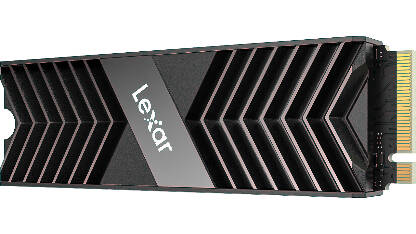
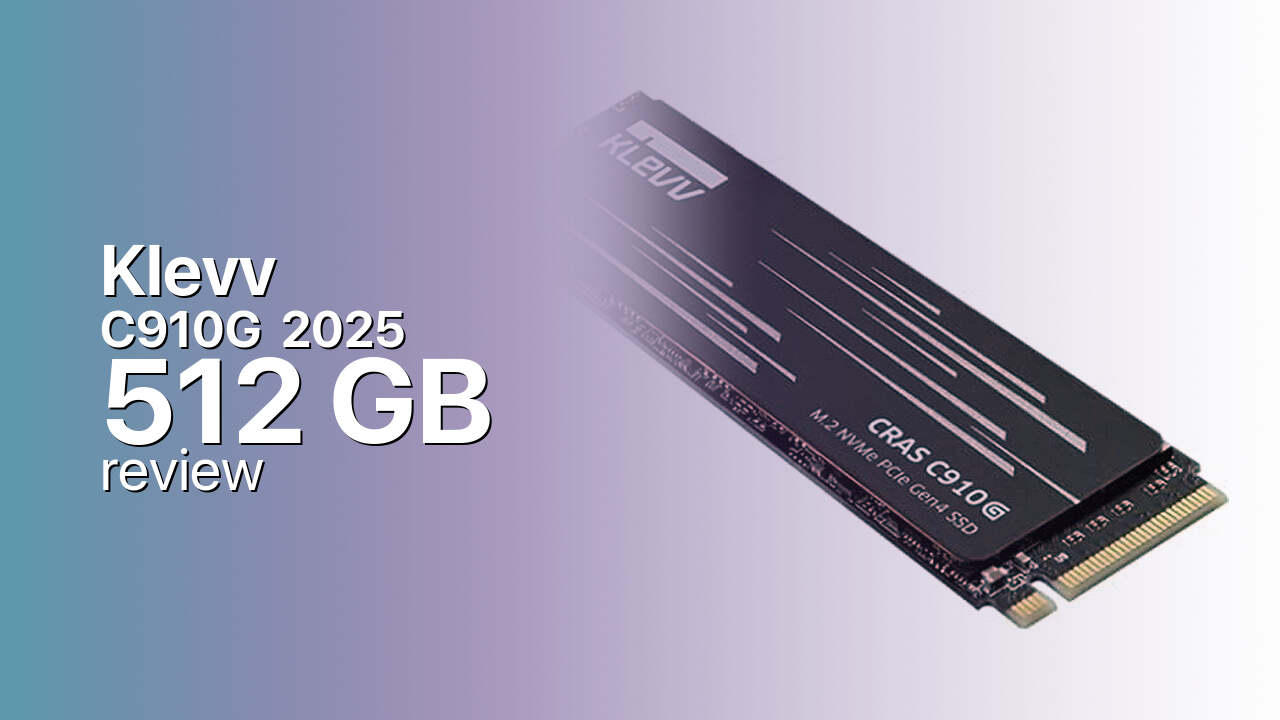
Inside, the C910G runs Realtek's RTS5772DL - an eight-channel DRAM-less controller speaking NVMe 1.4 over PCIe 4.0 x4 - managing SK Hynix-manufactured TLC flash that ships under Essencore's own branding. There is no DRAM package: mapping tables live in system memory through Host Memory Buffer while an intelligent SLC cache smooths write bursts. KLEVV fits every drive with an ultra-thin copper-graphene composite heatsink measuring roughly 0.26 mm, so the entire assembly stays slim enough for laptops, mini PCs and console bays without clearance issues.
This 512 GB version anchors the lineup as its most affordable tier, and its ratings show it: sequential throughput is quoted at 5,000 MB/s reading and 3,700 MB/s writing, below the 5,200 MB/s reads and 4,800 MB/s writes that the 2 TB and 4 TB models reach. Random activity tops out at 545K read and 510K write IOPS here, and endurance sits at 350 TBW. Funky Kit, reviewing the refresh, notes it keeps the original C910's strengths while improving power management.
As a package it competes with mainstream value drives like the WD Black SN770 rather than flagship hardware, while undercutting them on price; against QLC-based rivals such as the Crucial P3 Plus it argues for TLC durability at a similar street level. For boot duty, office work and general gaming, the specification covers everything most systems ask of it.
Storage Comparisons:
C910G 2025 Performance & Benchmarks
Rated figures are 5,000 MB/s sequential reads and 3,700 MB/s sequential writes over PCIe 4.0 x4, plus 545,000 random-read and 510,000 random-write IOPS. Platform credibility looks solid: UNIKO's Hardware measured the 1 TB sibling slightly above its own ratings in CrystalDiskMark, suggesting KLEVV quotes conservatively across this controller family. At this entry size, expect the lowest numbers of the line - the smaller pseudo-SLC cache exhausts sooner during big copy jobs, after which throughput drops toward native TLC levels until recovery.
Klevv C910G 2025 512 GB vs M.2 4.0 x 4 peers
Switch between sequential throughput and random IOPS to see how this drive stacks up against other M.2 4.0 x 4 SSDs in our database. The highlighted bar is the drive on this page — click any other bar to open that drive.
- Patriot Viper PV593 1 TB: 14,500 MB/s read, 14,000 MB/s write
- Patriot Viper PV593 2 TB: 14,500 MB/s read, 14,000 MB/s write
- Patriot Viper PV593 4 TB: 14,500 MB/s read, 14,000 MB/s write
- Patriot Viper PV573 2 TB: 14,000 MB/s read, 12,000 MB/s write
- Klevv C910G 2025 512 GB (this drive): 5,000 MB/s read, 3,700 MB/s write
In daily terms the experience still embarrasses any SATA drive: operating systems boot in seconds, games stream without stutter, and application launches feel immediate thanks to respectable 4K latency. The L1.2-style low-power behavior helps notebook battery budgets. Where expectations should stay tempered is sustained professional writing - video ingest, bulk archiving, endless small-file churn - where DRAM-equipped designs hold steadier speeds once caches empty. For the boot-drive role this capacity targets, those scenarios rarely arise.
Klevv C910G 2025 vs Competitors
See how the C910G 2025 stacks up against other M.2 4.0 x 4 drives in our database:
Compare with rival drives:
Endurance, TBW & Warranty
KLEVV covers the C910G line with a five-year limited warranty, and this 512 GB model carries a 350 TBW endurance rating. At a typical 20-50 GB written daily, that allowance represents roughly two decades or more of ordinary use before exhaustion, with coverage ending at whichever limit arrives first. Data integrity rides on third-generation LDPC error correction, CRC parity end-to-end, SRAM error handling, global wear leveling and thermal throttling, all reportable through S.M.A.R.T. monitoring; AES-256 hardware encryption support is built in. Every drive bundles an Acronis True Image activation key whose active protection also guards against ransomware. KLEVV publishes no MTBF statistic for this platform, so treat any precise reliability figure seen elsewhere as unofficial.
Klevv C910G 2025 512 GB Specifications
| Category | Value |
|---|---|
| Capacity [?] | 512 GB |
| Interface [?] | M.2 4.0 x 4 |
| Controller [?] | Realtek RTS5772DL |
| Memory type [?] | 3D TLC |
| DRAM [?] | No |
| Read speed (MB/s) [?] | 5000 |
| Write speed (MB/s) [?] | 3700 |
| Read IOPS [?] | 545000 |
| Write IOPS [?] | 510000 |
| Endurance (TBW) [?] | 350 |
| MTBF (million hours) [?] | 1800000 |
| Warranty (years) [?] | 5 |
Verdict: Is the C910G 2025 Worth It in 2026?
The CRAS C910G 512GB exists for one buyer: someone upgrading an aging SATA drive, spinning disk or cramped OEM SSD who wants genuine PCIe 4.0 responsiveness at the lowest sensible cost - and it serves that buyer well, with TLC endurance and a five-year warranty backing the low price. Enthusiasts chasing maximum throughput should step up to KLEVV's own C925G or a DRAM-equipped competitor instead, since 5,000 MB/s reads and 3,700 MB/s writes define this tier's ceiling. Creators moving large files constantly will find the 1 TB step-up more sensible, adding a full gigabyte of writes-per-second headroom plus doubled endurance for modest extra spend.
+ Pros
- Rated 5,000 MB/s reads on PCIe 4.0
- Graphene-copper heatsink fitted at the factory
- Five-year limited warranty
- TLC NAND avoids QLC write-wear concerns
- Slim single-sided build suits laptops and consoles
- Cons
- 3,700 MB/s write rating trails the rest of the line
- DRAM-less design relies on Host Memory Buffer
- 350 TBW endurance is the lowest in the range
- Out-of-cache sustained speeds are unremarkable
Buy this or similar SSD Storage:



Video Review
🛑 STOP Buying Bad SSDs! 🛑 Best SSD for Gaming 2025 (PC / PS5 / XBOX) | Best SSD 2025