Why the Klevv CRAS C930 2TB is the pick of its range (2026)
Quick answer
For most buyers eyeing this range, the 2TB C930 is simply the right answer: full-line speeds, twice the endurance, double the DRAM and the same detachable heatsink, typically at better cost per gigabyte than the smaller model.
Read: 7400 MB/s Write: 6800 MB/s Endurance: 1500 TBW Warranty: 5 years Interface: M.2 4.0 x 4
The Klevv CRAS C930 2TB pairs the lineup's peak 7,400/6,800 MB/s ratings with doubled DRAM and endurance, making it the definitive C930 configuration.
Controller & Memory
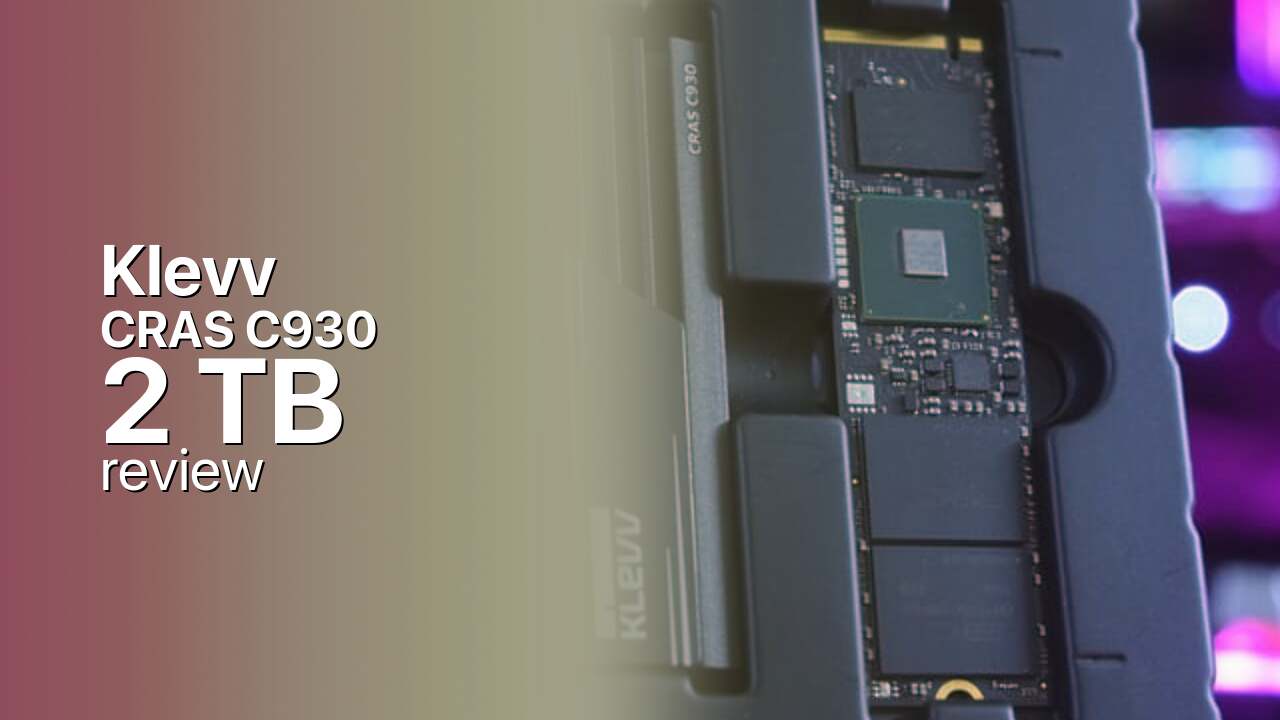
The flagship capacity of KLEVV's midrange Gen4 family combines InnoGrit's IG5236 Rainier controller - eight channels of 12nm silicon - with SK hynix 176-layer V7 TLC flash under Essencore branding and a full 2GB of Nanya LPDDR4-4266 DRAM for mapping tables, confirmed by TechPowerUp's board teardown. That cache matters most exactly here: four times the flash of an entry drive generates proportionally more mapping data to track, so dedicated silicon steadies behavior where cheaper HMB designs would lean on system RAM. The interface runs PCIe 4.0 x4 over NVMe 1.4 with LDPC correction and end-to-end CRC protection.
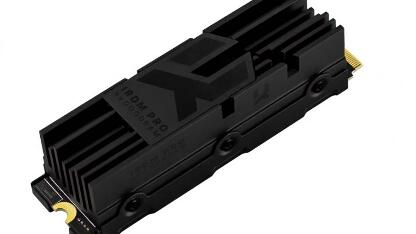
This configuration carries the range's best numbers throughout: up to 7,400 MB/s sequential reads, 6,800 MB/s sequential writes, and symmetric million-IOPS random targets, plus 1,500 TBW of rated endurance - twice the smaller tier's allowance, enough to outlast more than eighty years of heavy 50 GB-per-day writing. Like every C930 it ships with an optional flat-fin aluminium heatsink you mount yourself; fitted, the stack measures 8.7mm tall, clearing the PlayStation 5's bay cover and most motherboard shrouds without modification.
Independent verdicts have been kind without being effusive. GamesRadar+'s testing averaged 7,327/6,795 MB/s in CrystalDiskMark and recommended it as a budget PS5 upgrade after living with it as primary console storage; Tom's Hardware praised the hynix-flash pairing while scoring overall performance as merely competent against leaders like the WD Black SN850X. TechPowerUp reached a similar balance: strong specification sheet, honest execution.
Storage Comparisons:
CRAS C930 Performance & Benchmarks
Official ratings reach 7,400 MB/s sequential reads and 6,800 MB/s sequential writes over PCIe 4.0 x4, alongside 1,000,000 IOPS each way for random traffic. Measured results back them credibly: GamesRadar+'s three-run CrystalDiskMark average landed within one percent of both figures, while their PlayStation 5 installation reported 6,408 MB/s post-format - normal console overhead and comfortably above Sony's recommendations. Tom's Hardware characterized day-to-day performance as competent rather than class-leading, noting minor latency quirks from the hynix-on-InnoGrit combination but no meaningful weakness for typical workloads.
Klevv CRAS C930 2 TB vs M.2 4.0 x 4 peers
Switch between sequential throughput and random IOPS to see how this drive stacks up against other M.2 4.0 x 4 SSDs in our database. The highlighted bar is the drive on this page — click any other bar to open that drive.
- Patriot Viper PV593 1 TB: 14,500 MB/s read, 14,000 MB/s write
- Patriot Viper PV593 2 TB: 14,500 MB/s read, 14,000 MB/s write
- Patriot Viper PV593 4 TB: 14,500 MB/s read, 14,000 MB/s write
- Patriot Viper PV573 2 TB: 14,000 MB/s read, 12,000 MB/s write
- Klevv CRAS C930 2 TB (this drive): 7,400 MB/s read, 6,800 MB/s write
The doubled DRAM allocation shapes sustained behavior favorably: mapping operations never contend with system memory through Host Memory Buffer, so heavy multitasking, many small files and long mixed workloads keep their composure where cheaper DRAM-less drives wobble. Pure sustained writing still rides the pseudo-SLC cache before dropping toward native TLC speed during folding recovery - standard mechanics, executed acceptably here. For gaming loads, application launches and content consumption, differences versus costlier flagships are effectively invisible; professionals pushing continuous multi-hundred-gigabyte transfers remain the audience that would notice.
Klevv CRAS C930 vs Competitors
See how the CRAS C930 stacks up against other M.2 4.0 x 4 drives in our database:
Compare with rival drives:
Endurance, TBW & Warranty
A five-year limited warranty covers the drive, backed by 1,500 TBW of rated host writes - double the 1TB tier's allowance and equivalent to roughly eighty years of heavy 50 GB-per-day use, or centuries at ordinary volumes. Coverage ends at whichever limit arrives first. The protection stack beneath includes hardware LDPC error correction, end-to-end CRC parity, SRAM error handling, global wear leveling and thermal throttling safeguards, all reportable via S.M.A.R.T.; AES-256 hardware encryption is supported, though buyers should note this differs from TCG Opal self-encryption management. An Acronis True Image activation key ships in the box for cloning and backup duties. KLEVV publishes no MTBF statistic for this platform, so treat third-party reliability claims as unofficial.
Klevv CRAS C930 2 TB Specifications
| Category | Value |
|---|---|
| Capacity [?] | 2 TB |
| Interface [?] | M.2 4.0 x 4 |
| Controller [?] | InnoGrit IG5236 8 Channel |
| Memory type [?] | SK Hynix 176-L TLC |
| DRAM [?] | Yes |
| Read speed (MB/s) [?] | 7400 |
| Write speed (MB/s) [?] | 6800 |
| Read IOPS [?] | 1000000 |
| Write IOPS [?] | 1000000 |
| Endurance (TBW) [?] | 1500 |
| MTBF (million hours) [?] | 2000000 |
| Warranty (years) [?] | 5 |
Verdict: Is the CRAS C930 Worth It in 2026?
For most buyers eyeing this range, the 2TB C930 is simply the right answer: full-line speeds, twice the endurance, double the DRAM and the same detachable heatsink, typically at better cost per gigabyte than the smaller model. It suits gaming desktops, PlayStation 5 storage expansion and general upgrades especially well. Laptop builders should check slot depth first since the board is double-sided, and professionals running endless sustained transfers may still prefer newer TLC flagships with stronger out-of-cache consistency. Against the WD Black SN850X it concedes little that gameplay would ever reveal; against cheaper DRAM-less rivals like the Crucial P3 Plus, its consistency case is decisive.
+ Pros
- Line-peak 7,400/6,800 MB/s rated speeds
- Doubled DRAM cache (2GB LPDDR4-4266)
- 1,500 TBW endurance doubles the 1TB tier
- Five-year limited warranty
- Detachable flat-fin heatsink fits the PS5
- Cons
- Double-sided PCB limits some laptop slots
- Sustained out-of-cache speeds trail newer flagships
- Platform design dates to late 2022
- Availability varies noticeably by region
Buy this or similar SSD Storage:



Video Review
KLEVV CRAS C930 Review - Brilliant Results & Price!