Lexar NM710 512GB Review — Entry-Level PCIe 4.0 on a Budget (2026)
Quick answer
Buy the Lexar NM710 512GB as a boot drive or an office-grade uplift — it is one of the cheapest ways to put genuine PCIe 4.0 speed in a machine, and the 5-year warranty removes the usual entry-tier anxiety.
Read: 5000 MB/s Write: 2600 MB/s Endurance: 300 TBW Warranty: 5 years Interface: M.2 4.0 x 4
The Lexar NM710 512GB brings 5,000 MB/s PCIe 4.0 reads to budget builds, though its 2,600 MB/s write ceiling shows exactly where the money was saved.
Controller & Memory
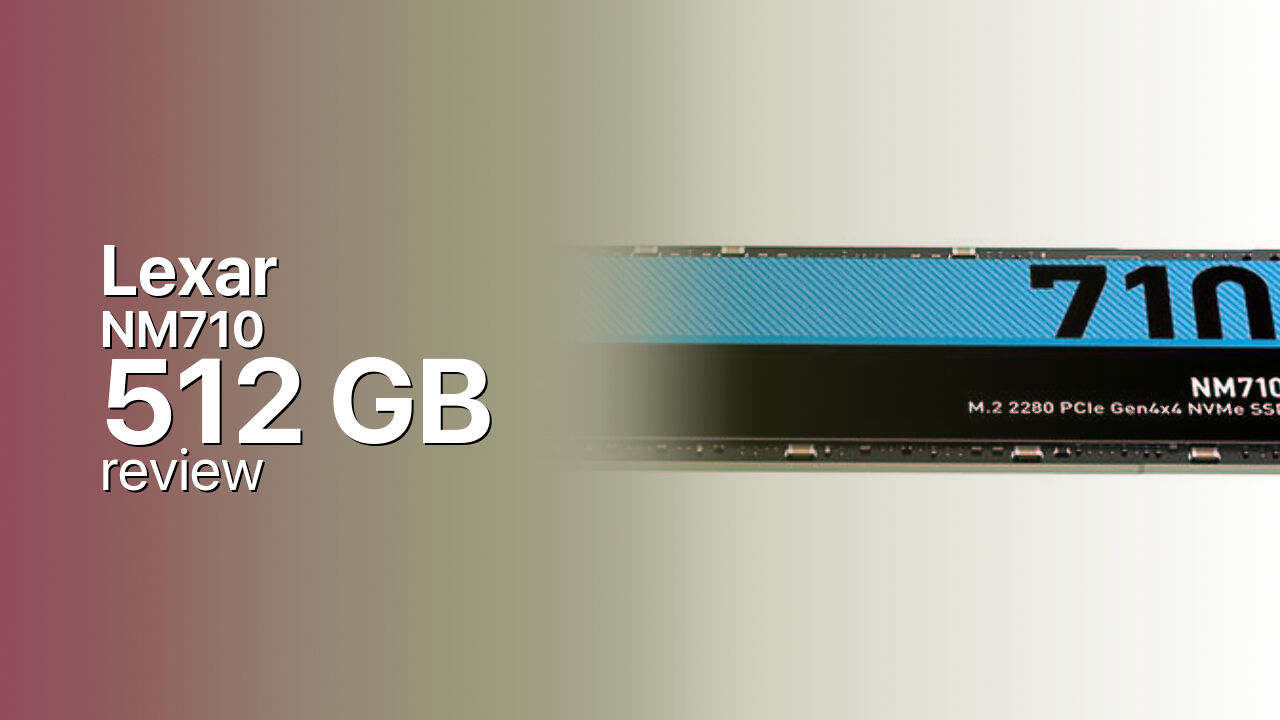
The Lexar NM710 512GB — the capacity Lexar itself labels 500 GB — is the entry point of a deliberately budgeted PCIe 4.0 line. A Maxio MAP1602 controller running four channels handles the workload without any DRAM on board, leaning on Host Memory Buffer and a pseudo-SLC cache instead, with Micron 176-layer TLC storage underneath per the launch-era specifications. ssd-tester's 500 GB unit measured roughly 80 GB of pSLC write cache, a generous cushion that hides the drive's modest native write speed in everyday use. The M.2 2280 stick reads at up to 5,000 MB/s, which is the headline number here.
Within the range, the small capacity pays the usual entry-tier tax. Reads hold at 5,000 MB/s across all three capacities, but writes drop from 4,500 MB/s on the 1 TB and 2 TB models to 2,600 MB/s on this one, and endurance halves from the 1 TB model's 600 TBW to 300 TBW. Everyone gets the same 5-year warranty and 1.5 million-hour MTBF rating, which is unusually generous for a drive at this rung of the market. Lexar's own NM790 sits a clear tier above with 7,400 MB/s reads and a DRAM-less platform tuned closer to the mainstream.
The audience is specific: boot drives, office PCs, secondary game drives, and anyone rescuing an older system from a SATA drive without paying mainstream NVMe prices. Against same-tier rivals like the Kingston NV2 and WD Blue SN580, the NM710's 5,000 MB/s read rating holds its own, and its weakness — the 2,600 MB/s write cap — is a trade-off those rivals share in spirit at this price. For a few dollars more, the 1 TB NM710 doubles endurance and nearly doubles write speed, and it is the smarter buy for anyone whose budget can stretch.
Storage Comparisons:
NM710 Performance & Benchmarks
Lexar rates the 512GB NM710 at 5,000 MB/s sequential reads and 2,600 MB/s writes over PCIe 4.0 x4, and notably publishes no random IOPS figures for this model at all. The read number is the story: it outruns every SATA SSD by a wide margin and makes boot times, application launches, and level loads feel immediate on a budget build. Game installs and file copies benefit from that same burst speed, since the roughly 80 GB pSLC cache that ssd-tester measured absorbs them at full rate.
Lexar NM710 512 GB vs M.2 4.0 x 4 peers
Switch between sequential throughput and random IOPS to see how this drive stacks up against other M.2 4.0 x 4 SSDs in our database. The highlighted bar is the drive on this page — click any other bar to open that drive.
- Patriot Viper PV593 1 TB: 14,500 MB/s read, 14,000 MB/s write
- Patriot Viper PV593 2 TB: 14,500 MB/s read, 14,000 MB/s write
- Patriot Viper PV593 4 TB: 14,500 MB/s read, 14,000 MB/s write
- Patriot Viper PV573 2 TB: 14,000 MB/s read, 12,000 MB/s write
- Lexar NM710 512 GB (this drive): 5,000 MB/s read, 2,600 MB/s write
The write ceiling defines the limits. Sustained copies beyond the pSLC cache settle to the 2,600 MB/s native rate, and as a DRAM-less HMB design, heavy random write sessions are where it trails DRAM-equipped drives most visibly — none of which matters much for a boot-and-games drive. Being a PCIe 4.0 drive, it also makes sense as a future-proofing play for boards that dropped SATA support entirely. Within its tier, reviewers consistently describe the experience as exactly what a budget NVMe should be: quick where it counts, cheap where it does not.
Lexar NM710 vs Competitors
See how the NM710 stacks up against other M.2 4.0 x 4 drives in our database:
Compare with rival drives:
Endurance, TBW & Warranty
Lexar stands behind the NM710 512GB with a 5-year limited warranty rated to 300 TBW, whichever comes first. The endurance figure is the range's lowest — the 1 TB model carries 600 TBW — but the math stays comfortable: at a modest 20 GB written per day, exhaustion would take more than forty years. The rated MTBF is 1.5 million hours, a fleet-level reliability statistic rather than a promise about any single drive. The 5-year coverage is the standout here, matching what Lexar gives its premium NM790 line and beating the 3-year terms still common on entry drives; claims are handled through Lexar in most regions, so a proof of purchase is worth keeping.
Lexar NM710 512 GB Specifications
| Category | Value |
|---|---|
| Capacity [?] | 512 GB |
| Interface [?] | M.2 4.0 x 4 |
| Controller [?] | Maxio MAP1602A 4 Channel |
| Memory type [?] | Micron 176-L TLC |
| DRAM [?] | No |
| Read speed (MB/s) [?] | 5000 |
| Write speed (MB/s) [?] | 2600 |
| Read IOPS [?] | |
| Write IOPS [?] | |
| Endurance (TBW) [?] | 300 |
| MTBF (million hours) [?] | 1500000 |
| Warranty (years) [?] | 5 |
Verdict: Is the NM710 Worth It in 2026?
Buy the Lexar NM710 512GB as a boot drive or an office-grade uplift — it is one of the cheapest ways to put genuine PCIe 4.0 speed in a machine, and the 5-year warranty removes the usual entry-tier anxiety. Skip it for sustained write workloads, console upgrades, or anything where capacity matters; 300 TBW, 2,600 MB/s writes, and 512 GB all point elsewhere. The obvious alternative sits one shelf over: the 1 TB NM710 fixes the write speed and endurance halves for a modest step up in cost, while the Kingston NV2 and WD Blue SN580 play the same budget game with their own trade-offs. As a cheap, warrantied Gen4 boot stick, the NM710 512GB does its job.
+ Pros
- 5,000 MB/s sequential reads
- 300 TBW endurance with 5-year warranty
- DRAM-less HMB design stays cool and efficient
- Far faster than any SATA alternative
- Cons
- Writes cap out at 2,600 MB/s
- No DRAM cache on the PCB
- 300 TBW endurance is the range's lowest
- Random IOPS ratings unpublished by Lexar
Buy this or similar SSD Storage:



Video Review
Are Lexar SSDs Any Good? - NM790, NM710, NM620 Review